Proviesec/google-dorks: A Search Query Collection for Web Security
Useful Google Dorks for WebSecurity and Bug Bounty
At a glance
- What is it?
- Proviesec/google-dorks is a repository of Google search patterns for web security research and bug bounty reconnaissance. It is useful as a query reference, but it is not an automated scanner and does not confirm that a discovered result is exploitable.
- Who is it for?
- Adopt this repository as a manual reconnaissance reference when you can review each result within an authorized scope. Do not treat it as a scanner or proof of a vulnerability, and verify scope, result provenance, file sensitivity and access controls before acting.
- Can I use it commercially?
- Yes, with credit. CC-BY-4.0 allows commercial use as long as you credit the authors and indicate what you changed. It is written for creative content, so check how it applies to any code.
- Is it still maintained?
- Yes. The repository last received commits 23 days ago.
- What is it written in?
- GitHub does not report a main language for this repository.
Answers come from the project's GitHub data, last synced on November 6, 2026, and from our analysis. They are not legal advice.
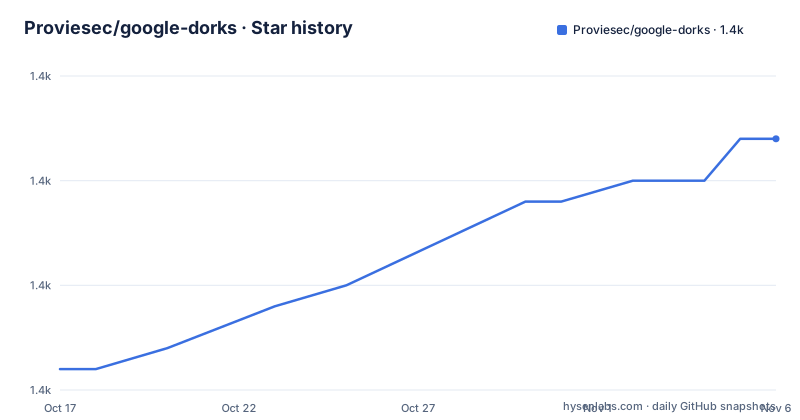
Star history
- Proviesec/google-dorks1,412 ★ · +11
| Repository | 2026-10-17 | 2026-11-06 |
|---|---|---|
| Proviesec/google-dorks | 1.4k | 1.4k |
11 Stars in the last 20 days, measured from the daily GitHub snapshot. Compare with other projects
Editorial analysis
What Proviesec/google-dorks Covers
Proviesec/google-dorks is aimed at people performing web security research, including bug bounty participants who need to locate publicly indexed information through Google. Its purpose is reconnaissance by search: finding pages, files, exposed services and references that may be worth reviewing. The repository is organized into plain-text collections such as google-dorks-for-aws-s3.txt, google-dorks-for-env-files.txt, google-dorks-for-git-files.txt, google-dorks-for-kubernetes.txt, google-dorks-for-login.txt, google-dorks-for-monitoring.txt and google-dorks-for-sql-injection.txt. Other entries cover backup files, CI/CD, cloud platforms, databases, JavaScript secrets, monitoring, OpenAI, SendGrid, Slack, Swagger and web servers. The README also lists ideas for Drupal, Shopify, presentations, reports and GitHub pages, although its checklist marks several of those items as unfinished. This is a manually consulted reference, not a service with an API, scanner or persistent target database. The repository does not state that queries are validated against current Google behavior, and it does not provide a formal rule set for determining whether a result belongs to a permitted scope.
Google Operators Behind the Query Collection
The collection is built around Google's documented search syntax as presented in the README. Operators such as intext:, intitle:, inurl:, allinurl:, site: and filetype: narrow where a term appears, while exact quotation marks constrain the search phrase. The README also describes OR and AND combinations, inclusion with a plus sign, exclusion with a minus sign, wildcard patterns, approximate matching with a tilde and date filters such as before: and after:. A query can therefore combine a target domain with a filename or visible phrase, rather than relying on a single keyword. For example, the repository's introductory query looks for directory-index text and a parent-directory label. Other examples show how to search for site-specific admin text or restrict results to a domain. This is the central mechanism: Google returns pages matching the expression, and the researcher inspects those pages. There is no code path in the repository that fetches or validates the results. The README also includes links to exploit-db.com, nvd.nist.gov, cxsecurity.com, vulnerability-lab.com and writeups, but those references are not integrated into an automated workflow.
Repository Layout and Review Scope
Based on the repository layout, the main resource is a large set of topic-specific text files rather than an installable package. all-google-dorks.txt and best-google-dorks.txt appear to be broad collections, while the remaining files narrow the subject to technologies or data types. The cms/ directory and technology/ directory provide category-based organization, and finding-username-passwords/ suggests a separate collection focused on locating credential-related material. The README contains the explanatory operators and examples, while the text files are intended to be copied into Google searches. This separation has a practical advantage. A researcher can review only the file relevant to a cloud, CI/CD or database investigation instead of searching the whole collection. It also makes the content easy to audit as a list of expressions. The downside is that the repository gives little metadata about individual queries. The README does not document a syntax validation step, expected result counts, query freshness, false-positive handling or a supported Google result limit. There is also no indication that the files are generated from a structured dataset. Each expression should therefore be treated as a research lead, not as a maintained assertion that the indexed result is still present.
First Google Search
Use the exact introductory expression from the README:
intext:"index of" "parent directory"Google should show pages that contain the quoted phrase and the words associated with a directory index. A result can be a stale index or an unrelated page, so open only an authorized result and inspect its context. The README gives this example of combining site restrictions with an intext search:
(site:instagram.com | site:twitter.com) & intext:"admin"This searches for pages on the two specified domains that contain the exact admin term. The query itself does not prove a vulnerability. It only identifies pages for manual review.
Examples of Specialized Query Files
The file names provide a useful indication of the intended search surface. google-dorks-for-aws-s3.txt is relevant to searches concerning publicly indexed S3-related material, while google-dorks-for-env-files.txt targets search expressions involving environment files. google-dorks-for-github-actions.txt, google-dorks-for-ci-cd.txt and google-dorks-for-git-files.txt cover distinct repository and delivery artifacts, so they should not be treated as interchangeable categories. google-dorks-for-monitoring.txt and google-dorks-for-kibana.txt point toward monitoring-related pages, while google-dorks-for-swagger.txt, google-dorks-for-frameworks.txt and google-dorks-for-webserver.txt address technology and service-specific searches. The repository also contains entries for OpenAI, Anthropic, GCP, Firebase, MongoDB, SendGrid, Stripe, Slack, Mailgun and Twilio. Those names describe query themes, not confirmed integrations. The README does not explain whether each file is complete, whether queries are duplicated across files, or how they were selected. Before using a category file, inspect its actual contents and check the current asset scope. A query aimed at a public cloud or SaaS provider can still return third-party data, cached pages or unrelated documents.
Limits, False Positives and Authorization
The main limitation is the gap between a Google result and a confirmed security issue. Google may return an indexed but stale page, a public example, a documentation page, an unrelated file or a result whose contents have since changed. A query can also generate a large result set without establishing that the target is vulnerable. The repository does not claim that every expression is exclusive, current or safe to run. Searching for usernames, passwords, environment files or secrets also raises a data-handling concern: researchers may encounter sensitive material that should not be copied into tickets, logs or chat systems. The README asks contributors to avoid abuse, but its visible disclaimer is truncated after the words "Needless to mention, ple", so the visible README does not provide a complete operational safety policy. Authorization is therefore the controlling boundary. A bug bounty program's written scope, excluded asset list and rules on data retention take priority over a query's apparent usefulness. Do not download, modify or disclose data merely because a search result exposes it.
Alternatives and Maintenance Cost
The real alternative is not another keyword list with a similar name. It is using direct discovery and inventory mechanisms that do not depend on Google's index: authenticated asset inventories, cloud storage policy queries, source-control access controls, web-application logs, secret scanning in code that you are authorized to inspect, and vulnerability scanners that map findings to a defined target list. The difference in approach is important. Google Dorks can reveal accidentally indexed material across public web results, whereas inventory and scanning tools start from known assets and produce more structured evidence. A search-expression collection has no package upgrade path. The repository has no GitHub releases, and its last push was on 2026-07-25. The README displays an MIT license badge and links to the MIT license page, but no separate top-level LICENSE file is listed, so license details should be checked before redistribution. The content may also age as Google syntax, indexed files and cloud naming conventions change.
Editorial conclusion
Adopt this repository as a manual reconnaissance reference when you can review each result within an authorized scope. Do not treat it as a scanner or proof of a vulnerability, and verify scope, result provenance, file sensitivity and access controls before acting. The repository is a collection of search expressions rather than an application, so the first check is whether its queries fit the exact asset and data type you are authorized to inspect.
Frequently asked questions
How do I install Proviesec/google-dorks?
The README does not provide installation steps because the repository is a collection of Google search expressions, not an installable application. Use the text files as references and paste an authorized query into Google.
What can Proviesec/google-dorks find?
The repository includes query collections for cloud storage, environment files, Git files, CI/CD, Kubernetes, databases, monitoring, Swagger and other web security topics. The README does not claim that these searches automatically confirm vulnerabilities.
Does Proviesec/google-dorks replace a vulnerability scanner?
No. The repository contains manually used Google search patterns and explanatory syntax. It does not provide an API, crawler, scanner or mechanism for validating discovered results.
Can I use these searches for any website?
Only within the authorization and scope that applies to your security testing. The visible disclaimer is truncated and does not document a complete testing policy.
Official sources
Add this badge to your README
If you maintain this project, the badge below links readers to this analysis and shows its maintenance status from the daily GitHub snapshot. Paste the markdown into your README; add ?metric=license or ?metric=stars to the image URL for a different field.

[](https://hysenlabs.com/projects/proviesec-google-dorks)Star history chart for your README
[](https://hysenlabs.com/projects/proviesec-google-dorks)Was this useful?