Qwen-AgentWorld ships a world model, and the top score belongs to a size it did not release
Qwen-AgentWorld: Language World Models for General Agents
At a glance
- What is it?
- A 35B MoE language world model that simulates seven agent environments, plus the benchmark used to score it. The open release is the 35B with 3B active parameters, while the best overall number in the results table, 58.71 against GPT-5.4's 58.25, belongs to a 397B variant that appears nowhere in the release list.
- Who is it for?
- Qwen-AgentWorld fits research groups who want to train agents in a simulated environment and can host a 35B MoE, since the weights, the context length and the evaluation set are all published. It does not fit anyone looking for a training recipe: the repository is a landing page with an evaluation directory and a prompts directory, and the model is distributed as weights on two hubs rather than as code you can rerun.
- Can I use it commercially?
- Yes. Apache-2.0 is a permissive licence: you can use, modify and sell software built on it, as long as you keep its copyright and licence notices.
- Is it still maintained?
- Yes. The repository last received commits 117 days ago.
- What is it written in?
- Mainly Python, according to GitHub's language statistics.
Answers come from the project's GitHub data, last synced on November 13, 2026, and from our analysis. They are not legal advice.
Star history
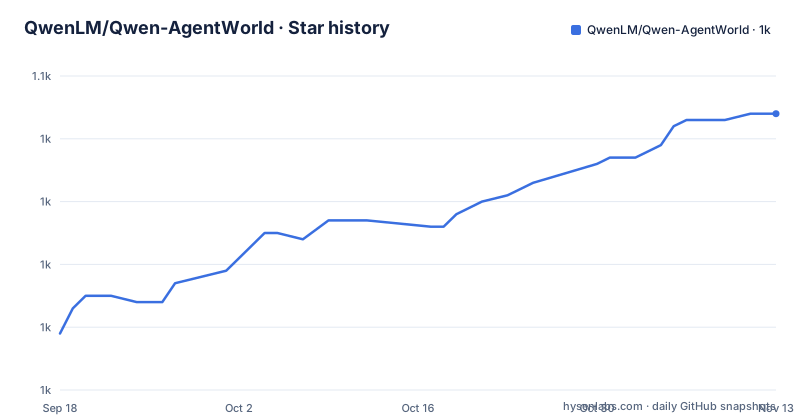
- QwenLM/Qwen-AgentWorld1,044 ★ · +35
| Repository | 2026-09-18 | 2026-11-13 |
|---|---|---|
| QwenLM/Qwen-AgentWorld | 1k | 1k |
35 Stars in the last 56 days, measured from the daily GitHub snapshot. Compare with other projects
Editorial analysis
The repository is a landing page, the weights live on two hubs
The GitHub tree is six entries: `.github/`, `LICENSE`, `README.md`, `assets/`, `eval/` and `prompts/`. There is no source tree, no training code and no inference example, which tells you what kind of artefact this is. Two things are open-sourced, and both are hosted elsewhere. The first is the model weights, a mixture-of-experts language world model with 35 billion total parameters, 3 billion active and a 256K context length. The second is AgentWorldBench, an evaluation benchmark across seven domains. Both are on the Hugging Face Hub under the Qwen organisation, where the page says you can fetch them automatically by model ID, naming `Qwen/Qwen-AgentWorld-35B-A3B` as the identifier, or download the files by hand with `huggingface download` or a git clone. The second host is ModelScope, described as being for users who cannot reach Hugging Face, and it is not a plain mirror: for supported frameworks you set an environment variable instead, with `SGLANG_USE_MODELSCOPE=true` and `VLLM_USE_MODELSCOPE=true` given as the examples. There is also a blog post, an interactive demo link, and a technical report on arXiv as 2606.24597.
Seven domains, and environment modelling from the first stage
The model's job is to simulate environments rather than answer questions about them, and it does that with long chain-of-thought reasoning across seven domains named on the page: MCP, Search, Terminal, SWE, Android, Web and OS. The part that distinguishes it from related work is stated as a training-design claim. Prior approaches treat world modelling as something bolted on afterwards, and Qwen-AgentWorld is described as a native world model where environment modelling is the training objective from the continued-pretraining stage onward. The pipeline has three stages with a stated job for each: CPT injects environment knowledge, supervised fine-tuning activates next-state-prediction reasoning, and reinforcement learning sharpens simulation fidelity. The training corpus is described as more than ten million real-world interaction trajectories. The other two claims on the feature list are generalisation and control: zero-shot generalisation to out-of-distribution environments, with a Claw Agent named as an example, and controllable perturbations plus fictional-world construction, which the page says surpass training in a real environment.
The best score in the table is a model that is not released
The performance section is a five-dimensional rubric mean on a 0 to 100 scale, per domain, across fourteen models. Reading the overall column is where the useful detail is. Qwen-AgentWorld-397B-A17B is listed at 58.71 and the page says it beats all frontier proprietary models, including GPT-5.4 at 58.25, which is a margin of 0.46 points. The released Qwen-AgentWorld-35B-A3B is at 56.39, which is above Claude Opus 4.8 at 56.59 only marginally below it, and below Claude Opus 4.6 at 57.80. The 397B variant appears in the results table and in the application tables, and it does not appear in the open-source release table, which lists only the 35B weights and the benchmark. The same table also shows that a higher version number is not a higher score, since Claude Opus 4.8 leads on Terminal and Web but trails Opus 4.6 on Android and OS, and lands behind it overall. So the honest reading is that the open model lands in the middle of the frontier field, and the claim of beating it belongs to a size you would have to request.
On tools, the gain comes from control, not from simulating
The MCP application table is the one place where the project's own numbers separate two things that are often conflated. On Tool Decathlon, the base supervised model scores 32.4, simulation reinforcement learning without control drops it to 31.5, and with control it reaches 36.1. On MCPMark the same three rows read 21.5, 24.6 and 33.8. The deltas printed in the table, plus 3.7 and plus 12.3, are measured against the base model, so the uncontrolled run contributes a negative 0.9 on one benchmark and a positive 3.1 on the other. Read that way, the claim being made is specific: simulating an environment on its own does not help an agent get better at tools, and what helps is injecting targeted perturbations to expose weaknesses. That is a more interesting result than a general improvement, and it is the one a user of the model can act on, because the control instructions are the part you can change.
Invented worlds transfer to real search, more for the small model
The second controlled-simulation table is labelled fictional-world construction, and the claim is that agents trained in fully invented, self-consistent worlds generalise to real search tasks. The measurements are WideSearch F1 at item and row level, for both sizes. The 35B supervised model scores 34.02 and 13.72 and reaches 50.31 and 24.21 after controlled simulation reinforcement learning, gains of 16.29 and 10.49. The 397B goes from 70.11 and 45.69 to 73.98 and 51.74, gains of 3.87 and 6.05. Two things fall out of the pairing. Training on fiction moves real search performance a long way for the model that had less of it, which supports the transfer claim. And the larger model gains about a quarter as much, which reads more like headroom being used up than like a technique that stops working. The row-level scores are also low in absolute terms, where 24.21 and 51.74 on a 0 to 100 scale leave plenty of room whatever the cause.
The out-of-domain columns move more than the in-domain ones
The last application table is the one that supports the foundation-model claim, and its shape is the evidence. A warm-up on single-turn, non-agentic trajectories, using the language world model reinforcement learning, is compared against the same base model without it. In-domain columns move a little: Terminal-Bench 2.0 from 33.25 to 39.55, SWE-Bench Verified from 64.47 to 67.86, SWE-Bench Pro from 42.18 to 47.42. The out-of-domain columns move more: WideSearch F1 item from 33.38 to 46.17, Claw-Eval from 53.60 to 64.88, QwenClawBench from 39.76 to 49.43, BFCL v4 from 62.29 to 71.25. Three of the seven are named as entirely out-of-domain. The same pattern holds in the environment-scaling table, where simulation reinforcement learning runs against 4000 out-of-distribution OpenClaw environments: with the 397B as the simulator, Claw-Eval goes from 65.4 to 69.7 and QwenClawBench from 47.9 to 55.0. With Qwen3.6-Plus as the simulator instead, Claw-Eval reaches only 66.7 and QwenClawBench slips to 47.8, so the stronger simulator is doing most of that work.
A rubric mean with the dimensions left undefined
Two things are worth holding in mind while reading any of these tables. The first is that every number is a five-dimensional rubric mean, normalised to a 0 to 100 scale, and the page does not define the five dimensions or the per-dimension scores, only the per-domain means. The domains also behave very differently from each other, and the spread inside a column is wide: the Search column runs from 21.94 for Qwen3.6-Plus to 37.82 for the 397B, while MCP runs from 55.28 to 70.10. An overall mean over seven such columns hides which capability a model actually has, and the interesting reading is always in the column. The second is the closing sentence of the feature list, which claims that controllable perturbations and fictional-world construction surpass real-environment training, phrased as a single claim covering two quite different interventions. The tables support the narrower statement that controlled simulation beats uncontrolled simulation on tools, and that a better simulator beats a weaker one when training on out-of-distribution environments. Whether controlled simulation beats real environment data is not something these numbers establish.
Editorial conclusion
Qwen-AgentWorld fits research groups who want to train agents in a simulated environment and can host a 35B MoE, since the weights, the context length and the evaluation set are all published. It does not fit anyone looking for a training recipe: the repository is a landing page with an evaluation directory and a prompts directory, and the model is distributed as weights on two hubs rather than as code you can rerun. Four things to check before building on it: which size you can actually serve, because the released model is 35B total with 3B active and 256K context while the headline score is a 397B; what the benchmark measures, since a five-dimensional rubric mean on a 0 to 100 scale is reported without defining the dimensions; whether controlled or uncontrolled simulation is what you need, since the tool benchmark improves only when control instructions are injected; and which hub you pull from, because the ModelScope path uses framework-specific environment variables rather than a plain download. The repository is Apache-2.0, the model and benchmark were announced on June 24, 2026, and the last commit is dated July 20, 2026.
Frequently asked questions
What is Qwen AgentWorld?
A native language world model that simulates agentic environments through long chain-of-thought reasoning across seven domains: MCP, Search, Terminal, SWE, Android, Web and OS. It is trained in three stages, continued pretraining, supervised fine-tuning and reinforcement learning, on more than 10 million real-world interaction trajectories.
what is qwen-agent world-35b-a3b
The open-weights release: a mixture-of-experts model with 35B total parameters, 3B active and a 256K context length, published on Hugging Face as `Qwen/Qwen-AgentWorld-35B-A3B`. It was announced on 2026-06-24 alongside the AgentWorldBench evaluation set.
qwen agentworld vs qwen3 6
On the five-dimensional rubric mean the page reports, Qwen-AgentWorld-35B-A3B scores 56.39 overall and Qwen-AgentWorld-397B-A17B 58.71, against 50.81 for Qwen3.6-Plus and 54.74 for Qwen3.5-397B-A17B. The 397B is the highest overall and is not in the open-source release list.
how to use qwen agent world
The weights are on the Hugging Face Hub and can be fetched by model ID, with `huggingface download` or a git clone as manual routes. For users who cannot reach that hub, ModelScope hosts the same collection, and supported frameworks pull from it by setting `SGLANG_USE_MODELSCOPE=true` or `VLLM_USE_MODELSCOPE=true`.
Official sources
Add this badge to your README
If you maintain this project, the badge below links readers to this analysis and shows its maintenance status from the daily GitHub snapshot. Paste the markdown into your README; add ?metric=license or ?metric=stars to the image URL for a different field.

[](https://hysenlabs.com/projects/qwenlm-qwen-agentworld)Star history chart for your README
[](https://hysenlabs.com/projects/qwenlm-qwen-agentworld)Was this useful?