raft.github.io: Raft Website and Implementation Directory
website at https://raft.github.io
At a glance
- What is it?
- raft.github.io is the static website for the Raft consensus algorithm and a directory of implementations. It is mainly useful to engineers looking for a maintained list, with a lightweight JSON-driven catalog and GitHub Pages hosting.
- Who is it for?
- Engineers who need a reference implementation list for Raft can use this site, especially when they want to inspect entries before selecting a library. Teams needing a live service, implementation benchmarks, or a supported production package should verify the linked repository, language, API, and maintenance history first.
- Can I use it commercially?
- Not without permission. GitHub finds no licence file in the repository, and without a licence all rights are reserved by default: you may read the code but not reuse it. Check the README, or ask the authors, before using it.
- Is it still maintained?
- Yes. The repository last received commits 125 days ago.
- What is it written in?
- Mainly HTML, according to GitHub's language statistics.
Answers come from the project's GitHub data, last synced on November 7, 2026, and from our analysis. They are not legal advice.
Star history
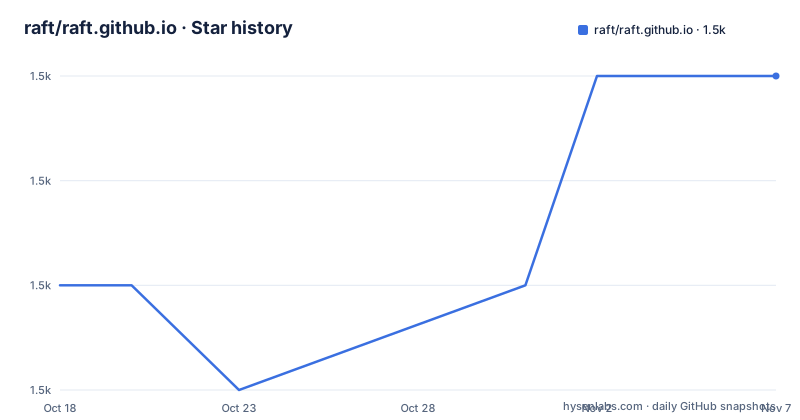
- raft/raft.github.io1,469 ★ · +2
| Repository | 2026-10-18 | 2026-11-07 |
|---|---|---|
| raft/raft.github.io | 1.5k | 1.5k |
2 Stars in the last 20 days, measured from the daily GitHub snapshot. Compare with other projects
Editorial analysis
What raft.github.io Contains
The repository is the source for the website at https://raft.github.io. Its central subject is the Raft consensus algorithm, and it also maintains an implementation directory that visitors can use to find Raft-related projects hosted on GitHub. The README describes the most common contribution as adding a new implementation to `implementations.json`. This makes the project useful to engineers who are searching for an existing implementation, to educators who need a public reference page, and to contributors who want to add a project to the directory.
The repository is primarily an HTML website, with `index.html` at the top level and supporting assets including `logo`, `slides`, `thumbnails`, and the Raft PDF. The directory data is separate from the page markup, which makes additions more manageable than editing the entire interface for every new entry. The site is hosted as a GitHub static page, so the deployed website is served without an application server in the production hosting arrangement described by the README.
Implementation Directory Data Flow
The visible implementation table is driven by `implementations.json`. The README states that entries are ordered lexicographically by GitHub repository URL, and automated checks enforce that ordering. When a pull request is submitted, `./check.py` verifies that the data is well formed. The associated `implementation.schema.json` describes the expected structure, while `check.py` performs the repository's validation step.
The website also uses information from GitHub to sort implementations according to repository stars and last update time. That information is obtained through the related repository tooling and cached on a separate server several times per day. As a result, a newly submitted implementation can appear at the bottom of the table for a few hours before cached metadata affects its position. This is an operational limitation of the directory: the data entry can be available before the displayed ordering reflects current repository metadata.
The page itself requests `implementations.json`, which is why the README instructs contributors to use a static web server when working locally. Opening the HTML as a local file can fail to reproduce the same data-loading behavior because browser restrictions on local file requests differ from HTTP serving.
Running the Website Locally
The README provides a local setup path for contributors. It first requires the repository's Git submodules to be initialized recursively. This matters because the top-level layout includes submodules and the local site may depend on their content. After the checkout is complete, the documented command starts Python's built-in HTTP server on localhost port 8000.
The following commands install the validation dependency, initialize the submodules, and serve the site locally:
pip3 install jsonschemaThe dependency is required for `./check.py` according to the README. If installing it globally is undesirable, the README points to Python's `venv` documentation for an isolated environment.
git submodule update --init --recursiveAfter the submodules are initialized, start the server from the repository directory:
python3 -m http.server 8000 --bind localhostOpen `http://localhost:8000/` in a browser. The README specifically says that the server is needed to allow `index.html` to retrieve `implementations.json`. A successful local page should load through HTTP rather than relying on direct file access.
Adding an Implementation Through Pull Request
Contributors should modify `implementations.json`, then ask the repository checks to validate the change. The README identifies pull requests as the preferred contribution method, with issues serving as an alternative. The ordering rule is strict: entries must remain lexicographically ordered by GitHub repository URL. A valid JSON document placed in the wrong position can therefore fail automation even if its contents are otherwise acceptable.
The validation entry point is `./check.py`. The README does not provide the exact JSON object for a particular implementation, so the appropriate record shape must be taken from the schema and existing entries in `implementations.json`. This is a concrete maintenance constraint for contributors. The directory is data-driven, but the schema is the contract that determines which fields are accepted.
The repository also includes `fetch_repo_info.py`. The README does not document every command-line option for that script, so its exact invocation should not be inferred. Its presence indicates separate tooling for obtaining repository information, while `check.py` is the documented validation step for submitted data.
Static Hosting Boundaries
raft.github.io is a website and catalog, not a Raft implementation itself. The repository does not document an API for consensus operations, a client library, a cluster runtime, or a deployment guide for running Raft nodes. Engineers who need to build a replicated system must follow one of the implementation projects listed by the site and evaluate that project independently.
The GitHub Pages model also changes what the repository can validate. The README confirms that implementation metadata is cached on another server and refreshed a few times per day. It does not describe cache invalidation controls, a manual refresh command, or a service-level guarantee for newly added entries. The directory can therefore serve as a starting point, but it should not be treated as a live health monitor for every listed repository.
The website documentation does not describe benchmarks or compatibility guarantees. Repository stars and last update time affect sorting, but the README does not say that those values establish correctness, production readiness, API stability, or licensing suitability. Those properties belong to the linked implementation repositories and require separate review.
Maintenance, License, and Upgrade Cost
The repository is not archived, and its last push was on 2026-07-06. The README gives contributors two routes for changes: submitting pull requests, preferably, or creating issues. It also defines automated checks for `implementations.json`, so contributors need to preserve the URL ordering and schema requirements when updating the directory.
The website work is licensed under the Creative Commons Attribution 3.0 Unported License. The README links to the license deed for details. That license statement applies to this website work as described by the repository. It does not establish the license of every implementation linked in the directory, so engineers must inspect the license of each linked repository separately before incorporating its code.
There are no GitHub releases in the repository record. The documentation also does not describe a semantic version, release cadence, compatibility matrix, or upgrade procedure for the website. Changes are therefore reviewed through repository contributions and automated validation rather than a documented release process.
Editorial conclusion
Engineers who need a reference implementation list for Raft can use this site, especially when they want to inspect entries before selecting a library. Teams needing a live service, implementation benchmarks, or a supported production package should verify the linked repository, language, API, and maintenance history first. For this website itself, contributions are accepted through pull requests or issues, and `implementations.json` is the central file to inspect.
Frequently asked questions
How do I run the raft.github.io website locally?
Initialize all Git submodules with `git submodule update --init --recursive`, then run `python3 -m http.server 8000 --bind localhost` from the repository directory and open `http://localhost:8000/`. The server is needed so `index.html` can retrieve `implementations.json`.
How do I add a Raft implementation to the directory?
Add the implementation to `implementations.json`, keeping the file ordered lexicographically by GitHub repository URL. Submit a pull request, preferably, and use `./check.py` to validate the data against the repository's requirements.
Why does a new implementation appear near the bottom of the table?
The website sorts implementations using GitHub stars and last update time, and that information is cached on a separate server a few times per day. A new entry can remain at the bottom for a few hours while the cached information updates.
Official sources
Add this badge to your README
If you maintain this project, the badge below links readers to this analysis and shows its maintenance status from the daily GitHub snapshot. Paste the markdown into your README; add ?metric=license or ?metric=stars to the image URL for a different field.

[](https://hysenlabs.com/projects/raft-raft-github-io)Star history chart for your README
[](https://hysenlabs.com/projects/raft-raft-github-io)Was this useful?