Humanoid motion intelligence: a paper reading index meant to be handed to an agent
A knowledge base on humanoid robot motion intelligence: papers, open-source projects, industry overview and job-seeking resources.
At a glance
- What is it?
- RealXiaoze/humanoid-motion-intelligence is a Chinese-language knowledge base on humanoid motion control, retargeting, whole-body manipulation and deployment, organised as six numbered tracks and one file per paper reading. It ships no code and no releases, just Markdown and an AGENTS.md written for retrieval.
- Who is it for?
- Use this if you are starting from scratch in humanoid control or need a survey shaped around a concrete question rather than a reading list you have to assemble yourself, and you read Chinese or work with an agent that does. Expect no runnable code, no dataset downloads and no citation tooling: the value is the curation and the file naming.
- Can I use it commercially?
- Check first. The repository uses a licence we do not classify automatically, so read its LICENSE file before any commercial use.
- Is it still maintained?
- Yes. The repository last received commits 3 days ago.
- What is it written in?
- GitHub does not report a main language for this repository.
Answers come from the project's GitHub data, last synced on November 25, 2026, and from our analysis. They are not legal advice.
Star history
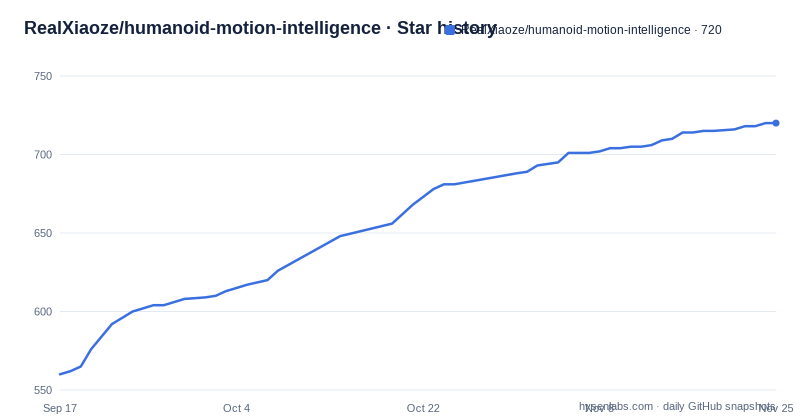
- RealXiaoze/humanoid-motion-intelligence720 ★ · +160
| Repository | 2026-09-17 | 2026-11-25 |
|---|---|---|
| RealXiaoze/humanoid-motion-intelligence | 560 | 720 |
160 Stars in the last 69 days, measured from the daily GitHub snapshot. Compare with other projects
Editorial analysis
This is a knowledge base, not a library of code
There is no package to install here. Every file at the top level is a Markdown document: an index of papers and projects, a dataset catalogue, a company and product table, a set of reinforcement learning resources, and a job and career folder. The repository describes itself as an embodied intelligence lab collection of papers, technical reports and engineering resources, and its central question is how to turn perception, task instructions and reference motion into stable movement in a real environment.
That framing sets the audience explicitly, and the four audiences are different. A beginner uses it to build the technical picture, an engineer looks up an implementation or an experimental baseline, a researcher compares methods and research questions, and a job seeker or tech lead reads project and industry context. A knowledge base written for all four is why the entries are summaries rather than code.
Six tracks numbered 01 to 06 split the field by input
The classification table runs from data to control, and the numbering is literal: each track is a numbered file under the papers and projects directory. Track 01 covers motion data and retargeting, from video human motion recovery to mapping motion onto a target body. Track 02 covers locomotion and motion priors, split into basic walking, vision and terrain perception, skill representation and behaviour bases, disturbance rejection and protective control, and training frameworks. Track 03 covers motion tracking and whole-body control, track 04 covers loco-manipulation and physical interaction, track 05 covers world models, VLA policies and agents, and track 06 covers engineering and real-robot deployment.
Track 06 is the one that answers the question most engineers arrive with, since it runs from robot models and state estimation through kinematics, control planning and simulation, to policy export, joint mapping, control frequency, hardware interfaces, run logs and task evaluation.
Each paper reading is its own numbered file
Readings sit in a subdirectory as numbered Markdown files, one per paper, so a citation is a file name rather than a heading you have to search for. The convention shows up throughout the index: BeyondRetarget is P213, UMR is P214, HOI-Retarget is P315, SONIC is P035, BeyondMimic is P034, MimicLite is P248, HEFT is P247.
The one-line summaries show what each name buys you. BeyondRetarget generates motion references for a target robot from monocular video. UMR transfers pose and contact through dense correspondence across the body surface. HOI-Retarget optimises motion transfer around hand and object contact and ships robot interaction reference data. HEFT leans on heavy-load teleoperation, MimicLite on training and evaluation for general tracking, and BeyondMimic on how a unified motion representation, reference tracking and motion generation are organised.
Entry points are keyed to your goal, not to a topic
Rather than a single suggested order, the knowledge base gives a table of goals and reading routes. Building foundations starts from the technical overview and the learning path, then adds books and courses before picking a training project. Reproducing a project means finding its purpose first, reading the matching method write-up, and building the experiment with the simulation and training tools. Comparing methods means locating same-task work in the paper index and holding task, input and output, training signal and results against each other. Designing a system means walking the capability stack and choosing between whole-body operation, upper-level models and vendor platforms.
The fifth row is the one aimed at hiring: it points at a role capability map, then uses papers and projects to fill in the gap, then interview material for motion control and for real-robot deployment.
The repo is written to be handed to an agent
Cloning it locally is two commands:
git clone https://github.com/RealXiaoze/humanoid-motion-intelligence.git
cd humanoid-motion-intelligence
You then open the directory in an agent that can read local files and state your background, your goal and what you already have. The README's own examples are concrete: a Python and PPO background wanting to train G1 walking in Isaac Lab, a request to compare BeyondMimic, SONIC and MimicLite on purpose, training method and control interface, or a plan for an experiment running from monocular video to motion tracking.
Two conventions in AGENTS.md shape the output. The agent is asked to cite pages and original sources, and to keep a paper's conclusion separate from its own inference. For engineering questions you feed in the robot model, the simulator, the observation and action definitions, and the training curves, so the retrieval lands on your setup rather than a generic one.
Industry tables and interview material sit beside the papers
The non-paper half is what makes this usable as a career resource. A company and product table is organised so you can look up robot bodies, components, models and developer platforms by country or region, and a companion file lists each company's open-source projects with their purpose, core method and official entry point. Reading them against a research question is the intended move rather than an accident.
The rest is study and hiring material: books and courses covering robotics, reinforcement learning, large models and AI infrastructure, a reinforcement learning developer folder with frameworks, simulators and training tools, and a job folder holding interview experience, project preparation, salary negotiation and referral information. There is also a table of wheeled-biped training solutions comparing frameworks, action interfaces and task capabilities, which is the closest thing in the repository to a buying decision.
Chinese throughout, with no releases and no stated licence
The practical constraint for an English reader is language. The README, the indexes and the file names are Chinese, so browsing it as documentation means translating on the fly, and the agent route is the only one that hides that cost. The navigation also depends on HTML anchors and collapsed details blocks, so a plain text reader sees less structure than a browser does.
Maintenance is current but unscheduled. The repository is not archived and its last push is dated 2026-10-02, yet it has no GitHub releases, which suits a knowledge base that tracks its subject rather than a tool with versions. A LICENSE.md exists at the root while the recorded licence metadata is unasserted, so read the file rather than the badge before reusing any of it.
Editorial conclusion
Use this if you are starting from scratch in humanoid control or need a survey shaped around a concrete question rather than a reading list you have to assemble yourself, and you read Chinese or work with an agent that does. Expect no runnable code, no dataset downloads and no citation tooling: the value is the curation and the file naming. Before you rely on a summary, follow the pointer back to the paper it came from, and check LICENSE.md yourself, since the repository metadata does not state the licence.
Frequently asked questions
What is the humanoid-motion-intelligence knowledge base?
A Chinese-language collection of paper and technical report readings, open-source project write-ups, dataset catalogues, company tables and job material on humanoid motion control and deployment. It is documentation only, with no runnable code.
How is humanoid-motion-intelligence organised?
Into six numbered tracks under the papers and projects directory: motion data and retargeting, locomotion and motion priors, motion tracking and whole-body control, loco-manipulation, world models with VLA and agents, and engineering with real-robot deployment. Paper readings are separate numbered files such as P213.
How do I use the humanoid-motion-intelligence repository with an AI agent?
Clone it, open the directory in an agent that can read local files, and state your background and goal. Usage conventions live in AGENTS.md, which ask the agent to cite pages and original sources and to separate a paper's conclusion from its own inference.
Does humanoid-motion-intelligence include job and interview material?
Yes. A job and career folder holds a role capability map, interview experience, project preparation, salary negotiation and referral information, including dedicated pages for motion control interviews and real-robot deployment interviews.
What licence is the humanoid-motion-intelligence repository under?
The recorded licence metadata is unasserted, while a LICENSE.md file sits at the repository root. There are no GitHub releases either; the last push to main is dated 2026-10-02.
Official sources
Add this badge to your README
If you maintain this project, the badge below links readers to this analysis and shows its maintenance status from the daily GitHub snapshot. Paste the markdown into your README; add ?metric=license or ?metric=stars to the image URL for a different field.

[](https://hysenlabs.com/projects/realxiaoze-humanoid-motion-intelligence)Star history chart for your README
[](https://hysenlabs.com/projects/realxiaoze-humanoid-motion-intelligence)Was this useful?