AccumulateMore/CV: A Chinese-Language Deep Learning Notebook Collection Built Around Four Video Courses
(Completed) Comprehensive deep learning notes covering Tudui's PyTorch course, Li Mu's Dive into Deep Learning, Andrew Ng's Deep Learning courses, and Dafei's LLM Agent course.
At a glance
- What is it?
- The repository is a numbered set of Jupyter notebooks mapped to Pytorch, Li Mu, Ng, and Agent video lectures, distributed through GitHub and Baidu Pan. It is a study companion, not a library, and the README doubles as a recruiting and mentoring channel.
- Who is it for?
- Adopt AccumulateMore/CV if you are following one of the four linked Chinese-language video courses and want a numbered notebook to read alongside it, and if you accept that the repository has no declared licence and that its README mixes study material with mentoring and referral offers. Do not adopt it as a library, a pip-installable package, or a source of production code.
- Can I use it commercially?
- Not without permission. GitHub finds no licence file in the repository, and without a licence all rights are reserved by default: you may read the code but not reuse it. Check the README, or ask the authors, before using it.
- Is it still maintained?
- Yes. The repository last received commits 55 days ago.
- What is it written in?
- Mainly Jupyter Notebook, according to GitHub's language statistics.
Answers come from the project's GitHub data, last synced on November 13, 2026, and from our analysis. They are not legal advice.
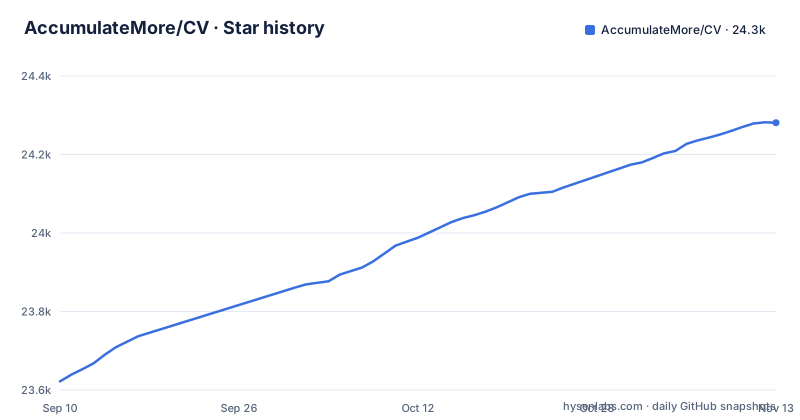
Star history
- AccumulateMore/CV24,281 ★ · +659
| Repository | 2026-09-10 | 2026-11-13 |
|---|---|---|
| AccumulateMore/CV | 23.6k | 24.3k |
659 Stars in the last 64 days, measured from the daily GitHub snapshot. Compare with other projects
Editorial analysis
What AccumulateMore/CV Actually Is, and Who It Is Written For
This is a notes repository, not software. The primary language is Jupyter Notebook, and the README describes the contents as a set of deep learning notes covering CV, NLP, large models, and Agent topics. The organising principle is unusual and worth stating plainly: the notes are numbered in blocks that correspond to specific video courses. The README assigns Pytorch material (instructor 土堆) to notes 100 through 122, deep learning material (instructor 李沐) to notes 200 through 268, deep learning material (instructor 吴恩达) to notes 300 through 354, and large model Agent material (instructor 大飞) to notes 400 through 409. A fifth block, 500 onward, is listed with a placeholder instructor name and a placeholder link, and the README says it is expected next year. That numbering scheme is the whole interface. If you are watching one of those four video series and want written notes that track the lecture order, the repository is aimed at you. If you want a library, a framework, or reusable modules, nothing in the README suggests you will find one. The README's own framing is study support for self-learners, including a stated motivation of helping isolated self-taught students through chat groups.
The Numbering Scheme Is the Architecture
There is no runtime, no build step, and no package. The data flow is: a video lecture series exists on Bilibili or another platform, a notebook with a number in the matching range covers the same topic, and the reader opens that notebook. The README gives the mapping as a table-like list rather than a manifest file, so the authoritative index lives in prose. That has a consequence worth naming: the repository cannot tell you which notebook corresponds to which lecture minute. You match by number range and by reading the notebook title. The only structural aids the README mentions are a Jupyter table-of-contents extension, which it recommends installing so you can jump between chapters, and the advice to view notebooks locally rather than on GitHub because images and formulas sometimes fail to render in the browser. Neither of those is enforced by any config file in the repository; they are instructions to the reader. The repository is also described as complete (已完结) in its own description, which sits awkwardly beside the placeholder 500-series block.
Getting the Notebooks Open: What the README Tells You to Do
The setup instructions are short and entirely procedural. The README states that notes are opened with Anaconda's Jupyter Notebook, and it warns that opening them through PyCharm's Jupyter integration will not display images correctly. It recommends installing a Jupyter Notebook table-of-contents extension so you can jump to chapters, and it points readers who do not know how to install one toward the author's separate Python repository, where a file or folder named 00_Python编辑器 is said to contain the relevant links. For downloading, the README tells readers to search for how to download files from GitHub rather than giving a command, so the README gives no git clone line and names no environment or requirements file. The datasets referenced by the notes are not hosted in the repository: the README gives a Baidu Pan link with the extraction code ppmu, and states that if the link expires, readers can contact the author through WeChat. That is the entire distribution path for data. Anyone expecting to reproduce the notebooks from a single command will not find one here.
The README Is Also a Services Page, and That Matters for Evaluation
A large fraction of the README has nothing to do with deep learning notes. It advertises WeChat study groups (with a note that the QR codes stop working past 200 members), mentoring described as thesis guidance (free for 研0 and 研1 students), job-search coaching, resume rewriting, interview rehearsal, and commercial project help, a referral list spanning dozens of Chinese employers including Alibaba, Tencent, ByteDance, Huawei, SenseTime, and DeepSeek, and screenshots presented as evidence of referral results. The README also states that the author has guided over a thousand students. None of those claims can be verified from the repository, and they are not technical evidence of note quality. For an engineer deciding whether to read the notebooks, the practical effect is that the README is noisy and mixes study guidance with commercial offers. The technical instructions are real and specific (Anaconda, the table-of-contents extension, the Baidu Pan code), but you have to separate them from the surrounding promotion. Treat the services section as context about the maintainer's incentives, not as documentation.
No Declared Licence, and What That Limits
The licence field is unknown in the repository metadata, and the README does not state one. That is the single most consequential gap here. Without a licence, the default position under most copyright regimes is that the author retains rights and no permission is granted, which means redistribution, incorporation into course material, or reuse in a commercial training product is not something you can assume is allowed. I am not giving legal advice here; the point is narrower. If your use is reading the notebooks yourself, the absence of a licence does not stop you. If your use involves copying notebook content into your own repository, a course, or a product, you have no documented permission to do so, and the README's tone (star the repo, contact me on WeChat) suggests the author expects to be asked. The datasets are a second layer: they are distributed through Baidu Pan rather than the repository, so their terms are whatever the uploader set, and the README does not describe them.
Where This Fails, and What to Use Instead
The wrong-tool cases are clear. If you need an executable reference implementation of a model, this repository is the wrong place, because the material is notes keyed to lectures, and the README describes no installable artifact. If you do not read Chinese, the notes are effectively closed to you, since the README, the video links, and the community channels are all Chinese-language. If you want a maintained, versioned curriculum with a changelog, the last push timestamp is the only freshness signal available, and there are no releases. A real alternative for the same job is the official course material that these notes accompany: Li Mu's d2l.ai book and its notebooks, or the Deep Learning Specialization notebooks published by DeepLearning.AI. The difference in approach is structural. AccumulateMore/CV inverts that: the video is primary and the notebook is a personal transcription and annotation layer, which is exactly why it is useful for following along and exactly why it is thin as a standalone reference. If you want a single source of truth you can cite, use the upstream course. If you want a second pass in Chinese with the author's own notes, use this.
Maintenance and Upgrade Cost
Upgrade cost here is not dependency drift, because there is no dependency manifest to drift. It is link rot and rendering. The README itself flags two recurring failure modes: images and formulas rendering incompletely on GitHub, and images not displaying in PyCharm's Jupyter view. Both push readers toward a local Anaconda install with a table-of-contents extension, which is a one-time setup cost per machine. The Baidu Pan dataset link is a second decay point, and the README anticipates it by telling readers to contact the author on WeChat if it breaks, which means recovery depends on a human response rather than a mirror. The 500-series block is a third: it is a placeholder with a placeholder instructor and a stated target of next year, so anyone planning a curriculum around it should treat it as unshipped. On the positive side, notebooks are static files, so a clone or download taken today will keep working offline even if the repository stops being updated. That property, not any maintenance promise, is what makes the material durable.
Editorial conclusion
Adopt AccumulateMore/CV if you are following one of the four linked Chinese-language video courses and want a numbered notebook to read alongside it, and if you accept that the repository has no declared licence and that its README mixes study material with mentoring and referral offers. Do not adopt it as a library, a pip-installable package, or a source of production code. Before relying on it, check the licence field on GitHub, confirm the Baidu Pan dataset link still resolves with the stated extraction code, and verify that the notebook numbers you need fall inside the ranges the README lists, since the 500-series is explicitly marked as a placeholder.
Frequently asked questions
What does AccumulateMore/CV actually contain?
Numbered Jupyter notebooks covering PyTorch, deep learning and large model agents, each range tied to a video course: 100 to 122 for the PyTorch series, 200 to 268 and 300 to 354 for the deep learning series, 400 to 409 for the agent series, and 500 onward announced for a later year. The PyTorch range runs from installation and data loading through CNNs, optimizers, GPU training and model validation.
Can I open the AccumulateMore/CV notebooks in PyCharm?
The notes state that PyCharm's Jupyter Notebook does not display the images properly, because the notebooks were written to be opened with Anaconda's Jupyter Notebook. It also recommends installing the Jupyter Notebook directory plugin so you can jump between chapters from a table of contents, and notes that formulas and images can render incompletely on github.com until the file is downloaded and read locally.
Where do the AccumulateMore/CV datasets come from?
They are shared free of charge through one Baidu Pan link with an extraction code, and the README says to contact the author over WeChat if that link stops working. There is no registry package or mirror, so the availability of the data depends on a single personal third-party drive.
Can I reuse AccumulateMore/CV notebooks in my own course or project?
Repository metadata records the license as unknown, so there is no stated grant for copying, redistribution or derivative commercial use. Reading and running the notebooks locally needs no permission, but anything you publish or sell needs a license that does not exist in the repository.
Official sources
Add this badge to your README
If you maintain this project, the badge below links readers to this analysis and shows its maintenance status from the daily GitHub snapshot. Paste the markdown into your README; add ?metric=license or ?metric=stars to the image URL for a different field.

[](https://hysenlabs.com/projects/accumulatemore-cv)Star history chart for your README
[](https://hysenlabs.com/projects/accumulatemore-cv)Was this useful?