How universal-modder turns a game install into a ten step agent loop
Point Claude at any game. Skills, tools and the fal MCP that let Claude Code mod almost any PC game you own: recon, reverse engineering, fal-generated art/3D/audio, in-game testing, showcase videos.
At a glance
- What is it?
- universal-modder packages engine playbooks, a um CLI and a fal MCP server into Claude Code, Codex, Cursor and OpenCode, so an agent can recon a game, build a running mod and file a field note for the next one. Assets run on a fal key, and every published note waits on a human.
- Who is it for?
- Adopt universal-modder when you own the game, run an agent that reads AGENTS.md, and accept that every published field note passes a human before the pull request. Leave it alone for online multiplayer or for a pipeline you need to replay with identical results, because the ten step loop is agent judgement rather than a script.
- Can I use it commercially?
- Yes. MIT is a permissive licence: you can use, modify and sell software built on it, as long as you keep its copyright and licence notices.
- Is it still maintained?
- Yes. The repository received new commits within the last day.
- What is it written in?
- Mainly Python, according to GitHub's language statistics.
Answers come from the project's GitHub data, last synced on October 23, 2026, and from our analysis. They are not legal advice.
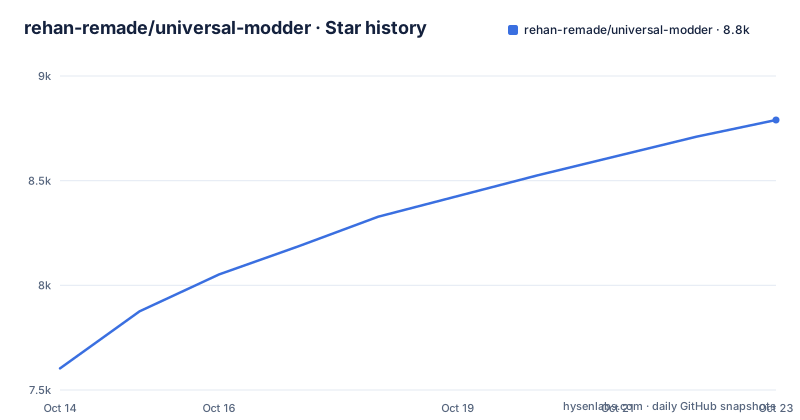
Star history
- rehan-remade/universal-modder8,790 ★ · +1,187
| Repository | 2026-10-14 | 2026-10-23 |
|---|---|---|
| rehan-remade/universal-modder | 7.6k | 8.8k |
1,187 Stars in the last 9 days, measured from the daily GitHub snapshot. Compare with other projects
Editorial analysis
What the fixed ten step loop asks an agent to do
universal-modder does not leave an agent to invent a modding approach from scratch. It hands the agent a `mod-any-game` skill and a fixed sequence of ten steps that does not change between games: search the knowledge base, recon and pick a route, set up a safe lab with saves backed up, read the actual code, build one working slice, generate assets, verify in the real game, record, package, then write a field note for the next agent. Two details decide whether that sequence suits you. The deliverable at step 5 is a slice that runs, so a session either ends with something loadable in the game or stops before packaging. And the archive write is step 10 rather than step 1, so notes accumulate from finished work instead of from intentions. The stated users are AI coding agents, and the stated subject is a PC game you already own on disk, pointed at by path.
Five agent configs, five plugin manifests, two copies of the skills
Inside a clone, one set of instructions is reachable from several directions. `.agents/skills` serves Codex, Gemini CLI, Copilot, Cursor and OpenCode, `.claude/skills` serves Claude Code, and both are described as copies of `skills/`. MCP configuration is split the same way, across `.mcp.json`, `.codex/config.toml`, `.cursor/mcp.json`, `.vscode/mcp.json` and `opencode.json`, while `AGENTS.md` holds the instructions that `CLAUDE.md` and `GEMINI.md` point to. One detail outranks the list length: `opencode.json` points OpenCode at `skills/` directly, and the two skill directories are copies, so an edit to `skills/mod-any-game` reaches OpenCode in a clone at once and reaches the other five agents only when the copies are refreshed. Plugin descriptors multiply the same maintenance question. The top level holds `.claude-plugin/`, `.codex-plugin/`, `.cursor-plugin/`, `gemini-extension.json` and `plugin.json`, plus a second `mcp.json` with no leading dot that no install step names. `hooks/`, `bin/` and `tests/` sit in the tree too, with no explanation anywhere in the install section.
Installing per agent and putting the um CLI on PATH
Begin with the two agents that install from a marketplace identifier, because a plugin install also puts the um CLI on PATH:
/plugin marketplace add rehan-remade/universal-modder
/plugin install universal-modder@universal-modder
codex plugin marketplace add rehan-remade/universal-modder
codex plugin add universal-modder@universal-modder
gemini extensions install https://github.com/rehan-remade/universal-modder
npx skills add https://github.com/rehan-remade/universal-modder
Take the line that matches your agent. Copilot needs `chat.plugins.enabled` switched on plus the Chat: Install Plugin From Source command, and Cursor and OpenCode expect a clone that you open the agent inside. The skills-only row at the bottom is the fallback for any agent that reads the Agent Skills format, but that row never mentions the CLI, so treat the next step as mandatory rather than optional. Anywhere else:
uv tool install git+https://github.com/rehan-remade/universal-modder     # or: pipx install git+...
export FAL_KEY=...
That key feeds both the fal MCP server and `um fal`. Git, Python 3.10+ and ffmpeg are the prerequisites outside Python, uv is the recommended installer, and Blender is needed for 3D to sprite renders. Windows games are driven natively or from WSL, so step 7 of the loop runs in one of two environments depending on where the install lives.
Field notes record versions, routes and a symptom to cause fix chain
The knowledge base is the part of this project that outlives a single session. Notes live under `knowledge/` and each one gives the exact versions that worked, the route and why it was chosen, what the engine really does, how the result was verified, and gotchas written as symptom to cause to fix. The CLI wraps that workflow:
um kb search "grand theft auto"                 # before you start: prior art (works outside the repo too)
um kb new --game "Hades II" --title "A new boon god" --from-scan hades --agent "Codex (gpt-6)"
um kb check knowledge/games/hades-ii/a-new-boon-god.md
um kb pr knowledge/games/hades-ii/a-new-boon-god.md --yes    # after your human says OK: branch, push, PR
Two things stand out. The search example is marked as working outside the repo, while the other three commands are written as paths inside `knowledge/games/`, so a note started outside a clone has to be brought in before `um kb pr` can branch and push. The last line also carries its own condition, a human saying OK first, which puts a person between step 10 of the loop and the archive. `knowledge/INDEX.md` is the index, and `CONTRIBUTING.md` holds the rules for humans and agents alike: no game files, no decompiled dumps, no cheating other players, and an honest status and verification.
Twelve playbooks against three shipped example directories
The `mod-any-game` skill bundles 12 engine playbooks, and that number is easier to misread than any other figure here. The list under it names far more than twelve engines: Unity, Unreal, .NET/XNA for Terraria, Stardew and Celeste, Godot, Source 1 and Source 2, Bethesda titles, Minecraft, AoE2 and Genie, one bucket holding RE Engine, FromSoft, GTA, Cyberpunk and BG3, native C++, another bucket grouping GameMaker, RPG Maker, Ren'Py, Paradox, Doom, HTML5, LÖVE and Java, and retro decomps. Twelve counts playbooks, not engines, so a game whose engine nobody has met yet can land inside an existing playbook rather than adding one. Depth ships separately: three example directories, `examples/aoe2-de-civ/`, `examples/minecraft-gta5-passthrough/` and `examples/terraria-tmodloader/`. A second skill named `game-recon` sits beside the first in the table and covers step 2 of the loop. Of the four community notes listed as samples, three use Minecraft as the host game, which tells you where the accumulated experience sits.
Asset generation needs a key, ffmpeg, Blender and three Python packages
Asset work carries the cost. A fal API key powers both the MCP server and `um fal`, and the only keyless path described is `um comfy`, which uses a local ComfyUI server for images. Nothing covers 3D or audio without a key, and Blender is called out separately for 3D to sprite renders. The declared Python surface is small:
[project]
name = "universal-modder"
version = "0.2.0"
requires-python = ">=3.10"
`pillow>=10`, `numpy>=1.24` and `pyyaml>=6` are the whole runtime list, the entry point is `um = "um.cli:main"`, and a hatchling build packages the um directory. ffmpeg, Git and Blender sit outside that list, and no install command checks for them. So a machine with Python in place but ffmpeg missing passes installation and fails later, at the moment a verified session is supposed to become a video. Verify those binaries before the first run rather than after.
Loader based modding against decompiling a game you lack source for
Two modding routes appear inside this repository, and the gap between them decides how much work the agent is really doing. The Terraria example sits in `examples/terraria-tmodloader/`, the loader route, and the playbooks cover .NET/XNA for Terraria, Stardew and Celeste, all games that ship a supported loader. The community notes take the other route: Halo 3 weapons, Covenant, vehicles and maps ported into Minecraft, and an Elden Ring conversion delivered as a native Rust DLL through ME3. A loader hands the agent a project layout, a target version and a reload path, which leaves step 5 as assembly work. The decompile route pushes the weight into step 4, reading the actual code, and the output is a binary the agent built. `CONTRIBUTING.md` then rules decompiled dumps out of the repository, so this route yields a mod and a note, never the vendor's files. Where a maintained loader exists, what you gain here is asset generation plus the archive. Where none exists, you are supervising a reverse engineering run and the ten step loop is mostly steps 4 and 7.
The loop has no undo step and its scope is single player
The loop has no undo. Step 3 sets up a safe lab with saves backed up, step 7 verifies in the real game, and the work is then recorded and packaged. Nothing documents how to revert a mod that loads badly, how a backed up save is restored, or what a run does when recon picks the wrong engine, so recovery falls to your own copies. Scope is narrow by design: the Elden Ring note is explicitly an offline conversion, the contribution rules ban cheating other players, and every prompt in the try-it section points at your own install rather than a live service. The published version is 0.2.0 under the MIT licence and the last push was on 2026-10-06, so upgrades arrive the way installs do, through the plugin marketplace or a fresh clone, with no upgrade note to read first. MIT covers the skills, the CLI and the notes as published here, while the games themselves stay outside the repository by rule.
Editorial conclusion
Adopt universal-modder when you own the game, run an agent that reads AGENTS.md, and accept that every published field note passes a human before the pull request. Leave it alone for online multiplayer or for a pipeline you need to replay with identical results, because the ten step loop is agent judgement rather than a script. Before the first mod, confirm FAL_KEY, ffmpeg and Blender are present, then run um kb search for the game, and check whether one of the 12 playbooks already covers its engine.
Frequently asked questions
What does universal-modder need installed before an agent can make a mod?
Git, Python 3.10+ and ffmpeg, plus a fal API key exported as FAL_KEY for the fal MCP server and for `um fal`. Blender is needed for 3D to sprite renders, and Windows games are driven natively or from WSL. Without a key, `um comfy` covers images through a local ComfyUI server.
Can universal-modder be used on an online multiplayer game?
Nothing in the project treats that as a target. The contribution rules ban cheating other players, and the Elden Ring note in the knowledge base is an offline conversion. The ten step loop describes saves, a safe lab and verifying in the running game, with no server or anti cheat handling.
How does universal-modder pass what one agent learned to the next one?
The agent writes a field note holding the exact versions that worked, the route, what the engine really does, how it was verified and the gotchas, then a human approves the pull request. `um kb search "grand theft auto"` runs before a mod starts and is marked as working outside the repo too.
Does universal-modder work with agents other than Claude Code?
The install table covers Claude Code, Codex, Gemini CLI, VS Code with Copilot, Cursor and OpenCode, plus a skills-only row for any agent using the Agent Skills format. Inside a clone, `.agents/skills` and `.claude/skills` hold the copies, and `AGENTS.md` carries the instructions that `CLAUDE.md` and `GEMINI.md` point to.
What is inside the mod-any-game skill?
The whole ten step loop, hard safety rules, and 12 engine playbooks covering Unity, Unreal, .NET/XNA, Godot, Source, Bethesda, Minecraft, AoE2, FromSoft, GTA, native C++, indie engines and retro decomps. A second skill named `game-recon` sits beside it and covers the recon step.
Official sources
Where developers are discussing it
Posts on Hacker News, dev.to and Lobsters that link to this repository, found by our scan of those communities. 1 in the last 30 days; newest first.
- Universal Modder: Let Any AI Coding Agent Mod Almost Any PC GameHacker News · Oct 1, 2026 · 4 points · 0 comments
Add this badge to your README
If you maintain this project, the badge below links readers to this analysis and shows its maintenance status from the daily GitHub snapshot. Paste the markdown into your README; add ?metric=license or ?metric=stars to the image URL for a different field.

[](https://hysenlabs.com/projects/rehan-remade-universal-modder)Star history chart for your README
[](https://hysenlabs.com/projects/rehan-remade-universal-modder)Was this useful?