Twenty-two deep learning pages, three machine learning pages, and releases that stopped in 2024
Open source guides/codes for mastering deep learning to deploying deep learning in production in PyTorch, Python, Apptainer, and more.
At a glance
- What is it?
- The source for a long-running free course site: notebooks and MkDocs markdown covering PyTorch, reinforcement learning, language models, RAPIDS, programming and Cassandra, published under MIT with a Zenodo deposit. The version tags stopped two years before the last commit, and the thinnest section is the one that got a release.
- Who is it for?
- Read it as curriculum history rather than as a reference you will return to. The value is in the shape of the path, which takes a reader from matrices and gradients through linear regression to convolutional, recurrent and LSTM networks, and then into reinforcement learning on FrozenLake, with each page a notebook behind a published URL.
- Can I use it commercially?
- Yes. MIT is a permissive licence: you can use, modify and sell software built on it, as long as you keep its copyright and licence notices.
- Is it still maintained?
- Yes. The repository last received commits 21 days ago.
- What is it written in?
- Mainly Python, according to GitHub's language statistics.
Answers come from the project's GitHub data, last synced on November 13, 2026, and from our analysis. They are not legal advice.
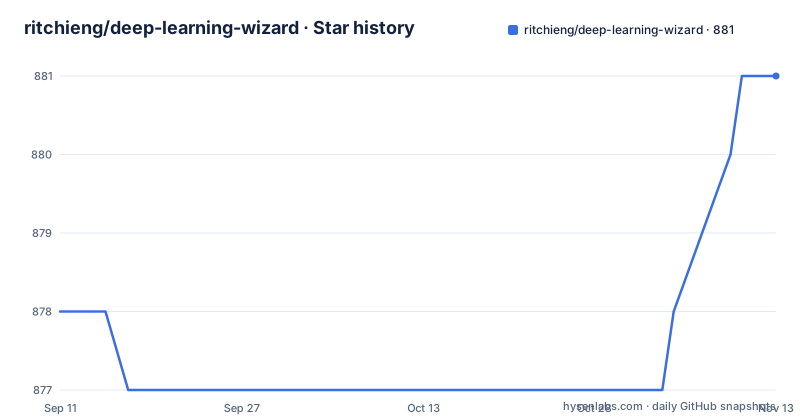
Star history
- ritchieng/deep-learning-wizard881 ★ · +3
| Repository | 2026-09-11 | 2026-11-13 |
|---|---|---|
| ritchieng/deep-learning-wizard | 878 | 881 |
3 Stars in the last 63 days, measured from the daily GitHub snapshot. Compare with other projects
Editorial analysis
Three releases, the newest from February 2024, and commits that ran to August 2026
The release history has three tags and a long tail. v1.0.1 is dated 2019-04-18 and titled for stable deep learning tutorials, v1.0.2 on 2023-10-03 is titled a cleaned stable release, and v1.0.3 on 2024-02-26 is titled for the language model section. The last push on the repository is dated 2026-08-07, more than two years after the newest tag. That gap is the practical fact for anyone pinning a version: the tags track announcements rather than the state of the content, so a reader who checks out v1.0.3 gets a February 2024 snapshot while the default branch carries considerably more. The project also carries a Zenodo badge in its header, which is the archival and citation path for the whole course.
Twenty-two pages of deep learning against three pages of machine learning
The table of contents carries 38 page links across five sections, and the distribution is the story. Deep learning and deep reinforcement learning takes 22 of them. Programming takes 6, one page each for C++, Bash, Python, Javascript and Electron behind an introduction. Language models take 5. Machine learning takes 3. Data engineering takes 2. So a site whose description covers machine learning, deep learning, deep reinforcement learning, data engineering, general programming and visualization devotes one page in fifteen to machine learning itself, and two of those three pages are RAPIDS cuDF topics rather than model fitting. That imbalance explains a lot about who this is written for: a reader who arrives wanting to understand neural networks gets a full path, while a reader who wants gradient boosting or a baseline model finds an index with almost nothing in it.
The language model section got the release and has the least content
The newest release is titled for the language model section, and that section is the thinnest of the substantive ones. It holds five pages: an introduction, HPC containers with Apptainer, an introduction to large language models with hyperparameter tuning, an introduction to multi-modal language models, and an introduction to embeddings under a retrieval-augmented generation heading spelled Retrieval Augemented Generation. Four of those five are single introduction pages. The section header names seven tools for them, Python, PyTorch, Ollama, LlamaIndex, CUDA, Huggingface and Apptainer, and the container page is the only one that goes beyond orientation.
The improvement material arrives after the models it is meant to improve
The practical ladder runs in a deliberate order: matrices, gradients, linear regression, logistic regression, a feedforward network, a convolutional network, a recurrent network, an LSTM, autoencoders, and fully connected overcomplete autoencoders. Then a separate block titled improving deep learning with PyTorch opens with derivatives, gradients and the Jacobian, followed by forward and backward propagation with gradient descent from a scratch regression, learning rate scheduling, optimization algorithms, and weight initialisation with activation functions. So the calculus that underpins the whole ladder arrives after the reader has already built ten models with it. That is a defensible order for a top-down course and a frustrating one for someone who wanted the derivatives first, and the two named unlinked entries, Course Progression and Introduction, sit above the practical block rather than being folded into it, so nothing in the index tells you which page to read next after the ladder ends.
Reinforcement learning is three pages and compute optimisation is one
The deep reinforcement learning block holds three pages: the move from supervised to reinforcement learning, Markov decision processes with Bellman equations, and dynamic programming worked through the FrozenLake environment. Everything else in that field is named in the section header, which lists Gym among the libraries, but has no page of its own. Compute optimisation gets a single entry, speed optimisation basics with Numba, and the from-scratch block gets one page, logistic regression classification. That last one is the most valuable thing in the repository for a reader who wants to understand what a framework is doing, and it is one notebook deep.
Data engineering is two Cassandra pages against seven named technologies
The data engineering section header names Bash, Databricks, Delta Live Tables, Parquet, Python, Cassandra and more. Under it sit two links, both Cassandra: an introduction and a cluster setup page. Nothing in the visible index covers Parquet, Delta Live Tables or Databricks. The programming section has the same shape in reverse, six pages covering languages and tooling with Electron and Javascript sitting alongside C++ and Bash, which is a broader and more coherent list than the data engineering one. Machine learning is comparable: cuDF and cuML are both named, cuML has no page, and the two GPU pages are GPU dataframes and fractional differencing between CPU and GPU.
The repository is the site source, and the notebooks are not at the top level
The description says the repository contains all the notebooks and the MkDocs markdown files powering the website. The top level carries a gitignore, the MIT license, the README, a deploy script, a test script, a docs directory, a material directory and an MkDocs configuration. No notebook directory appears at the root, so the notebooks live inside the docs tree or somewhere the root listing does not show. More striking is that a test script and a deploy script sit at the root with no workflow directory beside them, so nothing in the visible tree explains what runs them or when. The documentation itself still says this is an early work in progress and asks readers to be patient while guides are uploaded, which is a sentence that has now sat in front of the course for some time.
MIT materials with a paid video course attached, and contributions for errors only
The licensing is unambiguous and the business model is adjacent. The code is MIT licensed and the site is described as open-source and friendly to phones and tablets, while the same page invites visual learners to sign up for a video course. The scale claim, thousands of students across more than 120 countries, is stated without a source. The contribution line is narrow: the project asks people to contribute to the repository for errors and to open a pull request, and describes no route for contributing new tutorial material, which is the more expensive kind of contribution. The final visible heading in the README is empty. Among the credited supporters, one is listed as an assistant professor at NYU under Yann Lecun, which is how a well-known name gets misspelled in a credits block, and the main contributor is a single person with an editor and three supporters around him, which is the staffing of a course rather than of a framework.
Editorial conclusion
Read it as curriculum history rather than as a reference you will return to. The value is in the shape of the path, which takes a reader from matrices and gradients through linear regression to convolutional, recurrent and LSTM networks, and then into reinforcement learning on FrozenLake, with each page a notebook behind a published URL. That sequence is still a reasonable map of what to learn first, and the from-scratch pages matter most because they refuse to hide the calculus. Two limits to plan around. The course stops being tagged well before it stops changing, so nothing in the version numbers tells you whether a page was revised, and the machine learning and language model sections are too thin to rely on as-is, the latter having been added in a single 2024 release and left at five pages. If you are starting from zero, use the deep learning ladder and skip the sections that promise more than they deliver.
Frequently asked questions
What does the deep-learning-wizard repository contain?
The notebooks and MkDocs markdown files behind the course website, covering deep learning and deep reinforcement learning, language models, machine learning, programming and data engineering, plus an MkDocs configuration, a material directory and deploy and test scripts.
Which frameworks does the Deep Learning Wizard course cover?
The deep learning path uses Python, PyTorch, Gym, NumPy and Matplotlib. Other sections name RAPIDS cuDF and cuML, Ollama, LlamaIndex, CUDA, Huggingface, Apptainer, Databricks, Delta Live Tables, Parquet and Cassandra.
How current is the Deep Learning Wizard material?
The three releases are v1.0.1 from 2019, v1.0.2 from 2023 and v1.0.3 titled LLM Section Release from 2024-02-26. The last push on the repository is dated 2026-08-07, so the tags trail the content by more than two years.
How is Deep Learning Wizard material cited?
The README carries a Zenodo badge, which is the archived deposit for the course materials. The code itself is MIT licensed, with the LICENSE file at the repository root.
How do I contribute to Deep Learning Wizard?
The README asks for help with errors and says to open a pull request. No route is described for contributing new tutorial material or a new section.
Which reinforcement learning tutorials does Deep Learning Wizard have?
Three: moving from supervised learning to reinforcement learning, Markov decision processes with Bellman equations, and dynamic programming worked through on the FrozenLake environment.
Official sources
Add this badge to your README
If you maintain this project, the badge below links readers to this analysis and shows its maintenance status from the daily GitHub snapshot. Paste the markdown into your README; add ?metric=license or ?metric=stars to the image URL for a different field.

[](https://hysenlabs.com/projects/ritchieng-deep-learning-wizard)Star history chart for your README
[](https://hysenlabs.com/projects/ritchieng-deep-learning-wizard)Was this useful?