RoboBinding: an unmaintained MVVM framework for Android, and the readme that says so
A data-binding Presentation Model(MVVM) framework for the Android platform.
At a glance
- What is it?
- RoboBinding was a data-binding Presentation Model framework for Android that generated binding code instead of using reflection, and its readme now opens by stating that the project is no longer maintained and pointing users at the official Android data binding library. This looks at what the framework did and why it is worth reading rather than using.
- Who is it for?
- RoboBinding fits a developer studying how a data-binding MVVM framework is put together, or a team maintaining an existing Android app that already depends on it and needs to understand what it does. It does not fit a new Android project, because the project's own readme tells you to use the official data binding library instead, and the newest release dates from 2016.
- Can I use it commercially?
- Check first. The repository uses a licence we do not classify automatically, so read its LICENSE file before any commercial use.
- Is it still maintained?
- Yes. The repository last received commits 124 days ago.
- What is it written in?
- Mainly Java, according to GitHub's language statistics.
Answers come from the project's GitHub data, last synced on November 7, 2026, and from our analysis. They are not legal advice.
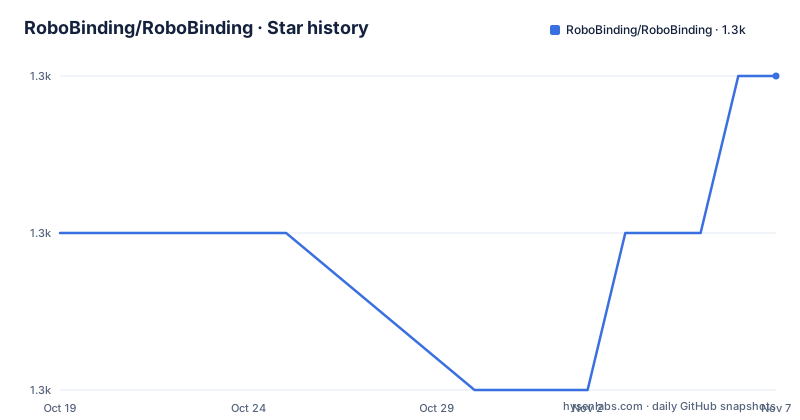
Star history
- RoboBinding/RoboBinding1,267 ★ · +1
| Repository | 2026-10-19 | 2026-11-07 |
|---|---|---|
| RoboBinding/RoboBinding | 1.3k | 1.3k |
1 Stars in the last 19 days, measured from the daily GitHub snapshot. Compare with other projects
Editorial analysis
The readme opens with a notice, not a pitch
The most important thing in this repository is the first line of the readme, and it is not a feature list.
It says: PLEASE NOTE, THIS PROJECT IS NO LONGER BEING MAINTAINED. The reason given is personal time constraints, with the author stating they are currently unable to keep up, and the instruction is to use the official Android data binding documentation instead.
That framing should shape any evaluation, and it is also what makes the project interesting to write about. A framework that is explicitly retired still contains a complete, readable implementation of a data-binding MVVM approach, with tests, and that is a different kind of artefact from a maintained library.
The history behind it is a normal story of a good idea arriving before the platform version of it. RoboBinding is a data-binding Presentation Model, MVVM, framework for the Android platform, and the readme frames it in terms of what it removes: lots of unnecessary code such as `addXXListener()` and `findViewById()`, by binding. It also turns hard to unit test, and Android unit tests running for ages which makes unit tests impractical, into pure POJO PresentationModels with normal JUnit tests.
The site is robobinding.org, the default branch is `develop`, and the licence is recorded as a custom one that GitHub cannot classify, with the terms in the `LICENSE` file at the repository root.
What the framework actually did
The feature list in the readme is short, and each item is a specific complaint about how Android UI code used to be written.
The first is the boilerplate removal. Binding replaces the ceremony of `addXXListener()` and `findViewById()` with declarations, so the view layer becomes a function of state rather than a sequence of imperative edits.
The second is testability, and it is the argument that sold the framework. When the presentation model is a plain POJO with no Android types in it, the unit tests are ordinary JUnit tests that run in milliseconds, rather than instrumentation tests that need a device or an emulator and take minutes. That is the difference between a team that writes tests and a team that means to.
The third is the object cursor. The readme describes it as a replacement for the relational cursor, but one we are used to operating objects. The idea is that a list in the UI is bound to a collection of model objects rather than to a Cursor, and the framework takes care of translating between them, including change notification.
The fourth is extensibility. The documentation says it is easy to implement attribute bindings for any custom components, third-party components or Android widgets, which simplifies the code and produces a more maintainable code base. That is the part that makes the framework interesting to a team with its own view components, because the binding syntax is a language you can extend rather than a fixed vocabulary.
The repository layout shows a code generation approach
The top level of the repository is informative even without a working build.
There is a `codegen/` directory, a `framework/` directory and an `extras/` directory, which is the three-part structure of a binding framework: the annotation processor that reads your annotated model and view classes and writes the binding code, the runtime that the generated code calls into, and the extras that are optional pieces. There is a `javadoc-taglet/` directory, which is a Javadoc taglet for the binding attributes, so that the XML attributes you write in a layout file are documented in the generated API documentation. That is a detail worth noticing, because the attribute names in a layout are the framework's user interface, and documenting them inside the IDE is a real piece of work.
The build is Gradle, with a `build.gradle`, a `settings.gradle`, a `gradle.properties`, the Gradle wrapper checked in as `gradlew` and `gradlew.bat`, and a `lint.xml` carrying the project's own lint configuration.
The readme makes a point about the implementation choice that explains the `codegen/` directory: RoboBinding helps you write UI code that is easier to read, test and maintain without performance compromise, code generation instead of java reflection. Generating the binding code rather than reflecting over it at runtime is the difference between a binding layer you can run in a plain JVM test and one that needs an Android runtime to do its work.
Where it was published, and the last version
The distribution details are in the readme, and they date the project precisely.
The releases are on Maven Central under the group `org.robobinding.robobinding`, with snapshots on the Sonatype OSS repository. The readme also links the version page and states that the latest version is 0.8.14. The release history in the project metadata matches: v0.8.14 on 2016-06-13, v0.8.13 on 2016-01-24, and v0.8.12 on 2015-12-05.
So the last published artefact is more than a decade old, and the newest tag predates the current generation of Android tooling by a wide margin. That is consistent with the maintenance notice, and it is the practical reason the framework is a reading project rather than a dependency.
The documentation site is the other place worth spending time. The readme links an introductory video on skillsmatter, an Insight Into Framework page that describes how the framework is put together, a getting started page, an API and binding attributes JavaDoc archive, and a versions page. There is also a Chinese index page, which tells you something about the community the project was built for, and a Google group for questions and discussions.
The project also describes its own values in a way that is unusual for a readme: it says it values code quality, that the framework source code is very readable and comes with a complete set of tests, which makes contributing easy, and that it wants to hear any voices, negative or positive.
Where RoboBinding is the wrong tool
The primary answer is given by the project itself, and it is worth restating plainly: for a new Android project, use the official Android data binding library.
The reason is not a judgement about the quality of the code. The official library does the same thing, generating binding classes from a data binding layout, and it ships with the platform. That means it tracks the Android Gradle Plugin, it is updated when the platform changes, and it does not have to be maintained by one person in their spare time.
There is a second, larger reason, and it is about where the industry went. RoboBinding is a Presentation Model framework, which is a specific and once popular way to structure an Android application: a POJO presentation model, an observable cursor, and declarative attribute bindings in layout files. The platform's own data binding and, later, a different declarative model built on composable functions have taken over the ground that a presentation model framework used to hold. A framework that competes with the platform's own tool is competing with something that ships with the toolchain, and the framework that is retired is the one that has to change.
The third limit is the age of the target. A framework last released in 2016 was written against the support library era, before AndroidX, before the current Gradle and Kotlin toolchain, and against annotation processing practices that have since shifted. Reading it is instructive. Depending on it is not a decision anybody should be making in 2026.
The fourth is the licensing question. The repository records a custom licence that GitHub cannot classify, and for a project whose artefacts sit in your dependency tree, that file is what decides the terms.
What is still worth taking from it
There is a case for keeping this repository around, and it is not that you should use the library.
The first is as a reference implementation of the pattern. A complete data-binding framework, split into a code generator, a runtime and extras, with the whole thing in a language and an idiom most Android developers can read, is a good deal cheaper to learn from than to build. The Insight Into Framework page and the javadoc-taglet are the two places where the design is explained properly.
The second is the emphasis on testability. The argument that a presentation model should be a plain POJO so that its tests are ordinary JUnit tests, with no emulator in sight, is still the right argument, whatever the framework. That idea outlived the implementation.
The third is the extension mechanism. The ability to define new binding attributes for your own components, with documentation generated into the JavaDoc, is a pattern that survives in the platform's own data binding, and seeing it built from scratch in a small codebase is instructive in a way that reading a platform document is not.
So the sensible way to treat this repository is as a historical reference. Read the feature list to understand the problems it was solving, read the generated code to see how a binding layer is implemented, and then use the platform's data binding, which does the same job and is still maintained. The first line of the readme says exactly that, and it is the correct advice.
Editorial conclusion
RoboBinding fits a developer studying how a data-binding MVVM framework is put together, or a team maintaining an existing Android app that already depends on it and needs to understand what it does. It does not fit a new Android project, because the project's own readme tells you to use the official data binding library instead, and the newest release dates from 2016. Before you invest in it, read the first paragraph of the readme rather than the feature list, and check the licence file, since the repository records a custom licence rather than a standard open source grant.
Frequently asked questions
Is RoboBinding still maintained?
No. The readme opens by stating that the project is no longer being maintained because of personal time constraints, and asks users to use the official Android data binding documentation instead. The newest release, v0.8.14, dates from 2016-06-13.
What was RoboBinding used for?
It was a data-binding Presentation Model, MVVM, framework for Android that generated binding code instead of using Java reflection, removing boilerplate like addXXListener() and findViewById(), and turning the presentation model into plain POJOs that could be tested with ordinary JUnit tests.
Where were the RoboBinding releases published?
On Maven Central under the group org.robobinding.robobinding, with snapshots on the Sonatype OSS repository. The documentation site is robobinding.org, with getting started, insight into framework, versions and JavaDoc pages.
What replaced RoboBinding for new Android projects?
The official Android data binding library, which the project's own readme points to. It offers the same generated binding classes and ships with the platform, so it is updated with the toolchain rather than maintained separately.
Can I still use RoboBinding in an existing Android app?
The project is not maintained, so new work on it is on you. If an app already depends on it, the last published version is 0.8.14, and the licence is recorded as a custom one whose terms are in the LICENSE file at the repository root.
Official sources
Add this badge to your README
If you maintain this project, the badge below links readers to this analysis and shows its maintenance status from the daily GitHub snapshot. Paste the markdown into your README; add ?metric=license or ?metric=stars to the image URL for a different field.

[](https://hysenlabs.com/projects/robobinding-robobinding)Star history chart for your README
[](https://hysenlabs.com/projects/robobinding-robobinding)Was this useful?