sadservers has no application code, one readme and nine images
SadServers: Linux & DevOps Troubleshooting Scenarios SaaS
At a glance
- What is it?
- SadServers is a paid service that hands you a broken real Linux server in a browser and destroys it on a timer. Its repository is not the service: the top level holds a readme, a security file, a scenarios directory and nine images, and the language recorded for the repository is infrastructure-as-code, which comes from the scenario definitions. What the readme does contain is unusually complete architecture writing, including the database argument and the launch-day outage.
- Who is it for?
- SadServers fits a hiring manager who wants a reproducible troubleshooting exercise with a defined success condition, or a developer who wants the same practice without arranging a broken machine themselves. Two things to know before you rely on it.
- Can I use it commercially?
- Not without permission. GitHub finds no licence file in the repository, and without a licence all rights are reserved by default: you may read the code but not reuse it. Check the README, or ask the authors, before using it.
- Is it still maintained?
- Yes. The repository last received commits 19 days ago.
- What is it written in?
- Mainly HCL, according to GitHub's language statistics.
Answers come from the project's GitHub data, last synced on November 21, 2026, and from our analysis. They are not legal advice.
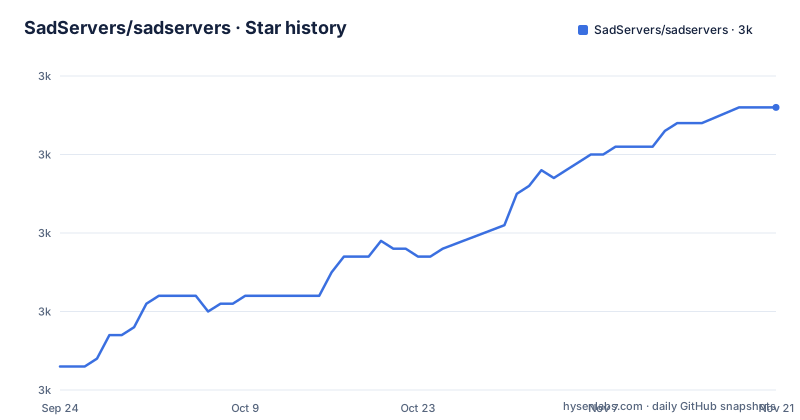
Star history
- SadServers/sadservers3,026 ★ · +33
| Repository | 2026-09-24 | 2026-11-21 |
|---|---|---|
| SadServers/sadservers | 3k | 3k |
33 Stars in the last 58 days, measured from the daily GitHub snapshot. Compare with other projects
Editorial analysis
The repository is documentation and nothing else
Look at the top level of this repository and there is no application in it.
There is a readme, a security file, a gitignore, a directory of scenarios, and nine images: a demo animation, two screenshots of command output, a screenshot of a terminal, an architecture diagram, a replay diagram, a lifecycle diagram, a virtual machine logging diagram, a medium-sized interface screenshot, and an image of the launch-day discussion.
So the service described in the readme is built somewhere else. The file names its stack precisely, a Python web framework with an application server behind a reverse proxy, a task queue on a message broker, an AWS SDK, and a single-file database. None of that is here.
The language recorded for the repository is infrastructure-as-code, which tells you where the code that is here lives: the scenario definitions are themselves infrastructure, describing the machines to be created. That is consistent with the service model, where each challenge is a small environment rather than a script.
The readme is therefore not a readme in the usual sense. It is the project's engineering documentation, and it is thirty sections long, with a table of contents that lists an architecture breakdown, a delivery section, development practices, site priorities, a licence section, a roadmap, a collaboration section and a contact section.
A browser terminal, and a machine destroyed on a timer
The What section is precise about what a user gets, and two details in it are worth separating out.
The first is the shell. The file says users get an SSH shell via a browser window. That is a terminal emulator in a page talking to a server, not an SSH client on your machine, which matters if you were planning to copy a configuration off it with your own tools.
The second is the lifetime. The server is ephemeral and is destroyed after the allotted time for solving the challenge. So the exercise has a deadline enforced by the infrastructure rather than by the person solving it, and anything worth keeping has to be written down inside the session.
The scenarios themselves come in two kinds, and the file distinguishes them. Some involve common software running on Linux, such as a database or a web server, where knowing the details of that specific application is not necessary. Others require you to be familiar with the technology, and a container scenario is given as the example. The stated intent is that the scenarios are real-world ones, described as similar to issues the author has encountered.
The audience is named as professional developers, system administrators, DevOps engineers and site reliability engineers, and the stated purpose is the troubleshooting portion of a job interview.
The only comparable thing it names shut down in 2022
The Why section explains the origin in one line, and then dates the market.
The project started because the author wanted it and was not aware of anything like it. The sentence that follows does the real work: there were sandbox solutions of a similar kind, one of which is named with its shutdown date in brackets, but nothing that gives you a specific problem with a condition of victory on a real server.
So the competitive claim in this readme is defined by a closure. The one comparable sandbox service named is recorded as shut down in May 2022, and the differentiator claimed over it is not the sandbox but the puzzle: a named fault and a test that says whether you fixed it.
That is a defensible position and it is also a fragile one. A file written after a competitor closed is evidence about the author's belief at the time, not about the current field, and the readme offers nothing more recent to compare against.
The rest of the section is about the hiring use, which the author says is real: companies using it to automate or facilitate Linux troubleshooting interviews, and for internal training. The specific complaint is worth quoting in spirit, because it is the design brief. Interviewers, it says, sometimes mislead you instead of helping, and candidates end up optimising for an arbitrary score rather than doing what they would do in a real incident, including the decision about whether to keep fixing or move to the next problem.
The launch-day outage is written into the readme
There is a When section, and it is two sentences long.
The project was launched on a well known link-sharing and discussion site in October 2022, reached the second position that day, and the file says plainly that it suffered from what is now called the hug of death for that site, with a link to a postmortem.
Most projects would not write that in the readme. This one does, with a link to someone else's write-up of what happened.
Two things follow. The first is that the launch is treated as a fact about the project rather than as marketing, which is why the interface section is as thin as it is: the How does it look heading has nothing under it at all, and the screenshots exist as image files in the tree rather than inline.
The second is that the failure mode is architectural rather than accidental. A service whose entire product is spinning up instances on demand, in front of a link that reaches a quarter of a million people in an afternoon, has exactly one bottleneck and it is the instance scheduler. The readme's own architecture section is built around that, which is why the queue and the scheduler get their own subsections and the interface does not.
The database section is the best writing in the file
There is a subsection explaining why a single-file database is the right choice, and it is written as criteria rather than as a decision.
The first criterion is write volume: the application must not be so write-heavy that you hit lock errors, and the error name is given in full. The second is cost, argued from the other direction. The reasoning is that the cost of the project, or of projects depending on it, is less than a few thousand dollars, while a managed relational database with high availability across two zones with point-in-time recovery runs in the hundreds of dollars a month.
The third is data and uptime criticality, and it is the one that generalises. The criterion is being fine with the downtime and the possible loss of data that comes from having no automatic failover, and recovering by copying a backup file. It then goes further: if you copy the file often, or stream it to a copy continuously, you are as close to guaranteed as you can be to having your data back, with one exception, the gap between the incident and the recovery.
And then the argument that is genuinely counter-intuitive, because it runs against the usual advice. Because full database systems have complexity and failure modes of their own, they can be hard to recover, and recovery can take a long time, for instance ingesting a large number of backed-up write-ahead logs.
That is a rare case of a project arguing that the boring choice has better failure characteristics than the impressive one, and it is the part of this repository worth reading even if you never use the service.
No incoming access on a challenge machine, and limited egress
The architecture section opens with the network boundary, and it is stated in one sentence.
Users interact only over HTTPS, with a web server and a proxy in front of the scenario machines. Everything else is internal, between networks or between cloud services. And each scenario machine lives in a network with no incoming access from the internet and limited outgoing access.
That last clause is the load-bearing one for a product whose whole premise is letting strangers break things. The challenge machines are not the web application, and they are not the control plane. They are isolated compute with a narrow path out, which is why a user can be handed shell access without that being equivalent to handing out a network position.
The rest of the architecture section is written the same way, naming each moving part and its library: the web tier and its reverse proxy and application server, the queue with its broker and its progress reporting on the front end, the storage tier, scenario instances, a replay system, resumable machines, an API, command history logging per scenario, and other infrastructure services.
There is even an aside about the queue stack admitting it may be more machinery than the job needs. That kind of comment is usually edited out of architecture documents, and its presence is a reasonable signal about how much weight the rest of the section deserves.
A table of contents with thirty entries and one empty section
The navigation block at the top of the file is longer than most projects' entire readmes, and it is worth reading as a statement of what the author thinks a software project owes its readers.
It lists, in order: what the thing is, why it exists, when it launched, how it looks, the architecture with nine named subsections, delivery with three, development practices with four, site priorities with two, and then the licence, issues, roadmap, collaboration, scenarios, contact and a star history chart.
Two of those entries point at nothing. The How does it look heading has no content under it, and it sits directly above the architecture section. The star history entry is the last thing in the file and is an image reference.
Everything else is present. The delivery section covers linting, formatting, automated testing and automated deployments. The practices section covers pull requests, feature flags, and a subsection on functions and comments. The priorities section has one subsection on user experience and one on security. There is a code licence section, and there is a roadmap section, which is unusual and worth reading precisely because most commercial services keep that private.
The existence of a named security priority alongside a named user experience priority is also the answer to the question the architecture boundary raises: for a service that gives strangers shell access, security is a stated product priority rather than an implementation detail.
Editorial conclusion
SadServers fits a hiring manager who wants a reproducible troubleshooting exercise with a defined success condition, or a developer who wants the same practice without arranging a broken machine themselves. Two things to know before you rely on it. Read the architecture section rather than the scenario list, because the readme is unusually honest about the shape of the service, including an acknowledged launch-day outage and a written justification for a single-file database, and that tells you more about whether it will still be there next year than any scenario description does. And check what your sessions actually give you, because the shell is a terminal in a browser window and the machine is destroyed when the time runs out, which is fine for practising and wrong for investigating anything you need to keep.
Frequently asked questions
what is sadservers
A SaaS for practising Linux and DevOps troubleshooting. Each scenario hands you a broken real Linux server with a description of the fault and a test that confirms whether you fixed it, reached through a terminal in the browser. The machine is ephemeral and is destroyed when the allotted time runs out.
is sadservers free
The file does not state pricing, and the repository contains no application to run yourself. What it describes is a hosted service whose scenario machines are requested from a cloud provider on demand and destroyed on a timer, with a paid path implied by a link to a page about earning money by authoring scenarios. There is no self-hosted route described anywhere in it.
sad servers alternative
The file names one comparable service, a sandbox platform, and records it as shut down in May 2022. Its claim to be different is not the sandbox but the puzzle format: a named fault with a condition of victory and a test for it, on a real server rather than a preconfigured environment.
Is SadServers good?
The file does not review itself or any competitor. It does describe its intended audience as professional developers, administrators, DevOps and reliability engineers, and says companies use it to run the troubleshooting part of interviews and for internal training, on the grounds that a sandbox cannot test whether someone would fix a real fault.
What is Sadservers' pricing?
Not stated anywhere in the repository. The file describes a hosted service with per-session machines created and destroyed on demand, a hosted documentation site, and a page about paying scenario authors, and it contains no subscription tiers, no free tier and no self-hosted option.
Official sources
Add this badge to your README
If you maintain this project, the badge below links readers to this analysis and shows its maintenance status from the daily GitHub snapshot. Paste the markdown into your README; add ?metric=license or ?metric=stars to the image URL for a different field.

[](https://hysenlabs.com/projects/sadservers-sadservers)Star history chart for your README
[](https://hysenlabs.com/projects/sadservers-sadservers)Was this useful?