DeepMatch stops at representation vectors, with TensorFlow and two of its seven models left out
A deep matching model library for recommendations & advertising. It's easy to train models and to export representation vectors which can be used for ANN search.
At a glance
- What is it?
- Seven matching models trained through `model.fit()`, with DeepCTR pinned below 0.10 and no TensorFlow in the dependency list. The library exports user and item vectors for somebody else's ANN index, and the examples directory covers five of the seven models the table advertises.
- Who is it for?
- DeepMatch earns a place when your training target is a user or item vector for a vector store you already run, and when `deepctr~=0.9.4` collides with nothing else in your environment.
- Can I use it commercially?
- Yes. Apache-2.0 is a permissive licence: you can use, modify and sell software built on it, as long as you keep its copyright and licence notices.
- Is it still maintained?
- Activity is slowing. The repository last received commits 7 months ago.
- What is it written in?
- Mainly Python, according to GitHub's language statistics.
Answers come from the project's GitHub data, last synced on November 15, 2026, and from our analysis. They are not legal advice.
Star history
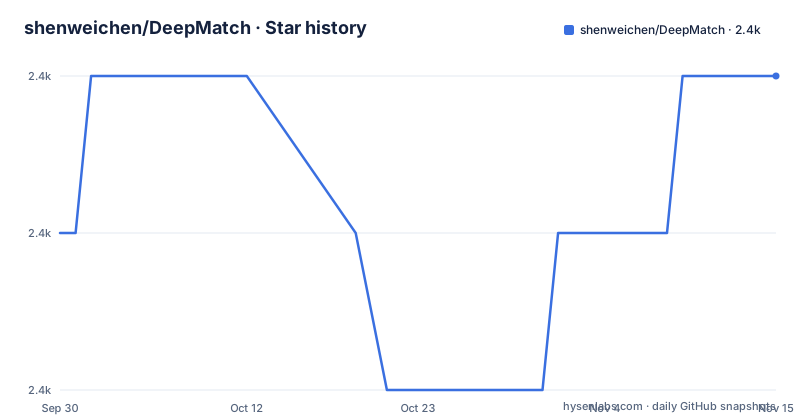
- shenweichen/DeepMatch2,437 ★ · +1
| Repository | 2026-09-30 | 2026-11-15 |
|---|---|---|
| shenweichen/DeepMatch | 2.4k | 2.4k |
1 Stars in the last 46 days, measured from the daily GitHub snapshot. Compare with other projects
Editorial analysis
TensorFlow is missing from REQUIRED_PACKAGES, so the install is two commands
setup.py declares exactly two install requirements: `requests` and `deepctr~=0.9.4`. TensorFlow appears nowhere in that list, which is why the documented install is two separate commands instead of one.
pip install tensorflow
pip install deepmatch
The first line is yours to get right, and the guidance attached to it asks you to match your Python, your NumPy, your CPU or GPU choice, and your operating system before installing. The second line brings in a library that cannot do anything until that build exists. The `~=0.9.4` pin on DeepCTR deserves a closer read: it is a compatible-release specifier, so that sibling library stays inside the 0.9 series and never crosses into 0.10. DeepMatch takes its layers from another project's package rather than vendoring them, and the version of that package gets decided here instead of in your resolver. Two entries in a metadata file, one of which is an entire modeling framework in its own right.
python_requires opens at 3.7 while the h5py guidance stops at 3.9
`setup.py` sets `python_requires=">=3.7"`. The classifier list underneath names 3.7, 3.10, 3.11 and 3.12, which leaves 3.8 and 3.9 sitting inside the declared range without a classifier of their own. The compatibility note in the README opens with a narrower condition: For Python `>=3.9`, DeepMatch and its dependencies allow modern `h5py` releases with `h5py>=3.7.0`.
Put the two together and a gap appears. A resolver running on 3.7 or 3.8 will install the package without complaint and land outside the one sentence that promises modern h5py is acceptable. Nothing in the metadata marks that boundary, so the difference between a defined install and an undefined one is a sentence of prose rather than a requirement you can query. The same paragraph also hands the NumPy decision back to TensorFlow: follow the requirement for your selected release, for example using `numpy<2` when required by TensorFlow. Sound advice, and it also means the version combination you end up with is really a TensorFlow user's version combination.
Seven rows in the model table, five models with runnable examples
The model table carries seven rows: FM, DSSM, YoutubeDNN, NCF, SDM, MIND and COMIREC, each paired with the paper it came from, running from ICDM 2010 to KDD 2020. The `examples/` directory covers five of them. Four notebooks are checked in: `colab_MovieLen1M_ComiRec.ipynb`, `colab_MovieLen1M_DSSM_InBatchSoftmax.ipynb`, `colab_MovieLen1M_SDM.ipynb` and `colab_MovieLen1M_YoutubeDNN.ipynb`. Five plain scripts sit beside them: `run_dssm_inbatchsoftmax.py`, `run_dssm_negsampling.py`, `run_ncf.py`, `run_sdm.py` and `run_youtubednn.py`. FM and MIND have neither a notebook nor a script, so two of the table's rows are name-only inside this repository.
DSSM is the odd one in the other direction. It occupies a single table row while shipping two training regimes, one file per regime, and only the in-batch softmax side received a notebook. Someone reading the table sees one DSSM. Someone reading the directory sees a decision about how negatives are handled, which is precisely what separates those two files. `examples/preprocess.py` and `examples/movielens_sample.txt` are shared across all of them, and the README's Run examples link points at the YoutubeDNN notebook rather than at the scripts.
The private keras namespace is where serialization breaks, and the README says so
The README spends a paragraph on a namespace conflict rather than on model architecture. Its advice: use public `tensorflow.keras` APIs in your own code and examples, and avoid mixing `tensorflow.python.keras` with `tensorflow.keras`, because `tensorflow.python.*` is private TensorFlow API and can break model serialization or optimizer/metric loading across TensorFlow versions.
Two named consequences, and both concern reloading a model rather than training one. DeepMatch's own description makes that the normal case: the library trains models and exports representation vectors for user and item, and those vectors are meant for an ANN search system living somewhere else. All of that assumes a model surviving a save, a process exit, and a load downstream. Serialization is the hand-off point rather than a side concern, and the paragraph names exactly which private path damages which part of a reloaded model, which is more precision than most libraries volunteer on a subject they cannot control.
Three releases, and three and a half years between the last two
Three releases appear in this repository's record. v0.3.0 is dated 2022-07-03, v0.3.1 is dated 2022-10-31, and v0.3.2 is dated 2026-04-18. The span between the first two is a little under four months. The span between the second and the third runs from late 2022 to spring 2026. The version string inside setup.py reads `0.3.2`, which matches the newest tag exactly, so there is no skew between what the packaging metadata claims and what was actually cut.
The last push recorded here is 2026-04-18T05:14:22Z, the same instant as the v0.3.2 release timestamp. The newest commit in this snapshot is therefore the release itself, not work that came after it. The repository is not archived, and the compatibility paragraph about Python 3.9 and `h5py>=3.7.0` reads like part of that same release rather than a later correction. The practical consequence is small but real: if you hit a problem in 0.3.2 there is no newer commit on this branch to compare against, and whatever you patch will be yours to carry.
fit() and predict() produce vectors, and the ANN index is somebody else's job
One sentence sets the boundary, and it is repeated in both the repository description and the packaging metadata: easy to train models and to export representation vectors which can be used for ANN search. Training is in scope. The representation vectors are in scope. The ANN search that consumes them is named as a downstream use rather than a feature.
The top level matches that split. It holds `.github/`, `.gitignore`, `.readthedocs.yml`, `CONTRIBUTING.md`, `LICENSE`, `README.md`, `deepmatch/`, `docs/`, `examples/`, `setup.py` and `tests/`. No index, no serving entry point, and no client library in that list. The programmatic surface described is narrow: `model.fit()` to train, `model.predict()` to produce the vectors, and the README presents that same pair as the way to use any complex model. If the plan was to install DeepMatch and end up with a searchable vector store, the second half of that sentence is yours to build, to operate and to keep running.
entry_points and extras_require are both present and both empty
Two fields in setup.py exist and hold nothing. `extras_require` is empty, and `entry_points` is empty. Together they settle two questions before you get around to asking them. There is no `deepmatch` command to run, so the package is imported and never invoked. And there is no extra target for a GPU build, a CPU build, or any TensorFlow variant, which sits consistently with leaving the framework to you, and also means there is no named thing to install when that decision goes wrong on a machine you cannot rebuild.
Package discovery uses `find_packages` with an exclusion list typed out by hand: `tests`, `tests.models` and `tests.layers`. Those three entries name the test tree explicitly, so test code does not ride along in the wheel, and nothing else is excluded or claimed. The remainder of the repository is documentation and examples, neither of which is importable. `docs/` feeds the site at deepmatch.readthedocs.io through `.readthedocs.yml`, the Quick Start link points there rather than into the tree, and the notebooks under `examples/` expect `movielens_sample.txt` to sit next to them.
Editorial conclusion
DeepMatch earns a place when your training target is a user or item vector for a vector store you already run, and when `deepctr~=0.9.4` collides with nothing else in your environment. Verify three things before committing: which TensorFlow build you will pair with the Python and NumPy you already have, because the package installs cleanly without one; whether you are on Python 3.9 or newer if the `h5py>=3.7.0` statement matters to you, since setup.py still opens at 3.7; and whether your model is one of the five with a runnable example rather than one of the seven rows in the table. Expect no index, no serving layer and no command line. Everything after `model.predict()` is your code.
Frequently asked questions
Which models does DeepMatch include?
Seven, one per row of its model table: FM, DSSM, YoutubeDNN, NCF, SDM, MIND and COMIREC, each paired with the paper it came from, from ICDM 2010 through KDD 2020.
Does installing deepmatch install TensorFlow for me?
No. The required packages are `requests` and `deepctr~=0.9.4`, and the README states that DeepMatch does not pin or install TensorFlow, so a matching build gets installed separately first.
What Python versions does DeepMatch support?
setup.py declares `python_requires=">=3.7"` and carries classifiers for 3.7, 3.10, 3.11 and 3.12. The statement about modern `h5py>=3.7.0` releases is scoped to Python `>=3.9` only.
Does DeepMatch ship an ANN vector search index?
No. It exports representation vectors for user and item that can be used for ANN search, and the top-level tree contains no index, no serving entry point and no search client.
Why does DeepMatch warn against tensorflow.python.keras?
Because `tensorflow.python.*` is private TensorFlow API and can break model serialization or optimizer and metric loading across TensorFlow versions, so the README asks you to stick to public `tensorflow.keras` APIs.
Official sources
Add this badge to your README
If you maintain this project, the badge below links readers to this analysis and shows its maintenance status from the daily GitHub snapshot. Paste the markdown into your README; add ?metric=license or ?metric=stars to the image URL for a different field.

[](https://hysenlabs.com/projects/shenweichen-deepmatch)Star history chart for your README
[](https://hysenlabs.com/projects/shenweichen-deepmatch)Was this useful?