Snorkel: weak supervision as code, unpinned since 2024
A system for quickly generating training data with weak supervision
At a glance
- What is it?
- Snorkel is a Python library for building labeled training data from weak supervision instead of hand labels. The repository is not archived and took a push on 2026-10-13, yet the newest release is still v0.10.0 from 2024-02-27, the README sends new work toward a separate commercial platform, and a plain pip install drags in torch and tensorboard whether or not you need a model.
- Who is it for?
- Adopt Snorkel when you have many noisy labeling rules to combine and you can live with a PyTorch sized dependency set and a Python 3.11 floor. Skip it when the whole job is one text rule, since spaCy's own annotators cover that alone, and skip it for a new project with no patience for an install whose newest tagged build is v0.10.0 from 2024-02-27.
- Can I use it commercially?
- Yes. Apache-2.0 is a permissive licence: you can use, modify and sell software built on it, as long as you keep its copyright and licence notices.
- Is it still maintained?
- Yes. The repository last received commits 41 days ago.
- What is it written in?
- Mainly Python, according to GitHub's language statistics.
Answers come from the project's GitHub data, last synced on November 23, 2026, and from our analysis. They are not legal advice.
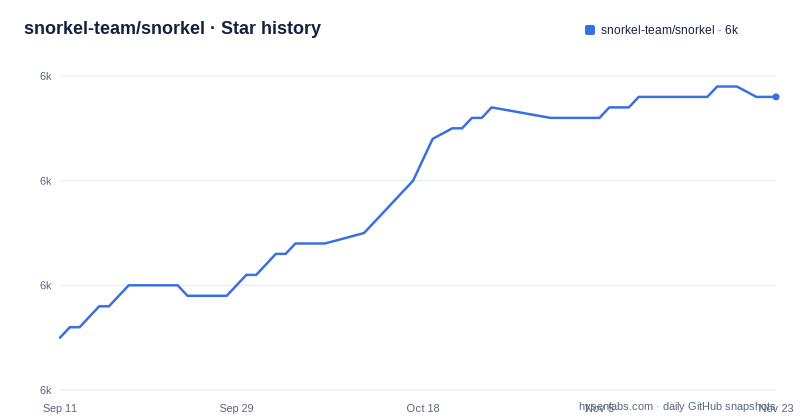
Star history
- snorkel-team/snorkel6,028 ★ · +23
| Repository | 2026-09-11 | 2026-11-23 |
|---|---|---|
| snorkel-team/snorkel | 6k | 6k |
23 Stars in the last 73 days, measured from the daily GitHub snapshot. Compare with other projects
Editorial analysis
Labeling functions and the graph that connects them
The project's own one line description is "A system for quickly generating training data with weak supervision", and the README dates the effort to a Stanford research project started in 2015 whose stated premise was that training data, not models, algorithms or infrastructure, decides whether a machine learning project succeeds or fails. The bet behind it is that labeling can be code instead of a queue of human decisions. Two entries in requirements.txt give the sharpest internal view of what the library does with those rules. `networkx>=2.2` sits under the comment "# LF dependency learning", which points at a graph over the labeling functions you write, and `munkres>=1.0.6` is filed under "Internal models" beside scikit-learn and torch. What none of this tells you is the call you actually type. The getting started section sends you to the Get Started page on snorkel.org and then to the full length tutorials in the snorkel-tutorials repository.
pip install snorkel brings torch and tensorboard with it
The install itself is one line, and it is worth seeing what that line drags in before you run it. Two package managers are offered. `pip install snorkel` is the recommended path and `conda install snorkel -c conda-forge` is the alternative. Underneath, setup.py lists ten install_requires entries, and three of them decide how heavy your environment becomes:
pip install snorkelinstall_requires=[
"munkres>=1.0.6",
"numpy>=1.24.0",
"scipy>=1.2.0",
"pandas>=1.0.0",
"tqdm>=4.33.0",
"scikit-learn>=0.20.2",
"torch>=1.2.0",
"tensorboard>=2.13.0",
"protobuf>=3.19.6",
"networkx>=2.2",
],
python_requires=">=3.11",`torch` is a deep learning framework, `tensorboard>=2.13.0` is its logging companion, and `protobuf>=3.19.6` sits with tensorboard under "Model introspection tools" in requirements.txt. None of the three is marked optional in the metadata. So if your intent is only to turn a handful of heuristics into labels, you still install the training stack, and on a laptop or a small CI runner the download is the part you wait on. That is a cost of the dependency list rather than a defect in the labeling code, but it lands on the first command a new user runs.
The conda snippet pins a 0.9.0 release next to a Python 3.11 floor
The install section states that Snorkel requires Python 3.11 or later, and setup.py agrees with `python_requires=">=3.11"`. The collapsed conda block underneath tells a different story. It asks you to create an environment called snorkel-env on python=3.11, then install pytorch==1.1.0 from the pytorch channel and snorkel==0.9.0 from conda-forge, with a comment saying PyTorch is named there to ensure compatibility but may not be necessary:
# [OPTIONAL] Activate a virtual environment called "snorkel"
conda create --yes -n snorkel-env python=3.11
conda activate snorkel-env

# We specify PyTorch here to ensure compatibility, but it may not be necessary.
conda install pytorch==1.1.0 -c pytorch
conda install snorkel==0.9.0 -c conda-forge
Version 0.9.0 predates both the 3.11 floor and every release the repository lists, where the newest tags are v0.9.8 from 2021-11-19, v0.9.9 from 2022-07-29 and v0.10.0 from 2024-02-27. Pasting those two pin lines into a fresh environment is the quickest route to a solver failure on a current machine, and the block never says which interpreter 0.9.0 supported. Read it as a record of how the project was installed in its earlier years and use the unpinned conda-forge line for anything you intend to run now. The mismatch also tells you something about the docs generally: the page has been patched at the top for 3.11 while the detail underneath kept its old pins.
Windows is documented as limited, with Docker and WSL as the way around
A dedicated note tells Windows users that the project "highly recommend[s] using Docker", pointing at a Dockerfile inside the snorkel-tutorials repository, or the Linux subsystem, and then says plainly: "We've done limited testing on Windows", followed by an invitation to open a pull request with better instructions. The consequences are practical rather than theoretical. A Python 3.11 environment inside WSL means your labeling code executes on the Linux side, so file paths and any Spark work (the tree carries `requirements-pyspark.txt`) have to be written for Linux rather than for the drive letters on the host. Docker adds another layer: your code and its pins live inside the image you build, which also means the environment has to be rebuilt whenever a pin moves.
No tag since v0.10.0 while the branch keeps taking commits
The repository is not archived and its most recent push is dated 2026-10-13, so the branch is not frozen. The releases tell a separate story. v0.10.0 was published 2024-02-27, v0.9.9 on 2022-07-29 and v0.9.8 on 2021-11-19, and nothing newer is tagged. That gap has a direct effect on what you install: `pip install snorkel` hands you v0.10.0, and anything merged to main after February 2024 reaches you only by installing from source, which the install section routes to CONTRIBUTING.md. Your upgrade path therefore depends on commits rather than versions. Pinning stops being a release tag and starts being a commit hash, and a dependency bump can land on main with no version change to announce it, so two machines in the same week can resolve different trees from the same command. The README's announcement section gives its own account of the split, stating that the team is now focusing its efforts on Snorkel Flow, an end to end AI application development platform that carries the core ideas of the open source project into a commercial product. Apache 2.0 covers the code either way, with no copyleft obligation on what you build with it.
check_requirements.py enforces section headers inside requirements.txt
The comment header at the top of requirements.txt is an instruction to contributors: every essential package must sit under a section named '#### ESSENTIAL ...' so that the script `./scripts/check_requirements.py` can find them. The dependency file is therefore a structured document with a test enforcing its shape, not a flat list. Three groups follow, each introduced by a comment that states its purpose. ESSENTIAL LIBRARIES holds numpy, scipy, pandas, tqdm, scikit-learn, torch, munkres, networkx, protobuf and tensorboard. EXTRA/TEST LIBRARIES adds `spacy>=2.1.0` and `blis>=0.3.0` under "(NLP)", `dask[dataframe]>=2020.12.0` and `distributed>=2023.7.0` under "(parallelism)", and `dill>=0.3.0` under "(serialization)". DEV TOOLS closes it out with black, flake8, isort, mypy, pydocstyle, pytest, pytest-cov, pytest-doctestplus and tox. Two pins there deserve a second read if you plan to contribute: `importlib_metadata<5` is capped below version 5 with the comment "necessary for flake8", and `mypy>=0.760` names a floor from 2019. A contributing environment is an older linting stack pinned inside a Python 3.11 project, which is the kind of conflict you resolve in your own environment rather than in the library's requirements.
For text labeling rules, spaCy is already a dependency here
The EXTRA/TEST LIBRARIES group is the closest thing this repository says about alternatives, and it deserves a precise reading. spaCy and blis are pulled in as something Snorkel is tested against, not as something it reimplements, and the difference in approach is concrete. spaCy's rule based annotators are single deterministic matchers over a token sequence: each one returns labels or returns nothing, and you wire them yourself. The subject of Snorkel is the step after that, the aggregation of many noisy sources and the dependencies between them, which is where `networkx>=2.2` and an assignment solver come in. So if your labeling problem is one regex over tokenized text, spaCy's matcher does that job on its own and Snorkel adds a layer you did not ask for. If a dozen people have written a dozen heuristics with different error rates and you need a model to weigh them, that is the case this library is shaped for. Two details about the surrounding set matter as much: dask and distributed are test only, so the parallelism story exists without being promised by the core install, and `requirements-pyspark.txt` sits in the tree as a separate file.
The contribution walkthrough breaks off mid sentence
The README sends you to CONTRIBUTING.md for installing from source and contributing, and the tree shows the rest: CONTRIBUTING.md for the process, `tox.ini` and `setup.cfg` for test configuration, `.circleci/` for the pipeline, `.codecov.yaml` and `.coveragerc` for coverage, `test/` for the suite, and RELEASING.md for the process that produced the tags listed above. `docs/` with `.readthedocs.yml` carries the documentation build, and the badge at the top of the README points at snorkel.readthedocs.io for the master branch, while the default branch of the repository itself is main. For a first real use, the getting started section sends you to a web page and a tutorials repository, which it describes as covering a variety of tasks, domains, labeling techniques and integrations. Expect to learn the API from those tutorials rather than from the project page, and check the issues tracker before assuming a missing snippet is a documentation bug: it says plainly that maintainers may ask for contributions when a fix does not fit the immediate roadmap.
Editorial conclusion
Adopt Snorkel when you have many noisy labeling rules to combine and you can live with a PyTorch sized dependency set and a Python 3.11 floor. Skip it when the whole job is one text rule, since spaCy's own annotators cover that alone, and skip it for a new project with no patience for an install whose newest tagged build is v0.10.0 from 2024-02-27. Before committing, check whether the API you need sits on a released version or only on main, because the repository is not archived but has published no tag since February 2024 while the README states the team's focus has moved to Snorkel Flow.
Frequently asked questions
What does Snorkel do and who is it for?
It describes itself as a system for quickly generating training data with weak supervision. Its own account dates the project to a Stanford research effort that began in 2015 on the premise that training data, rather than models or infrastructure, decides whether a machine learning project succeeds, and the audience is teams that would otherwise label data by hand.
How do I install Snorkel?
It requires Python 3.11 or later. The project recommends `pip install snorkel` or `conda install snorkel -c conda-forge`. On Windows it recommends Docker or the Linux subsystem and states that it has done limited testing on native Windows.
What dependencies come with the snorkel package?
setup.py lists ten install_requires entries: munkres>=1.0.6, numpy>=1.24.0, scipy>=1.2.0, pandas>=1.0.0, tqdm>=4.33.0, scikit-learn>=0.20.2, torch>=1.2.0, tensorboard>=2.13.0, protobuf>=3.19.6 and networkx>=2.2. torch and tensorboard are not marked optional, so they install with the package.
Is the Snorkel repository still being updated?
The repository is not archived and its last push is dated 2026-10-13. The newest release is v0.10.0, published 2024-02-27, before v0.9.9 from 2022-07-29 and v0.9.8 from 2021-11-19, so no tagged build newer than February 2024 exists, and the README announcement states the team's focus has moved to Snorkel Flow.
Where can I find a working Snorkel example?
The README points first to the Get Started page on snorkel.org and then to the full length tutorials in the snorkel-tutorials repository, which it says cover a variety of tasks, domains, labeling techniques and integrations.
Does Snorkel replace hand labeling, and what is its license?
The stated premise is that training data, not models, algorithms or infrastructure, decides whether a machine learning project succeeds, and the goal was to replace what it calls an often entirely manual process of training data creation with programmatic labeling. setup.py declares the package under the Apache License 2.0.
Official sources
Add this badge to your README
If you maintain this project, the badge below links readers to this analysis and shows its maintenance status from the daily GitHub snapshot. Paste the markdown into your README; add ?metric=license or ?metric=stars to the image URL for a different field.

[](https://hysenlabs.com/projects/snorkel-team-snorkel)Star history chart for your README
[](https://hysenlabs.com/projects/snorkel-team-snorkel)Was this useful?