Solace Agent Mesh: an agent platform whose repository now holds Desktop downloads and examples
An event-driven framework designed to build and orchestrate multi-agent AI systems. It enables seamless integration of AI agents with real-world data sources and systems, facilitating complex, multi-step workflows.
At a glance
- What is it?
- Solace Agent Mesh is an agent development and runtime platform that hosts agents, runs their tools and coordinates them over an event broker. Its repository now holds Agent Mesh Desktop downloads and ready-to-run examples, with the source code described as coming soon.
- Who is it for?
- Treat this repository as the place to get Agent Mesh Desktop and its examples, not as source code: the README says the source is coming soon. Install with the script for your platform (preview it with --dry-run first), try the support triage example with `sam config apply`, and plan for a Solace commercial license, Kubernetes or Agent Mesh Cloud before any production use.
- Can I use it commercially?
- Check first. The repository uses a licence we do not classify automatically, so read its LICENSE file before any commercial use.
- Is it still maintained?
- Yes. The repository last received commits 10 days ago.
- What is it written in?
- Mainly Python, according to GitHub's language statistics.
Answers come from the project's GitHub data, last synced on November 15, 2026, and from our analysis. They are not legal advice.
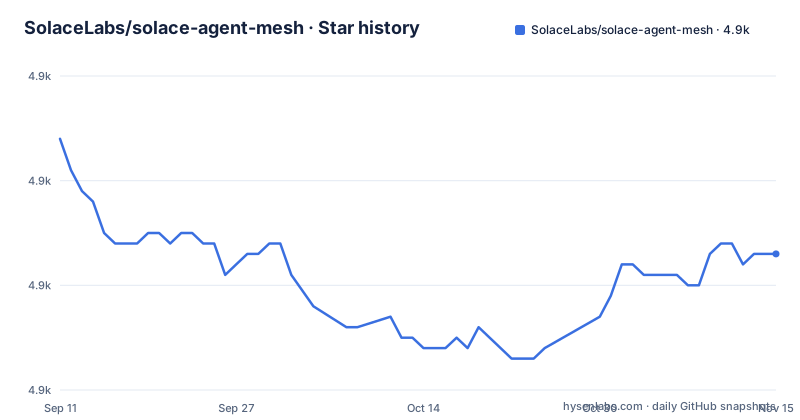
Star history
- SolaceLabs/solace-agent-mesh4,923 ★ · -11
| Repository | 2026-09-11 | 2026-11-15 |
|---|---|---|
| SolaceLabs/solace-agent-mesh | 4.9k | 4.9k |
-11 Stars in the last 65 days, measured from the daily GitHub snapshot. Compare with other projects
Editorial analysis
Desktop downloads and examples in the current repository
The README describes Solace Agent Mesh as an agent development and runtime platform that hosts the agents you build, runs the tools they call, and coordinates everything over an event broker. A note says the source code is coming to this repository soon; until then it holds Agent Mesh Desktop downloads and ready-to-run examples. The repository is not archived, the last push was on 2026-10-23, and the newest release is v2.455.0 (2026-10-22), after 1.28.8 (2026-08-28) and 1.28.7 (2026-08-11).
Three layers: ADK logic, a SAC host, Solace as transport
The README says the platform supports the full agent development lifecycle (build, test, deploy, monitor, and improve agents and business process workflows), with sessions, artifacts, authentication, evaluators, and observability built in.
Discovery is automatic, delegation is the Orchestrator's job
The `examples` directory contains use cases that you apply to Agent Mesh with `sam config apply`. In the support ticket triage example, a customer creates a ticket in the fictional Acme Help Desk, and Agent Mesh classifies the issue, calculates the response deadline, drafts the first reply, escalates the ticket if it is urgent, and writes the result back to the ticket. The README says the examples are for learning and evaluation and are not production-ready.
Gateways decide who is allowed to talk to the mesh
Agent Mesh Desktop includes the `sam` CLI. On Windows the installer places `sam.exe` in `%LOCALAPPDATA%\Programs\Solace Agent Mesh\cli` and the install script adds that folder to your user `PATH`; on macOS and Linux you create an alias. The `sam ai-assistance` and `sam config` commands are Early Access, so their commands, flags, and output may change between releases.
Install assumes a clean machine and refuses in-place upgrades
Agent Mesh Desktop is free and runs as a single application. On macOS and Linux:
curl -fsSL https://raw.githubusercontent.com/SolaceProducts/solace-agent-mesh/main/install/install.sh | shOn Windows, in PowerShell:
irm https://raw.githubusercontent.com/SolaceProducts/solace-agent-mesh/main/install/install.ps1 | iexIt runs on macOS 11 (Big Sur) and later, Windows 10 and later (x86_64), and Linux (Experimental). Before installing, the script checks the download against the SHA-256 checksum of the release asset and verifies the Apple notarization on macOS or the Authenticode signature on Windows. To preview without installing, pass `--dry-run` (through `sh -s --` on macOS and Linux) or set `$env:SAM_INSTALL_DRY_RUN=1` on Windows.
Capabilities are YAML, extensions are plugins
Configuration goes through a manifest: `sam config plan -m manifest.yaml` previews a change and `sam config apply -m manifest.yaml` applies it to a running Agent Mesh instance. `sam ai-assistance skill install` installs skills for AI coding assistants, written to .agents/skills/ by default, with `--target claude` for Claude Code.
The dependency list is a CVE ledger frozen in the manifest
pyproject.toml pins almost everything exactly, and several pins carry a comment naming the advisory they answer. mcp is held at 1.28.1 for CVE-2026-59950, CVE-2026-52870 and CVE-2026-52869, click at 8.3.3 for CVE-2026-7246, idna at 3.15 for CVE-2026-45409, jwcrypto at 1.5.7 for CVE-2026-39373, pyjwt at 2.13.0 or newer for CVE-2026-48526 because it rejects JWK JSON passed as an HMAC secret, and python-liquid at 2.2.1 for CVE-2026-55865, a denial of service through a malformed case tag that loops at parse time. Two of those lines in full:
"mcp==1.28.1",  # [CVE-2026-59950, CVE-2026-52870, CVE-2026-52869] Security fix: pins transitive dep (from google-adk) to 1.28.1
"click==8.3.3",  # [CVE-2026-7246] Security fix
Read as a snapshot of a security-conscious release, this is careful work. The Python manifest marks its package as inactive, while the current README describes Desktop downloads and examples and says source code is forthcoming. These historical pins should not be assumed to describe the Desktop application's complete current dependency set; inspect the specific release you deploy. The build backend is capped below hatchling 1.32 with a comment about core metadata 2.5 being rejected by current PyPI upload tooling.
Three Node stages build two front ends before Python runs
The repository does not accept issues or pull requests. Questions and feature requests go to the Solace Community, and bugs and security vulnerabilities are reported by email to [email protected].
Editorial conclusion
Treat this repository as the place to get Agent Mesh Desktop and its examples, not as source code: the README says the source is coming soon. Install with the script for your platform (preview it with --dry-run first), try the support triage example with `sam config apply`, and plan for a Solace commercial license, Kubernetes or Agent Mesh Cloud before any production use.
Frequently asked questions
What is Solace Agent Mesh?
An agent development and runtime platform that hosts the agents you build, runs the tools they call, and coordinates everything over an event broker, with sessions, artifacts, authentication, evaluators, and observability built in.
Where is the Solace Agent Mesh source code?
The README says the source code is coming to this repository soon; until then it holds Agent Mesh Desktop downloads and ready-to-run examples. The repository is not archived; the last push was 2026-10-23 and the newest release is v2.455.0 from 2026-10-22.
What do I need before installing Solace Agent Mesh locally?
Agent Mesh Desktop runs on macOS 11 (Big Sur) and later, Windows 10 and later (x86_64), and Linux (Experimental). You install it with the install script for your operating system and connect an LLM the first time you open the application.
Can I preview the Agent Mesh Desktop install?
Yes. Run the install script with `--dry-run`, passing it through `sh -s --` on macOS and Linux, or set `$env:SAM_INSTALL_DRY_RUN=1` on Windows.
What do the Solace Agent Mesh examples show?
The examples directory holds use cases applied with `sam config apply`, such as support ticket triage for the fictional Acme Help Desk. The README says they are for learning and evaluation and are not production-ready.
Can Agent Mesh Desktop be used in production?
No. Desktop is for building and testing on your own computer; production use requires a Solace commercial license and a deployment to Kubernetes or Agent Mesh Cloud.
Official sources
Add this badge to your README
If you maintain this project, the badge below links readers to this analysis and shows its maintenance status from the daily GitHub snapshot. Paste the markdown into your README; add ?metric=license or ?metric=stars to the image URL for a different field.

[](https://hysenlabs.com/projects/solacelabs-solace-agent-mesh)Star history chart for your README
[](https://hysenlabs.com/projects/solacelabs-solace-agent-mesh)Was this useful?