Nothing Archive, a community index of firmware, OTA images and phone tools
Nothing Community Apps & Projects Index • Nothing OS Firmware Archive • OTA Updates & Changelogs for Nothing Phones & CMF By Nothing Phones • Tools for Nothing Glyph LED & Glyph Matrix • Windows, macOS & Linux Tools • Nothing Phone Unbrick • Nothing Ear & CMF Buds Tools • Official Resources • Kernel Sources • Rooting, Unrooting & Technical Guides
At a glance
- What is it?
- Nothing Archive is an open source, community-driven index for the Nothing and CMF ecosystem, cataloguing device specifications, direct OTA download links, archived stock factory images and technical guides for unlocking, rooting and recovery. The interesting part is the licensing structure, which splits the compilation from the OEM material it points at.
- Who is it for?
- Nothing Archive suits a Nothing or CMF phone owner who missed a firmware build, lives in a region where the OTA rollout was staggered, or wants the changelog for a version they cannot easily find, since the archive indexes direct links and keeps a chronological database of release notes.
- Can I use it commercially?
- Check first. The repository uses a licence we do not classify automatically, so read its LICENSE file before any commercial use.
- Is it still maintained?
- Yes. The repository last received commits 2 days ago.
- What is it written in?
- Mainly TypeScript, according to GitHub's language statistics.
Answers come from the project's GitHub data, last synced on November 6, 2026, and from our analysis. They are not legal advice.
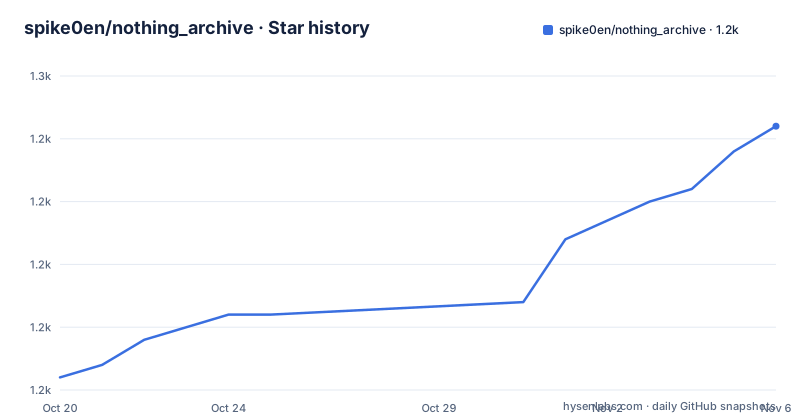
Star history
- spike0en/nothing_archive1,246 ★ · +20
| Repository | 2026-10-20 | 2026-11-06 |
|---|---|---|
| spike0en/nothing_archive | 1.2k | 1.2k |
20 Stars in the last 17 days, measured from the daily GitHub snapshot. Compare with other projects
Editorial analysis
An index, not a tool, and the difference matters
Nothing Archive describes itself as the largest open-source, community-driven index and archive for the Nothing and CMF ecosystem, featuring Nothing OS firmware, OTA updates, community-built apps and projects, hardware customization tools, official developer resources and detailed guides.
The word index is the one to hold on to. The repository's top level is a website directory, a scripts directory, a bin directory, assets, a README, a CONTRIBUTING.md and two licence files. The website holds the documentation, and each documentation page has a workspace source file, for example website/docs/devices.md for the device catalog and website/docs/guides.md for the guides. So the substance is markdown and the tooling around it, not code you would call.
The sections are grouped as core pillars. The Devices Catalog is a detailed catalog of Nothing and CMF products with hardware specifications, codename mappings and release dates. Firmware and Delta OTAs gives direct download links for sideloading incremental and full OTA updates sourced from official OEM servers, bypassing staggered regional rollouts. Stock Factory Images are unmodified stock OTA partition images archived for supported phone models, obtained by extracting and reconstructing base and incremental OTA updates through an automated pipeline. Nothing OS Changelogs is a complete chronological database of official release notes, system changes, bug fixes and security patches for every Nothing and CMF phone model.
Then the more hands-on sections. Technical Guides covers step-by-step guides for critical technical operations, including bootloader unlocking, custom ROM installation, partition backups, rooting and device recovery. Official OEM Resources is a curated collection of official Nothing apps, wallpapers, system fonts, kernel sources, 3D product models and user manuals. Community Apps and Projects is a directory of community-developed applications, Glyph LED integrations, custom widgets, utilities, flashing toolkits and wearable scripts. And Camera Configs and Mods covers stable Google Camera ports, custom community-made XML configurations, stock presets and custom LUTs optimized for Nothing's camera hardware.
The site is at nothingarchive.tech, the last push was on 2026-10-15, and the default branch is main.
The licensing structure, which is the most careful part
Nothing Archive employs a multi-license structure to protect the original work of contributors, respect third-party intellectual property and prevent legal liabilities. The three-part split is worth reading closely, because it explains the shape of the whole project.
The first part covers the project effort and database compilation, licensed under CC BY-NC 4.0. The reasoning is spelled out: while the underlying links are publicly available, the curated compilation database, structured tables, device codename mappings, extraction indices and custom flashing and recovery guides represent original research, maintenance and self-hosted pipeline development. So the data is the work, and the data is non-commercial.
The second part covers OEM firmware and official resources, which remain the exclusive proprietary intellectual property of Nothing Technology Limited or their partners. All indexed firmware payloads, OTA update links distributed by GMS and Google servers, official system APKs, system fonts, device wallpapers, 3D models and user manuals are mirrored and indexed solely for non-commercial community recovery and archival purposes under Fair Use.
The third part covers community projects and third-party apps, and the visible text is cut off mid-sentence in the source, but the shape is clear from the two preceding clauses: each project keeps its own licence and the index does not claim it.
There is a LICENSE file and a LICENSE-MIT file in the repository root, and the README badge shows both CC BY-NC 4.0 and MIT, which is how a single project carries a Creative Commons licence for its data and a permissive licence for the code.
For a reader this is the most informative part of the README, because it tells you what kind of project this is. It is an index maintained by people who wanted a single place to look, and the licence structure is the author's attempt to make that sustainable without claiming ownership of anything the OEM or the community built. The recent release tags are community ROMs rather than releases of this repository, with names like Metroid_C5.0-260924-2115, Tetris_B4.1-260928-1140 and Pacman_B4.1-260928-1157, all dated in October 2026, which suggests the repository's own release workflow publishes whatever custom builds the community has produced.
The devices catalog, and why codenames are the join key
The Devices Catalog is the foundation every other section hangs off, and its description is specific: a detailed catalog of Nothing and CMF products, detailing hardware specifications, codename mappings and release dates.
Codename mappings are the part that makes the rest work. Nothing OS builds are delivered per device and a build is identified by a codename rather than a marketing name, so a changelog entry, an OTA package and a recovery guide all have to be matched to the same internal name. The archive keeps that mapping in one table, which means a reader who has a filename in their downloads folder can find the right documentation for it, and a reader looking for a device can find the codename to search for.
The release dates in the same table serve a second purpose. A Nothing phone spans several years of updates, and the archive's changelog section claims a complete chronological database of official release notes, system changes, bug fixes and security patches for every Nothing and CMF phone model. Matching a security patch note to the date it shipped, and the date to the device, is what turns a changelog list into something you can act on after an update goes out.
The same reasoning appears in the community sections. The community apps and projects index covers Glyph LED integrations, custom widgets, utilities, flashing toolkits and wearable scripts, and the Glyph category is specific to Nothing hardware because the programmable light strips on the back of the phones are what those projects talk to. The wearable scripts cover the Nothing Ear and CMF Buds.
The repository description also lists Windows, macOS and Linux tools and Nothing Phone unbrick alongside the rest, which tells you the archive extends beyond the phone itself to the tooling people use on their computers to work with it.
The contribution rules, and why the firmware files are closed
The contribution guidelines section exists because this is a curated database rather than a free-form collection, and the README is explicit that several files are restricted to automated updates.
The table of categories and scope is short. The Device Catalog is open, as is Community Initiatives Indexing with apps.md and projects.md, Official Resources with official.md, and Guides with guides.md and photography.md. Firmware and Changelogs is marked restricted, automated, covering firmware.md and the changelogs/ directory.
The reasoning is practical rather than bureaucratic. The firmware files are generated by the pipeline that extracts and reconstructs the OTA images, so a hand edit would be overwritten by the next run and would desynchronise the archive from the source. The same applies to the changelog database, which is a chronological extract of official release notes.
Everything else is open, which means a contributor who has written a better rooting guide, or catalogued a device that is missing, or listed a community app that nobody has indexed yet, can add it directly. The README asks contributors to read the CONTRIBUTING.md before creating a pull request, to ensure compliance with sorting rules, casing conventions and spacing standards, which is a reasonable ask for a table-driven set of documents.
The site navigation points to an Explore Hub, a Firmware Archive, Guides and a Telegram community, so the repository is the source and the site is where the content is browsed. The community link points at a Telegram channel, NothingTechCommunity, which is where the sort of person who finds a missing firmware build would go.
For anyone using the archive, the practical question is whether the phone is in the catalogue at all. Everything in the archive is organised by device, and a device that is not listed is a device for which none of the firmware, the changelog or the guides will help.
Editorial conclusion
Nothing Archive suits a Nothing or CMF phone owner who missed a firmware build, lives in a region where the OTA rollout was staggered, or wants the changelog for a version they cannot easily find, since the archive indexes direct links and keeps a chronological database of release notes. It is the wrong tool if you need a device that is not in the catalogue, and it is the wrong tool if you want the tooling itself, because the repository is mostly documentation and links rather than the flashing utilities it points at. Before relying on a firmware link, read the licensing section, since the project is careful to claim only the compilation and to leave the OEM firmware as the property of Nothing Technology Limited, and check the contribution rules, because the firmware and changelog files are restricted to automated updates and will not accept a pull request.
Frequently asked questions
What is Nothing Archive?
An open-source, community-driven index and archive for the Nothing and CMF ecosystem, covering Nothing OS firmware and OTA updates, community apps and projects, hardware customization tools, official developer resources and technical guides. The site is at nothingarchive.tech.
What does Nothing Archive provide for firmware?
Direct download links for sideloading incremental and full OTA updates sourced from official OEM servers, bypassing staggered regional rollouts, plus unmodified stock OTA partition images archived for supported phone models, obtained by extracting and reconstructing base and incremental OTA updates through an automated pipeline.
How is Nothing Archive licensed?
It uses a multi-licence structure. The project effort and the database compilation are under CC BY-NC 4.0, because the curated tables, device codename mappings, extraction indices and custom guides are original work. OEM firmware and official resources remain the proprietary intellectual property of Nothing Technology Limited and are indexed solely for non-commercial community recovery and archival purposes under Fair Use. The repository root carries both a LICENSE file and a LICENSE-MIT file.
Can I contribute firmware or changelog entries?
Not directly. The contribution table marks Firmware and Changelogs as restricted to automated updates, covering firmware.md and the changelogs/ directory, because those files are generated by the extraction pipeline. The device catalog, the community apps and projects index, the official resources, the guides and the photography docs are all open to pull requests.
What technical guides does Nothing Archive include?
Detailed step-by-step guides covering critical technical operations including bootloader unlocking, custom ROM installation, partition backups, rooting and device recovery, plus a camera section with stable Google Camera ports, community-made XML configurations, stock presets and custom LUTs for Nothing's camera hardware.
Official sources
Add this badge to your README
If you maintain this project, the badge below links readers to this analysis and shows its maintenance status from the daily GitHub snapshot. Paste the markdown into your README; add ?metric=license or ?metric=stars to the image URL for a different field.

[](https://hysenlabs.com/projects/spike0en-nothing-archive)Star history chart for your README
[](https://hysenlabs.com/projects/spike0en-nothing-archive)Was this useful?