Spring Data MongoDB for Java repository and template access
Provides support to increase developer productivity in Java when using MongoDB. Uses familiar Spring concepts such as a template classes for core API usage and lightweight repository style data access.
At a glance
- What is it?
- Spring Data MongoDB gives Java applications a Spring-style programming model for MongoDB, including POJO mapping, template-based access, and lightweight repository interfaces. It is most suitable for applications already using Spring that want MongoDB without designing a separate persistence layer from scratch.
- Who is it for?
- Spring Data MongoDB is a sensible choice for Java teams building Spring applications around MongoDB and willing to accept its repository and mapping conventions. It is less suitable for applications that need direct driver control, have no Spring dependency, or require behavior outside the documented abstraction.
- Can I use it commercially?
- Yes. Apache-2.0 is a permissive licence: you can use, modify and sell software built on it, as long as you keep its copyright and licence notices.
- Is it still maintained?
- Yes. The repository last received commits 3 days ago.
- What is it written in?
- Mainly Java, according to GitHub's language statistics.
Answers come from the project's GitHub data, last synced on November 7, 2026, and from our analysis. They are not legal advice.
Star history
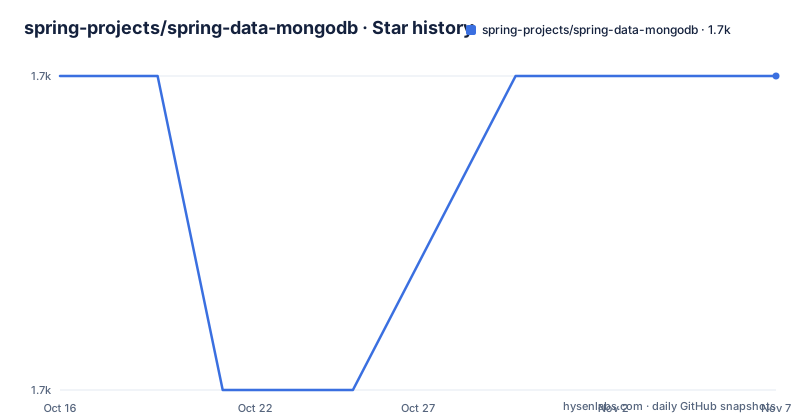
- spring-projects/spring-data-mongodb1,687 ★ · +0
| Repository | 2026-10-16 | 2026-11-07 |
|---|---|---|
| spring-projects/spring-data-mongodb | 1.7k | 1.7k |
0 Stars in the last 22 days, measured from the daily GitHub snapshot. Compare with other projects
Editorial analysis
What Spring Data MongoDB Adds to MongoDB
Spring Data MongoDB addresses the programming-model gap between MongoDB and Spring applications. MongoDB stores data as documents, while Java applications commonly work with ordinary Java objects. The project provides a POJO-centric model for interacting with a MongoDB Document, plus repository-style data access that follows familiar Spring conventions.
The target audience is developers building Spring-powered applications that use MongoDB as a document database. It is also relevant to teams that want a shared data access approach across services, because Spring Data supplies consistent abstractions while retaining MongoDB-specific capabilities. The README does not claim that the library removes the need to understand MongoDB queries, indexes, transactions, or document design. Those database concerns remain separate from the Java integration layer.
The main entry points are the repository abstraction and the template classes. A repository can handle common operations through `CrudRepository`, while template-based access provides a more direct route for application code that needs to work with MongoDB data without relying on a generated repository method. The choice between these approaches affects how much query behavior remains visible in the Java code.
Repository Interfaces and MongoDB Configuration
The README's example defines a repository by extending `CrudRepository<Person, Long>`. Spring Data derives the data access methods from the interface name and parameter types. The example includes `findByLastname` and `findByFirstnameLike`, which correspond to common MongoDB query conditions expressed through method naming.
Repository scanning is enabled with `@EnableMongoRepositories`. The example configuration extends `AbstractMongoClientConfiguration` and supplies the database name through `getDatabaseName()`. This separates configuration of the MongoDB client integration from the repository interface itself. The service receives the repository through its constructor, then calls `save`, `findByLastname`, and `findByFirstnameLike`.
The data flow is straightforward at the application level. Java code passes a `Person` object to `repository.save`, or passes a string to a finder method. Spring Data translates the operation into MongoDB access and maps the returned documents into `Person` objects. The README does not provide enough detail to describe the internal converter implementation, query construction stages, or client settings, so those mechanisms should not be inferred from this example.
Maven Installation and a First Repository Operation
The README documents Maven installation through the `spring-data-mongodb` dependency. The `${version}` placeholder must be replaced with a version compatible with the rest of the Spring application. The README also provides a snapshot repository configuration for snapshots of an upcoming major version, but it does not specify a release version to use for a normal production application.
Add the dependency to the Maven project:
<dependency>
  <groupId>org.springframework.data</groupId>
  <artifactId>spring-data-mongodb</artifactId>
  <version>${version}</version>
</dependency>
The first application code can follow the repository example. This interface declares a MongoDB-backed repository for `Person` records:
public interface PersonRepository extends CrudRepository<Person, Long> {
  List<Person> findByLastname(String lastname);
  List<Person> findByFirstnameLike(String firstname);
}
Enable repository scanning and configure the database name in the application configuration:
@Configuration
@EnableMongoRepositories
class ApplicationConfig extends AbstractMongoClientConfiguration {
  @Override
  protected String getDatabaseName() {
    return "springdata";
  }
}
The service can then save and retrieve people through the injected repository:
@Service
public class MyService {
  private final PersonRepository repository;

  public MyService(PersonRepository repository) {
    this.repository = repository;
  }

  public void doWork() {
    repository.deleteAll();

    Person person = new Person();
    person.setFirstname("Oliver");
    person.setLastname("Drotbohm");
    repository.save(person);

    List<Person> lastNameResults = repository.findByLastname("Drotbohm");
  }
}
The application must also provide a reachable MongoDB deployment and the Spring client configuration required by the application. The README points to `start.spring.io` for creating a Spring Boot project with MongoDB support. It also links to the `Accessing Data with MongoDB` guide for a basic application setup and the `Accessing MongoDB Data with REST` guide for a REST service built on repositories.
Repository Abstraction Versus Template Access
Spring Data MongoDB offers two visible styles of access. The repository style keeps persistence calls behind an interface such as `CrudRepository`. This is useful when an application wants common create, read, update, and delete operations with method-derived queries. The repository contract also makes the data access dependency easy to inject into a service.
Template classes are intended for core API usage. The project description names template classes as part of the integration, but the README excerpt does not show a template class, method signature, or query example. Therefore, the exact API surface should be confirmed in the reference documentation or Javadocs before designing code around it. A template-based design is likely to be relevant when a repository-derived method cannot express the intended query cleanly, but the README does not establish that boundary in detail.
This distinction is a design decision rather than a performance guarantee. The repository does not publish benchmark results or claim that either access style is faster. Choosing between them should depend on the query, the amount of MongoDB-specific behavior the application needs, and how much abstraction the service layer should own.
Snapshot Releases, Upgrades, and Compatibility Boundaries
The README identifies both released artifacts and snapshots. For snapshots of an upcoming major version, it directs users to the Maven snapshot repository and uses a `${version}-SNAPSHOT` dependency value. That configuration is intended for development against an upcoming major version, not a documented production default. The project also links to the Spring Data Commons wiki for upgrade instructions and release notes.
The repository layout includes Maven wrapper files, `pom.xml`, the `spring-data-mongodb` module, and a `spring-data-mongodb-distribution` directory. This indicates a multi-module Maven project, although the README does not give a complete source build procedure or enumerate all build prerequisites. It does say that binaries are available from Maven Central, so building from source is not required for normal consumption.
Maintenance information is positive but bounded. The repository is not archived, and its last push was on 2026-10-14. Recent releases include `5.2.0-M2` on 2026-09-24, `5.2.0-M1` on 2026-08-21, and `5.1.1` on 2026-08-21. The presence of milestone releases means that the version line may have pre-release artifacts alongside a maintenance release. Upgrade planning should use the linked release notes rather than assuming that all Spring Data modules share identical compatibility constraints.
License, Support, and Practical Limits
The repository identifies its license as Apache-2.0. That is a licensing designation for the project source, not a substitute for reviewing the complete license file and any dependency licenses used by an application. The repository contains `LICENSE.txt`, and the README does not provide legal interpretation or warranty terms beyond pointing to the project's licensing information.
The clearest limitation is abstraction scope. The README does not document transaction boundaries, write concerns, read preferences, indexes, aggregation pipelines, schema validation, or the full set of MongoDB query operators. Those omissions mean that the library should not be treated as a complete MongoDB feature reference. A developer may need the underlying MongoDB client or template APIs for behavior outside the documented repository methods.
There is also no documentation in the README for rollback procedures, migration compatibility, connection-pool tuning, or production deployment. The project's support path points to the reference documentation, Javadocs, Spring guides, Stack Overflow questions tagged `spring-data-mongodb`, and the GitHub issue tracker. The issue instructions ask for the Spring Data version, JVM version, stack trace, and, ideally, a complete minimal reproducible example. Those details are the first evidence to collect when reporting a problem.
Editorial conclusion
Spring Data MongoDB is a sensible choice for Java teams building Spring applications around MongoDB and willing to accept its repository and mapping conventions. It is less suitable for applications that need direct driver control, have no Spring dependency, or require behavior outside the documented abstraction. Before adoption, verify compatibility between the selected Spring Data MongoDB release and the Spring Framework, Spring Boot, Java, and MongoDB versions used by the application. The repository's last push was on 2026-10-14.
Frequently asked questions
How do I add Spring Data MongoDB to a Maven project?
Add the `org.springframework.data:spring-data-mongodb` dependency with a chosen `${version}` value. For snapshots of an upcoming major version, the README also documents the Spring snapshot repository and a `${version}-SNAPSHOT` dependency.
How do I create a repository for a MongoDB document in Spring Data MongoDB?
Define an interface that extends `CrudRepository<Person, Long>`, then enable repository scanning with `@EnableMongoRepositories`. The README example obtains the database name from `AbstractMongoClientConfiguration`.
Does Spring Data MongoDB provide template-based access as well as repositories?
The project description names template classes for core API usage, while the README example focuses on repository interfaces. The README excerpt does not include a template example, so the exact API should be checked in the reference documentation or Javadocs.
Official sources
Add this badge to your README
If you maintain this project, the badge below links readers to this analysis and shows its maintenance status from the daily GitHub snapshot. Paste the markdown into your README; add ?metric=license or ?metric=stars to the image URL for a different field.

[](https://hysenlabs.com/projects/spring-projects-spring-data-mongodb)Star history chart for your README
[](https://hysenlabs.com/projects/spring-projects-spring-data-mongodb)Was this useful?