Day1Global-Skills: finance checklists handed to an AI agent
Day1Global Finance Skills Share: US Stock, Macro Market, Crypto
At a glance
- What is it?
- Five skills, five directories and a matching .skill file each, covering earnings deep dives, value investing, market sentiment, macro liquidity and Bitcoin cycle timing. There is no code here. The value is in the structure of the analysis, the scoring schemes and the evidence tiers, and the risk is that a model with these instructions will produce a confident memo.
- Who is it for?
- Day1Global-Skills fits a team that wants a repeatable structure for its investment research, that has settled on using an agent to draft the memo and has kept a human in the loop, and that values the explicit scoring and the evidence tiers. It is the wrong tool for a model without market data access, because the skills structure the reasoning and do not supply the numbers, and it is the wrong tool for anybody who treats the output as advice rather than as a draft.
- Can I use it commercially?
- Yes. MIT is a permissive licence: you can use, modify and sell software built on it, as long as you keep its copyright and licence notices.
- Is it still maintained?
- Yes. The repository last received commits 82 days ago.
- What is it written in?
- GitHub does not report a main language for this repository.
Answers come from the project's GitHub data, last synced on November 7, 2026, and from our analysis. They are not legal advice.
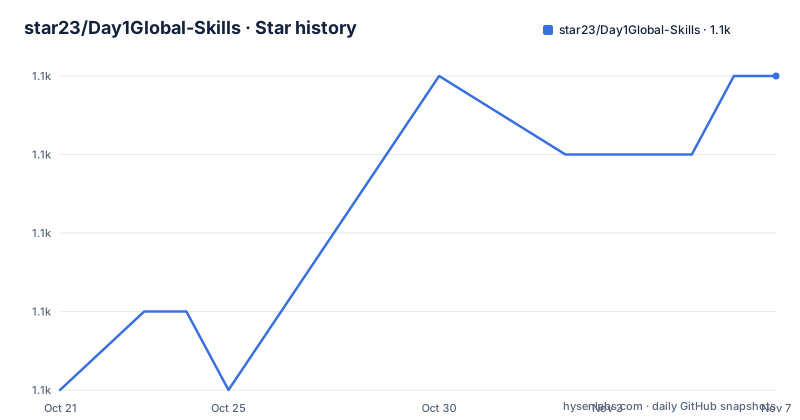
Star history
- star23/Day1Global-Skills1,064 ★ · +4
| Repository | 2026-10-21 | 2026-11-07 |
|---|---|---|
| star23/Day1Global-Skills | 1.1k | 1.1k |
4 Stars in the last 17 days, measured from the daily GitHub snapshot. Compare with other projects
Editorial analysis
What a skill pack is, file by file
The repository is a set of analysis instructions for AI agents, and the layout says everything about how it works.
There are five skills, and each one is a directory paired with a file of the same name ending in `.skill`: `tech-earnings-deepdive`, `us-value-investing`, `us-market-sentiment`, `macro-liquidity` and `btc-bottom-model`. The `Examples/` directory holds the output the authors expect, PDF reports in both Chinese and English for several tickers, including a Circle valuation update, a Robinhood deep dive, an Nvidia research report from March 2026 and a Rocket Lab deep dive.
The pairing of a directory and a `.skill` file is the packaging convention that makes the thing installable, and the install behaviour is described in the README. With the skills.sh route, the skills are installed to `.agents/skills/` and activate automatically when matching topics are detected in conversation. With the Claude Code route, the skill directories are copied into `.claude/skills/` and become slash commands, invoked as `/btc-bottom-model` or `/us-value-investing`.
The activation model is the part that decides how useful this is in practice. An agent that carries these instructions does not need to be told to use them, it recognises a question about an earnings report or about liquidity and loads the relevant analysis. That is a different thing from a prompt you paste by hand, and for a research workflow where the same kinds of question come up every week, the difference is the whole value proposition.
The project is MIT licensed, the homepage is day1global.xyz, the default branch is `main`, and the last push was on 2026-08-18. There are no releases, and the primary language of the repository is not reported, because there is no code in it.
Two installation routes, and a restart either way
The installation instructions are short, and the difference between the two routes is which agent you are using.
The first route is automatic discovery:
npx skills add https://github.com/star23/Day1Global-Skills --allThe skills land in `.agents/skills/` and activate on their own when the agent detects a matching topic. No further configuration is needed after that; the README says to simply ask the agent questions in natural language.
The second route is for the slash command style. The repository is cloned and the skill directories are copied into the project's `.claude/skills/` directory:
git clone https://github.com/star23/Day1Global-Skills.git

mkdir -p your-project/.claude/skills
cp -r Day1Global-Skills/btc-bottom-model your-project/.claude/skills/
cp -r Day1Global-Skills/us-value-investing your-project/.claude/skills/
Copying to `~/.claude/skills/` instead gives access across every project, and after copying you restart Claude Code and can use the skills as slash commands.
Two practical details are worth planning for. The first is that the per-skill copy is explicit, so a project that wants one skill does not get the other four, and the README shows exactly one copy line per skill for that reason. The second is the restart, which sounds trivial and is the step people miss, because the skills are discovered at startup rather than watched for changes.
Nothing in either route installs a package or pulls a dependency. The content is text, and installing it is a copy of directories, which is the simplest possible supply chain story and also the simplest possible update story.
The earnings skill is sixteen modules and six philosophies
The tech-earnings-deepdive skill is the largest of the five, and it is worth reading as a template rather than as an analysis method, because that is what it is.
It is described as a comprehensive tech stock earnings analysis and multi-perspective investment memo system, version 3.0, and its first move is to pinpoint one to three decisive forces that determine the company's future value. From there it runs 16 analysis modules, lettered A to P: revenue quality, profitability, cash flow, forward guidance, competitive landscape, core KPIs, products and new businesses, partner ecosystem, executive team, macro and policy impact, valuation models, ownership distribution, long-term monitoring variables, R&D efficiency, accounting quality and ESG screening.
The second axis is six investment philosophies, each attached to a named set of investors: Quality Compounder for Buffett and Munger, Imaginative Growth for Baillie Gifford and ARK, Fundamental Long-Short for Tiger Cubs, Deep Value for Klarman and Marks, Catalyst-Driven for Tepper and Ackman, and Macro Tactical for Druckenmiller. The point of running the same company through six lenses is to make disagreement visible, and the skill has a dedicated step for that, the variant view, which is to identify blind spots in the market consensus.
The valuation step is a matrix rather than a single method: Owner Earnings, PEG, Reverse DCF, Magic Formula, EV/EBITDA, and EV/Revenue combined with the Rule of 40.
And then the part that makes it a research discipline rather than a prompt: the anti-bias framework, with six cognitive trap self-checks, seven financial red flags, five tech-specific blind spots and a Pre-Mortem analysis, followed by actionable decisions with an Action Price, a position sizing cadence, add, trim and exit triggers, and a long-term monitoring checklist. A memo that ends with an exit trigger is a memo you can hold somebody to later, which is a different object from an essay about a company.
The other three are small, scored models
The remaining skills are much smaller than the earnings one, and they share a shape: a small number of named inputs, a scoring rule and a rating.
us-value-investing evaluates a listed company through four dimensions using Buffett-style methods. They are ROE sustainability, which wants three or more years of consistent returns on equity, debt safety, assessed from the debt-to-asset ratio and the debt load, free cash flow quality, measured as the ratio of free cash flow to net income, and the economic moat, which covers brand, network effects, cost advantage and switching costs. Each dimension scores 0 to 3 points for a maximum of 12, and the ratings are A for 10 to 12, B for 7 to 9, C for 4 to 6 and D for 0 to 3.
us-market-sentiment monitors the market through five indicators to place greed and fear: the NAAIM Exposure Index, which is active fund manager equity exposure, institutional equity allocation as the global institutional portfolio allocation, retail net buying as the daily retail investor fund flows, the S&P 500 forward P/E against its historical range, and hedge fund leverage taken from prime brokerage borrowing multiples.
macro-liquidity tracks what the skill calls the water level in the global financial system, with four indicators: Fed net liquidity, defined as Fed total assets minus TGA minus ON RRP, the SOFR rate as a measure of overnight funding stress, the MOVE index as Treasury market volatility, and the yen carry trade signals from USDJPY and the US-Japan yield spread.
The scoring is the interesting design choice. A skill that asks the agent to analyse and then write a view produces prose, and prose is hard to compare between quarters. A skill that produces a number out of a fixed rubric produces something that can be tracked, and the example prompts in the README reflect that, asking whether the market is overheating right now and whether to reduce positions rather than asking for an essay.
The Bitcoin model scores 0 to 100 across two horizons
btc-bottom-model is the most mechanical of the five, and the name is misleading only slightly, because the model covers the whole cycle.
It is a Bitcoin cycle timing model with a weighted 0 to 100 Market Heat Score, tracking 13 indicators across two horizons: Daily Pulse, worth 32 points, and Weekly Structure, worth 68 points. The README is explicit that it provides both buy and sell recommendations across the full market cycle, so it is not a bottom-calling model despite the name.
The daily indicators are ETF daily net flow at 12 points, which is institutional demand through the spot Bitcoin ETFs, the funding rate at 8 points as a reading of derivatives market positioning, the Fear and Greed Index at 7 points, and the long/short ratio at 5 points as a trader positioning balance.
The weekly block starts with LTH-MVRV, the long-term holder profit and loss ratio, at 12 points, followed by NUPL, and the list continues from there. The split of the weights is itself a statement: the daily block is a third of the score and the weekly structure is two thirds, so a reading that looks extreme on daily data cannot on its own push the score to an extreme.
That is the difference between this and a dashboard, and it is the reason the skill asks for thirteen inputs rather than one indicator. The other skills have the same property in a smaller way, the four dimensions of value investing and the five indicators of sentiment are each individually weak and collectively informative, and a framework that names the weak inputs is more useful to a reader than one that names a single strong one.
Evidence tiers, and the examples as the real test
Two features in the README are about honesty rather than analysis, and they are what separates this from a collection of clever prompts.
The first is the evidence standard, which the earnings skill applies to every claim it makes. There are three tiers. Tier 1 is primary sources, and the examples are CEO quotes, employee reviews, customer feedback, GitHub activity, patents and hiring trends. Tier 2 is factual sources, namely SEC filings such as the 10-K, 10-Q and 8-K, financial data and court documents. Tier 3 is opinion sources, which are sell-side research, news analysis and price target consensus. The point of a tier system is not the classification but the requirement that a claim be traceable, so a reader can check what the memo is standing on.
The second is the `Examples/` directory, and it is the part to look at first when judging the project. A skill repository claims what its output looks like, and the examples are the claim. The folder holds finished reports in Chinese and English for Circle, Robinhood, Nvidia and Rocket Lab, including a valuation update dated February 2026 and an Nvidia deep dive from March 2026. Reading one end to end tells you more about how the skill behaves than any description of its sixteen modules, because the modules tell you what the agent is asked to do and the report tells you what it did.
The authors are Ruby and Star, and the README carries both a Chinese and an English version of the documentation, with the Chinese one first in the file.
Where this skill pack is the wrong tool
Three limits are worth stating, and the first is the one that decides everything else.
The first is that the skills structure the reasoning and do not supply the data. Nothing in this repository connects to a market data feed, a filings database or a price series, so the agent that loads the earnings skill still has to be given the numbers, and the quality of the memo depends on the data it was handed. That is fine when the agent in the loop has browsing or data tools of its own, and it is a serious problem when it does not, because a sixteen module analysis applied to invented figures produces a very long and entirely fictional document.
The second is the risk of the format itself. A memo with an Action Price, a rating and an exit trigger is a persuasive object, and an agent that produces one on request will produce one whatever the evidence. The evidence tiers and the anti-bias framework are the mitigations the authors have built in, and they are good ones, but they are mitigations inside a format whose whole purpose is to be decisive. A team that reads the output of these skills as a decision rather than as a draft has misread the design.
The third is the scope. Five skills covering US equities, macro and Bitcoin is a research assistant for one person or a small fund writing up its own process, and it is not a substitute for the tools that produce the underlying evidence, the filings, the flow data and the on-chain series. The alternative approach for most teams is the reverse order: pull the data into a terminal or a spreadsheet, and use an agent to structure and check the notes, rather than using the agent to structure a document whose numbers came from somewhere else.
The difference in approach is that this repository moves the analysis template into the agent, so that the reasoning is repeatable and the rubric is visible, while the alternative keeps the template in the analyst's own process and uses the agent for the parts where language helps. Which one wins depends entirely on how much of the workflow the agent is allowed to touch.
Editorial conclusion
Day1Global-Skills fits a team that wants a repeatable structure for its investment research, that has settled on using an agent to draft the memo and has kept a human in the loop, and that values the explicit scoring and the evidence tiers. It is the wrong tool for a model without market data access, because the skills structure the reasoning and do not supply the numbers, and it is the wrong tool for anybody who treats the output as advice rather than as a draft. Before installing, read one of the worked example reports in the `Examples/` directory end to end, decide which of the two installation routes fits your agent, and set the expectation that the agent's job is to organise the analysis and that the judgement stays with the person who owns the position.
Frequently asked questions
What is Day1Global-Skills?
It is a set of MIT-licensed finance analysis skills for AI agents, covering tech earnings deep dives, US value investing, US market sentiment, macro liquidity and Bitcoin cycle timing. Each skill is a directory with a matching .skill file, and the Examples folder holds finished reports in Chinese and English.
How do I install the Day1Global skills?
With `npx skills add https://github.com/star23/Day1Global-Skills --all`, which installs them to `.agents/skills/` and activates them when matching topics are detected. Or clone the repository and copy the skill directories into `.claude/skills/` in a project, or into `~/.claude/skills/` for global use, then restart the agent to use them as slash commands.
Which indicators does the macro-liquidity skill track?
Four: Fed net liquidity, computed as Fed total assets minus TGA minus ON RRP, the SOFR rate as a measure of overnight funding stress, the MOVE index for Treasury market volatility, and yen carry trade signals from USDJPY and the US-Japan yield spread.
How does the us-value-investing skill score a company?
Through four dimensions, ROE sustainability over three or more years, debt safety, free cash flow quality and the economic moat, each scored 0 to 3 points for a maximum of 12. The ratings are A for 10 to 12, B for 7 to 9, C for 4 to 6 and D for 0 to 3.
Official sources
Add this badge to your README
If you maintain this project, the badge below links readers to this analysis and shows its maintenance status from the daily GitHub snapshot. Paste the markdown into your README; add ?metric=license or ?metric=stars to the image URL for a different field.

[](https://hysenlabs.com/projects/star23-day1global-skills)Star history chart for your README
[](https://hysenlabs.com/projects/star23-day1global-skills)Was this useful?