AutoJs6: the Auto.js fork that kept shipping after 4.1.1 Alpha2
An Android JavaScript automation tool, a continuation/redevelopment of Auto.js.
At a glance
- What is it?
- A Java-built Android app that drives the system through accessibility services so you can script it, forked from a tool that stopped in 2020. It still cuts releases, but the README is a link block and a timeline, and the documentation lives on another host.
- Who is it for?
- AutoJs6 fits people who already write Auto.js scripts and want a fork with a recent tag behind it; its documentation is published at docs.autojs6.com. Before you commit, check the release dates against the Android version on your device, read the permission list on the documentation site rather than in the code, and plan for the two halves of this project to be updated separately.
- Can I use it commercially?
- Yes, with conditions. MPL-2.0 is a weak copyleft licence: you can use it inside commercial and closed-source software, but if you distribute changes to its own files, you must publish those changes under the same licence.
- Is it still maintained?
- Yes. The repository last received commits 12 days ago.
- What is it written in?
- Mainly Java, according to GitHub's language statistics.
Answers come from the project's GitHub data, last synced on November 15, 2026, and from our analysis. They are not legal advice.
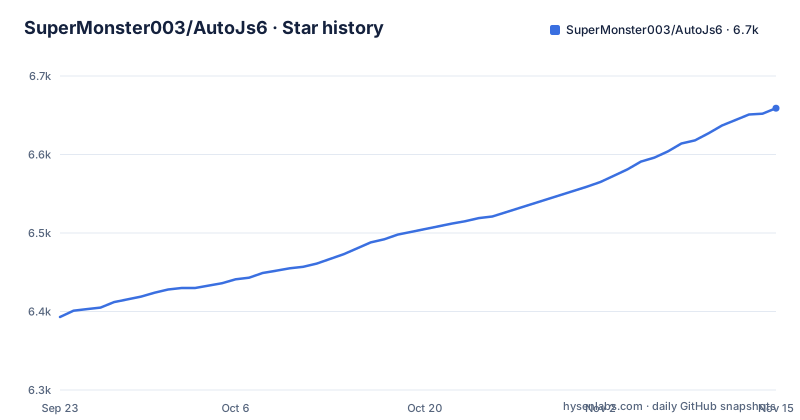
Star history
- SuperMonster003/AutoJs66,659 ★ · +266
| Repository | 2026-09-23 | 2026-11-15 |
|---|---|---|
| SuperMonster003/AutoJs6 | 6.4k | 6.7k |
266 Stars in the last 53 days, measured from the daily GitHub snapshot. Compare with other projects
Editorial analysis
A fork of a tool that stopped maintenance in March 2020
Auto.js, the original, was written by hyb1996 and first released on 2017/01/27. It stopped maintenance on 2020/03/13, and the final version is recorded as 4.1.1 Alpha2 with build number 461. AutoJs6 is the second development of that codebase: it began on 2021/12/01 and continues to be open source and free. The scope is stated in a single line, a JavaScript automation tool for Android that works through accessibility services, and the fork relationship is stated just as plainly.
The sibling table counts lifespans, not features
The README carries a table of Auto.js related projects, with columns for application name, main developer, creation date, most recent activity, and active maintenance period in years. AutoJs6 heads the table, created 2021/12/01 and last active 2026/11/03, an active period of 4.93 years. AutoX by aiselp runs from 2024/04/21 to 2026/10/09 (2.47 years), the autox-community AutoX from 2025/03/30 to 2025/11/29 (0.67 years), and the Auto.js M fork by TonyJiangWJ was created 2019/11/21 and last active 2025/08/22. What the table cannot tell you is any feature difference between these projects. It is a timeline rather than a comparison, and it names no JavaScript engine and no Android level for any entry.
Release v6.7.0 shipped 2026-03-14, nine months after v6.6.4
Three recent releases are listed: v6.8.0 published 2026-11-03, v6.7.0 on 2026-03-14, and v6.6.4 on 2025-05-31. The pattern is long gaps between releases: v6.7.0 landed roughly nine and a half months after v6.6.4, and v6.8.0 nearly eight months after that. The last push to the master branch is dated 2026-03-16, two days after the v6.7.0 tag, so the branch tip sits just past that release. Read the dates as the state of the project: it ships, then goes quiet for long stretches, which is worth knowing before you pin your own tooling to a version number. The release titles add nothing to that picture, because each one repeats its own version and date, such as 6.7.0 @ 2026/03/14.
Getting the app means opening download.autojs6.com
Installing AutoJs6 does not begin with a command. The link block at the top of the README points at a download host, a separate issue tracker, and a commit viewer, with the last one pinned to one specific revision.
http://download.autojs6.com
http://issues.autojs6.com
http://commit.autojs6.com/99a1d8490fac5b6d55f6f183db59ad833a2064ed
https://github.com/mozilla/rhino
Of those addresses, the three project hosts divide the work: packages, bug reports, and a diff view. The Rhino entry is a plain link to the Mozilla JavaScript engine project, which is the closest thing here to a statement about what runs your scripts.
Docs sit on docs.autojs6.com while translations sit on a mirror
Documentation lives at https://docs.autojs6.com, and the repository also has a top-level docs/ directory. The README translations and the licence file are served from a second host, project.autojs6.com, at paths such as .readme/README-en.md and blob/master/LICENSE. The commit link is pinned to a single revision rather than to a branch, so it is a snapshot diff and not a live view of master.
Ten README translations, and only one marked current
The README exists in ten languages, and the list is part of the file rather than a translation service. Simplified Chinese is marked as the language of the current file. The rest are Traditional Chinese for Hong Kong, Traditional Chinese for Taiwan, English, French, Spanish, Japanese, Korean, Russian, and Arabic, each kept as its own file under .readme/ on the mirror host. Nothing in the list records when a translation was last touched. Nine of the ten are served over plain http on project.autojs6.com rather than https, which is worth knowing before you treat that mirror as an authoritative copy.
Kotlin DSL build files, a committed wrapper, and no build command
The repository is a Gradle project written in the Kotlin DSL, with build.gradle.kts and settings.gradle.kts at the top level, gradle.properties and version.properties carrying settings, and both wrapper launchers committed as gradlew and gradlew.bat.
gradlew
gradlew.bat
build.gradle.kts
settings.gradle.kts
gradle.properties
version.properties
app/
modules/
libs/
plugin-api/
build-logic/
The layout describes a multi-module build with a separate directory for build logic and a separate file for the version, not a single-module app. The wrapper launchers are there to be run, and .run/ and .utils/ are present at the top level, but neither is explained. There is also a .python/ directory inside an otherwise Java and Gradle project, and nothing visible says what it is for.
MPL-2.0 licence, a Java core, and an unexplained Rhino link
The licence is MPL-2.0, and the language counted for the project is Java rather than JavaScript. That pairing is the shape of the thing in one line: a Java application that embeds a script runtime so other people can automate it. The link block backs the reading by pointing at the Mozilla Rhino engine repository alongside an archive of Android Studio builds and older IntelliJ IDEA releases, which is the toolchain trail the project leaves behind. The header also carries a JetBrains address with an AutoJs6 campaign parameter in it, so one line of that block is a vendor link rather than documentation.
Editorial conclusion
AutoJs6 fits people who already write Auto.js scripts and want a fork with a recent tag behind it; its documentation is published at docs.autojs6.com. Before you commit, check the release dates against the Android version on your device, read the permission list on the documentation site rather than in the code, and plan for the two halves of this project to be updated separately.
Frequently asked questions
What is AutoJs6 and which project is it based on?
AutoJs6 is a JavaScript automation tool for Android that drives the system through accessibility services. It is a secondary development of Auto.js by hyb1996, which stopped maintenance on 2020/03/13 at version 4.1.1 Alpha2, build number 461. AutoJs6 began on 2021/12/01 and stays open source and free under MPL-2.0.
Where do I download AutoJs6 and where do I report bugs?
The README header links http://download.autojs6.com for the package, http://issues.autojs6.com for the tracker, and http://commit.autojs6.com/99a1d8490fac5b6d55f6f183db59ad833a2064ed for a diff pinned to one commit. Documentation is at https://docs.autojs6.com.
How do I build AutoJs6 from source?
The repository commits a Gradle wrapper as gradlew and gradlew.bat, with Kotlin DSL build files, gradle.properties, version.properties, and directories for app, modules, libs, plugin-api, and build-logic.
What is the newest AutoJs6 release, and when was the last change?
v6.8.0 was published on 2026-11-03, preceded by v6.7.0 on 2026-03-14 and v6.6.4 on 2025-05-31. The last push to the master branch is dated 2026-03-16.
Official sources
Add this badge to your README
If you maintain this project, the badge below links readers to this analysis and shows its maintenance status from the daily GitHub snapshot. Paste the markdown into your README; add ?metric=license or ?metric=stars to the image URL for a different field.

[](https://hysenlabs.com/projects/supermonster003-autojs6)Star history chart for your README
[](https://hysenlabs.com/projects/supermonster003-autojs6)Was this useful?