generator-gulp-angular asks you to install bower and stopped releasing in 2016
GitHub describes it as Yeoman generator for AngularJS with GulpJS [UNMAINTAINED next iteration is FountainJS]. The repository metadata lists JavaScript as its primary language. This article stays within the project description and details documented in the GitHub repository README.
At a glance
- What is it?
- Swiip/generator-gulp-angular is a Yeoman generator for AngularJS and Gulp whose own document calls it unmaintained and outdated, with the last commit on the default branch dated 2022-06-16 and the newest release tag from 2016. Its homepage is the successor project, and the install instructions still pull in bower.
- Who is it for?
- This generator fits someone working inside an existing AngularJS and Gulp project who wants the same boilerplate regenerated, and nobody starting something new. Three things to accept first.
- Can I use it commercially?
- Not without permission. GitHub finds no licence file in the repository, and without a licence all rights are reserved by default: you may read the code but not reuse it. Check the README, or ask the authors, before using it.
- Is it still maintained?
- Probably not. The repository last received commits 52 months ago, on June 16, 2022.
- What is it written in?
- Mainly JavaScript, according to GitHub's language statistics.
Answers come from the project's GitHub data, last synced on October 22, 2026, and from our analysis. They are not legal advice.
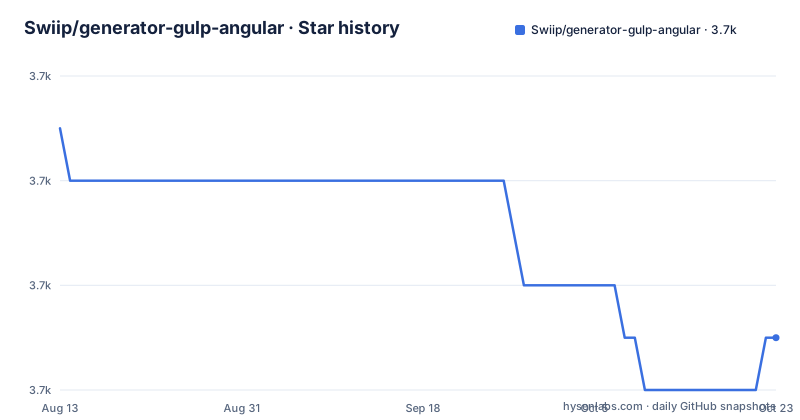
Star history
- Swiip/generator-gulp-angular3,681 ★ · -4
| Repository | 2026-08-13 | 2026-10-22 |
|---|---|---|
| Swiip/generator-gulp-angular | 3.7k | 3.7k |
-4 Stars in the last 70 days, measured from the daily GitHub snapshot. Compare with other projects
Editorial analysis
The last commit is 2022 and the last release is from 2016
The document does not hide this. A heading states the generator is unmaintained and outdated, and the sentence under it says it works but is unmaintained and outdated for various reasons, with a link to pull request 1155 as the explanation. The repository description carries the same message, ending with a marker for unmaintained and pointing at FountainJS as the next iteration.
The dates back that up. The last commit on the default branch is 2022-06-16. The newest release is v1.1.1 from 2016-06-29, with v1.1.0 from 2016-03-31 and v1.0.2 from 2015-11-24 behind it.
So there is a six-year gap between the last release and the last commit, and roughly four years between that commit and today. Nothing in the release history suggests a cadence that resumed: three releases across 2015 and 2016, then nothing.
The manifest version matches the last tag at 1.1.1, so the package on npm and the newest GitHub release are the same build, and both predate the final commit by years.
The recorded homepage is the successor project
The homepage for the repository is `http://fountainjs.io`, which is not this project. It is the next iteration the document keeps pointing at, with the claim that the most important features and more are present there.
That single field does a lot of work. Anyone who finds the repository through a search or a dependency listing is sent to a different codebase as the place to look, which is a reasonable thing for a maintainer to do and a confusing thing for a user to hit. The URL is also plain HTTP rather than HTTPS.
The rest of the documentation follows the same pattern of pointing outward. The tutorial is not in this repository but in the Yeoman codelab, and the changelog is not a file but the GitHub releases page.
What is in the repository is a `docs/` directory with four documents: a README, a usage page, a user guide and a how-it-works page. The document links each one by name, and the features list and the list of questions the generator asks both live in the usage page rather than in the README.
The install line still pulls in bower
Installation is two global installs. First the tools:
npm install -g yo gulp bowerthen the generator itself:
npm install -g generator-gulp-angular`bower` in that first line is the package manager that the JavaScript ecosystem moved away from, and it is still a required install rather than an optional extra. The manifest is consistent with the global requirement: `preferGlobal` is set to true.
Running it is a directory and a subcommand:
mkdir my-new-project && cd $_followed by `yo gulp-angular`, at which point the generator asks which technologies you want. The `files` array in the manifest lists only `index.js` and `generators`, so what npm publishes is the generator code and nothing else. The documentation the README sends you to, including the usage page with the feature list, is not in the tarball at all.
engines claims node 0.10 while every dependency is a tilde on an old major
The manifest declares `"engines": { "node": ">=0.10.0" }`, which is a floor from the era when this was current.
The dependencies sit in the same period. Runtime: `chalk` at about 1.1.1, `insight` at about 0.7.0, `lodash` at about 3.10.1, `slash` at about 1.0.0, `underscore.string` at about 3.2.2, `yeoman-generator` at about 0.20.3 and `yosay` at about 1.0.5. Every one is a tilde range on a major version that has since been superseded, and `yeoman-generator` at 0.x is the generation of Yeoman that predates the current one.
Development tells the same story: `eslint` at about 1.6.0, `mocha` at about 2.3.3, `chai` at about 3.3.0, `istanbul` at about 0.3.22, `sinon` at about 1.17.1, `bower` at about 1.5.3 and `bluebird` at about 2.10.2.
The keyword list in the manifest is a better description of the generator's scope than the README is. It names restangular, ui-router, bootstrap, angular-material, foundation, sass, less, es6, babel, traceur, typescript, coffeescript, jade, haml, webpack and eslint, which is the set of choices the generator offers rather than a build stack it requires.
insight is a runtime dependency and the test run turns it off
One runtime dependency is not a build tool. `insight`, at about 0.7.0, is a library for reporting anonymous usage data to a remote endpoint, and it sits in `dependencies` rather than `devDependencies`, which means it is installed for anyone who installs the generator.
The test script shows how the project itself handles it. The full test command is:
istanbul cover _mocha -- test/node test/template && mocha test/inception/test-inception.js -ig protractor --no-insightThe `--no-insight` flag on the second half disables reporting for the test run, and `-ig protractor` excludes the browser tests. So the analytics library is present and active in normal use and explicitly disabled while testing.
Two further things are visible in that one line. Coverage is measured with istanbul over the node and template tests, and the inception test runs as a separate mocha invocation rather than through the coverage wrapper, so whatever it covers is outside the coverage report.
The manifest also has three shell scripts wired to npm: `pretest` runs `./scripts/prepare-test.sh`, `update-shrinkwrap` runs `./scripts/update-test-shrinkwrap.sh`, and `deploy` runs `./scripts/deploy-boilerplate.sh`.
A committed shrinkwrap and a badge pointing at another organisation
Two pieces of housekeeping in the tree explain how this repository was maintained.
`npm-shrinkwrap.json` is committed at the root, which pins the exact dependency tree rather than the ranges in the manifest, and there is a dedicated script to refresh it. That is the right call for a generator whose output depends on the versions it resolves, and it also means the install a user gets is fixed to whatever the tree was when it was last updated.
The badges are the other story. The dependency badge points at `david-dm.org/eleven-labs/generator-gulp-angular`, while the repository is under the `Swiip` organisation. One of the two contributor entries in the manifest gives an eleven-labs.com address, so the badge was written when the project lived under that organisation and never updated after the move.
The rest of the badge row has the same vintage: a Travis CI status pointing at `travis-ci.org`, a Codecov badge pinned to the `master` branch, and both the pull request badge and the npm badge duplicated in the markup.
The tree itself is conventional for a Yeoman generator: `index.js`, `generators/`, `test/`, `docs/`, `scripts/`, `.eslintrc` with `.eslintignore`, `.editorconfig`, `.istanbul.yml` and `.travis.yml`.
MIT is claimed twice and there is no LICENSE file
The licence question is inconsistent in a way that is easy to check.
The document has a licence section that says MIT. The manifest has `"license": "MIT"`. The licence recorded for the repository itself is not resolved, and the tree contains no `LICENSE` file, only a `CONTRIBUTING.md`.
So the terms are asserted in two places a user will read and absent from the place a lawyer would look. Nothing in the document explains the omission, and for a generator whose output is copied into other people's projects, that gap is worth closing before anyone relies on it.
The authorship is at least recorded. The manifest names Matthieu Lux and Mehdy Dara as author and contributors, with a GitHub profile for the first and an eleven-labs.com address for the second.
The contribution rules are pointed at rather than summarised, with `CONTRIBUTING.md` as the target and a general statement that pull requests are welcome.
Editorial conclusion
This generator fits someone working inside an existing AngularJS and Gulp project who wants the same boilerplate regenerated, and nobody starting something new. Three things to accept first. The document tells you it is unmaintained and outdated and routes you to FountainJS, whose site is the project's recorded homepage, so treat this as a reference implementation rather than a starting point. The toolchain it installs is a 2016 toolchain, with bower in the install line and a package manifest that declares a Node floor of 0.10.0. And the published tarball is only index.js and the generators directory, so the documentation you are sent to lives in the repository rather than in the package. MIT is claimed in two places with no LICENSE file in the tree, so check the terms yourself before shipping anything it generates.
Frequently asked questions
Is generator-gulp-angular still maintained?
The document says it is unmaintained and outdated, the repository description carries an unmaintained marker, and the last commit on the default branch is dated 2022-06-16. The newest release is v1.1.1 from 2016-06-29, and the recorded homepage is FountainJS, described as the next iteration.
How do I create a project with generator-gulp-angular?
Install the tools globally with npm install -g yo gulp bower, install the generator with npm install -g generator-gulp-angular, then run mkdir my-new-project && cd $_ followed by yo gulp-angular and answer the questions about which technologies you want.
Where are the generator-gulp-angular options documented?
In the repository's docs directory rather than in the published package. docs/usage.md carries the features included in the gulpfile and the questions the generator will ask, alongside docs/README.md, docs/user-guide.md and docs/how-it-works.md. The manifest publishes only index.js and the generators directory.
What license does generator-gulp-angular use?
MIT is stated in the document and in package.json, with Matthieu Lux and Mehdy Dara named as author and contributors. The tree contains no LICENSE file, and the licence recorded for the repository is not resolved.
Does generator-gulp-angular report usage data?
Its runtime dependencies include insight at about 0.7.0, a library for anonymous usage reporting, and the test script passes --no-insight to disable it. Nothing in the document describes what is collected or how to turn it off for normal use.
Official sources
Add this badge to your README
If you maintain this project, the badge below links readers to this analysis and shows its maintenance status from the daily GitHub snapshot. Paste the markdown into your README; add ?metric=license or ?metric=stars to the image URL for a different field.

[](https://hysenlabs.com/projects/swiip-generator-gulp-angular)Star history chart for your README
[](https://hysenlabs.com/projects/swiip-generator-gulp-angular)