taiko-mono: a based rollup where the released protocol is not on main
A based rollup protocol for Ethereum🥁
At a glance
- What is it?
- taiko-mono is the monorepo behind Taiko Alethia, an Ethereum based rollup: protocol contracts, a Go client, a Rust client, a relayer, a bridge UI, an indexer and a balance monitor, with a root Dockerfile parameterised by package. Its README warns that main is under active development and that the release process carries security measures main does not.
- Who is it for?
- Use taiko-mono if you are running or integrating a Taiko Alethia node, contributing to the protocol contracts, or building one of the services around the rollup, because the Go and Rust clients, the relayer and the contract sources all live here. Do not treat `main` as a deployable protocol version, since the README points to the `taiko-alethia-protocol-v3.1.0` branch for the latest contracts and states the release process carries security measures main does not guarantee.
- Can I use it commercially?
- Check first. The repository uses a licence we do not classify automatically, so read its LICENSE file before any commercial use.
- Is it still maintained?
- Yes. The repository last received commits 1 day ago.
- What is it written in?
- Mainly Rust, according to GitHub's language statistics.
Answers come from the project's GitHub data, last synced on November 25, 2026, and from our analysis. They are not legal advice.
Star history
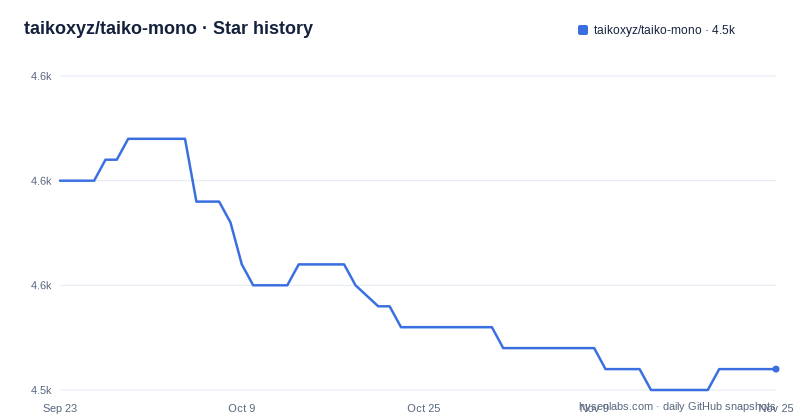
- taikoxyz/taiko-mono4,546 ★ · -9
| Repository | 2026-09-23 | 2026-11-25 |
|---|---|---|
| taikoxyz/taiko-mono | 4.6k | 4.5k |
-9 Stars in the last 63 days, measured from the daily GitHub snapshot. Compare with other projects
Editorial analysis
The released protocol is on a branch, and main says so itself
The README opens with a warning, and it is the most consequential line in the file.
The `main` branch is under active development. For the latest version of the Taiko Alethia protocol contracts, which the warning describes as an Unzen fork, you should use the `taiko-alethia-protocol-v3.1.0` branch.
The reason given is the one to sit with: the release process involves security measures that the `main` branch does not guarantee.
That sentence inverts the usual relationship between a trunk and a release. Normally the release branch is derived from trunk and lags slightly behind it. Here the release branch is the artefact with guarantees attached, and trunk is the place where those guarantees do not hold.
For an operator, the practical consequence is that a deployment which tracks `main` is deploying something other than the released protocol, whatever the commit hash says. For a contributor, it means a change to the contracts on `main` is not the same artefact as the one the network runs.
One Dockerfile, eleven packages, a PACKAGE argument
There is a single `Dockerfile` at the repository root, and it builds any of the Go services rather than one named application.
The whole mechanism is a build argument:
ARG PACKAGE=eventindexerThe builder stage is `golang:1.26.0`, installs git and curl, copies the repository, runs `go mod download`, and then moves into `packages/${PACKAGE}` to build `cmd/main.go`:
RUN CGO_ENABLED=0 GOOS=linux go build -o /taiko-mono/packages/${PACKAGE}/bin/${PACKAGE} /taiko-mono/packages/${PACKAGE}/cmd/main.goThe runtime stage is `alpine:latest` with `ca-certificates` added, the binary copied to `/usr/local/bin/`, and `ENTRYPOINT /usr/local/bin/${PACKAGE}` with the package name passed through as an environment variable.
Two details are worth noting. The binary is built with `CGO_ENABLED=0`, so the services are statically linked and run on a bare Alpine image. And the default value of `PACKAGE` is `eventindexer`, which means an unparameterised build produces the event indexer rather than the client, so anyone building must pass the package name deliberately.
Eleven packages: contracts, two clients, and the services around them
The packages table is the map of the system, and it divides cleanly by role.
At the centre are the protocol smart contracts in `packages/protocol`, fully documented with NatSpec, and a second package of supplementary contracts that are explicitly not part of the Taiko Alethia protocol.
Then there are two client implementations, `taiko-client` in Go and `taiko-client-rs` in Rust, and the repository's primary language is Rust while its module file is Go.
Around them sit the services. A `relayer` is the bridge backend, a `bridge-ui` is the user-facing side of it, an `eventindexer` processes events, and a `balance-monitor` watches Ethereum L1 and L2 addresses and token balances. An `ejector` service handles preconfirmation ejection for operators who run into issues, a `fork-diff` package backs a fork diff page, and an `nfts` package holds NFT-related contracts and utilities.
Read as a system, that is a rollup plus the operational surface around it, which is why the repository is a monorepo rather than a set of independent projects.
go-ethereum, optimism and libp2p in one module
The Go module at the repository root is `github.com/taikoxyz/taiko-mono` and declares `go 1.26.10`, and its dependency list says more about the architecture than the package names do.
`github.com/ethereum/go-ethereum` at v1.15.5 is the execution client library, and `github.com/ethereum-optimism/optimism` at v1.7.4 is the OP Stack.
Below those sit the usual service dependencies. `github.com/libp2p/go-libp2p` at v0.36.5 for peer networking, `github.com/labstack/echo/v4` at v4.16.2 with `echo-jwt` for the HTTP layer, `github.com/pressly/goose/v3` at v3.29.0 for database migrations, `gorm.io` with a MySQL driver, `github.com/rabbitmq/amqp091-go` for the queue, and `github.com/prometheus/client_golang` for metrics.
The list also includes `github.com/prysmaticlabs/prysm/v5` at v5.3.3, a consensus client, and `github.com/testcontainers/testcontainers-go` at v0.44.0, which is how integration tests get real dependencies.
The module also carries `github.com/swaggo/swag` for API documentation, which is the sort of entry that tells you a service exposes an HTTP API worth documenting.
Release tags carry the package name
The three most recent releases are all package-scoped: `taiko-alethia-client` v2.8.0 on 2026-10-09, `bridge-ui` v2.19.1 on 2026-10-08 and `bridge-ui` v2.19.0 on 2026-10-08.
So a tag tells you which component moved and by how much.
The README's operational tip sits alongside this: make sure your node is using the latest version tags for `taiko-client` and `alethia-reth`, and check the node releases page for the current versions. That page is outside this repository, which means the authoritative version list for a node operator is not the release list here.
Release automation is configured in the root with `release-please-config.json` and `.release-please-manifest.json`, alongside a `RELEASE.md` and a `CHANGELOG.md`.
The last push was on 2026-11-02, so the work is current even though the branch warning means current code is not current protocol.
The JavaScript in the root is three scripts and two dev tools
The root `package.json` is a private package at version 0.23.0 with three scripts, and they are all about local repository hygiene rather than application code.
`postinstall` runs `bash scripts/setup-local-ignores.sh`, and there are matching `setup:ignores` and `remove:ignores` scripts pointing at `scripts/setup-local-ignores.sh` and `scripts/remove-local-ignores.sh`.
The only dev dependencies are `lefthook` at ^1.6.10 and `prettier` at ^3.2.5, with `lefthook.yml` in the root for git hooks and a `.prettierignore` alongside.
That is the whole JavaScript surface. The workspace is declared with `pnpm-workspace.yaml` and locked with `pnpm-lock.yaml`, so the front-end packages inside `packages/` use the same pnpm workspace, but the root manifest itself builds nothing.
The rest of the root is quality tooling with a distinctive fingerprint: `.gitleaks.toml` for secret scanning, `_typos.toml` for spelling, `lychee.toml` for link checking, `codecov.yml` for coverage reporting, and `AGENTS.md`, `CLAUDE.md` and a `.claude/` directory for machine-readable guidance. A `testdata/` directory and a `Dockerfile` complete the picture.
Read the protocol spec and the NatSpec comments before the code
Taiko Alethia is described in the README as the first based rollup, and the documentation is split into three layers with a deliberate order.
The entry point is the Taiko Alethia documentation site at docs.taiko.xyz, which holds high-level concepts, guides, resources and reference pages, with its source in the separate `taiko-docs` repository.
Below that sits the protocol specification at `packages/protocol/docs/README.md`, described as in-depth specifications of the protocol for deeper understanding.
Below that are the smart contracts in `packages/protocol/contracts/`, documented with NatSpec, which is the layer a Solidity developer reads when the specification is not enough.
So the repository is where you go after the concepts, and the concepts are where you go before the repository.
For participation, the README points at `CONTRIBUTING.md`, at a grants cycle hosted at taiko.xyz, and at Discord for questions. Bugs and feature requests go through GitHub's issue chooser rather than a bare issue form.
Editorial conclusion
Use taiko-mono if you are running or integrating a Taiko Alethia node, contributing to the protocol contracts, or building one of the services around the rollup, because the Go and Rust clients, the relayer and the contract sources all live here. Do not treat `main` as a deployable protocol version, since the README points to the `taiko-alethia-protocol-v3.1.0` branch for the latest contracts and states the release process carries security measures main does not guarantee. Before you pin anything, check three things: which branch carries the contracts you intend to run, which client tags your node needs for `taiko-client` and `alethia-reth` according to the node releases page, and which package your Dockerfile should build, since `PACKAGE` defaults to `eventindexer` rather than to the client.
Frequently asked questions
What is taiko-mono?
The monorepo behind Taiko Alethia, which the README calls the first based rollup. It contains the protocol smart contracts and supplementary contracts, two client implementations in Go and Rust, and the services around them: a bridge relayer, a bridge UI, an event indexer, a balance monitor for L1 and L2 addresses, a preconfirmation ejector, an NFT package and a fork diff page.
Which branch has the latest Taiko Alethia protocol contracts?
Not `main`. The README warns that `main` is under active development and directs you to the `taiko-alethia-protocol-v3.1.0` branch for the latest protocol contracts, which are an Unzen fork. Its reason is stated plainly: the release process involves security measures that the `main` branch does not guarantee.
How do I build a taiko-mono service into a container?
The root Dockerfile takes a `PACKAGE` build argument that defaults to `eventindexer`. It builds with `golang:1.26.0` and `CGO_ENABLED=0 GOOS=linux go build` on `packages/${PACKAGE}/cmd/main.go`, then copies the static binary into an `alpine:latest` image with ca-certificates and sets `ENTRYPOINT /usr/local/bin/${PACKAGE}`.
Which client tags should a Taiko Alethia node run?
The README tells you to use the latest version tags for `taiko-client` and `alethia-reth`, and to check the node releases page at docs.taiko.xyz/network/software-releases for the current versions. Releases in this repository are tagged per package, so each package carries its own version line.
How are taiko-mono releases produced?
Release automation is configured in the root through `release-please-config.json` and `.release-please-manifest.json`, with a `RELEASE.md` and a `CHANGELOG.md` alongside. The resulting tags name the package, for example `taiko-alethia-client` v2.8.0 and `bridge-ui` v2.19.1.
Official sources
Add this badge to your README
If you maintain this project, the badge below links readers to this analysis and shows its maintenance status from the daily GitHub snapshot. Paste the markdown into your README; add ?metric=license or ?metric=stars to the image URL for a different field.

[](https://hysenlabs.com/projects/taikoxyz-taiko-mono)Star history chart for your README
[](https://hysenlabs.com/projects/taikoxyz-taiko-mono)Was this useful?