AutoHedge runs a four-agent trading line on Solana and nothing else yet
Build your autonomous hedge fund in minutes. AutoHedge harnesses the power of swarm intelligence and AI agents to automate market analysis, risk management, and trade execution.
At a glance
- What is it?
- The Swarm Corporation's AutoHedge is a 0.1.5 Python package that chains a Director, Quant, Risk Manager and Execution agent into one trade pipeline. It is worth reading for the pipeline shape; it is not yet a multi-venue system.
- Who is it for?
- Read AutoHedge if you want a concrete example of how The Swarm Corporation wires agent roles into a trade decision, and if you already trade Solana and want to inspect where the risk sizing sits in the chain. Do not hand it a funded wallet expecting an institutional stack: version 0.1.5 carries a Beta classifier, the venue table supports one chain, and no GitHub release exists to upgrade between.
- Can I use it commercially?
- Yes. MIT is a permissive licence: you can use, modify and sell software built on it, as long as you keep its copyright and licence notices.
- Is it still maintained?
- Activity is slowing. The repository last received commits 6 months ago.
- What is it written in?
- Mainly Python, according to GitHub's language statistics.
Answers come from the project's GitHub data, last synced on November 15, 2026, and from our analysis. They are not legal advice.
Star history
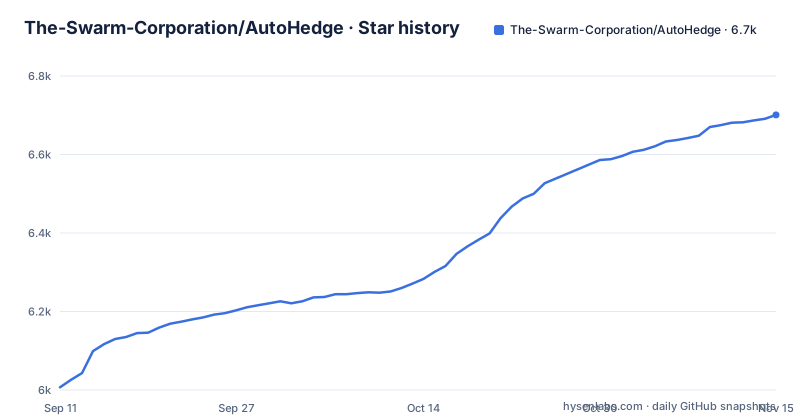
- The-Swarm-Corporation/AutoHedge6,701 ★ · +694
| Repository | 2026-09-11 | 2026-11-15 |
|---|---|---|
| The-Swarm-Corporation/AutoHedge | 6k | 6.7k |
694 Stars in the last 65 days, measured from the daily GitHub snapshot. Compare with other projects
Editorial analysis
Four agents in a fixed line, ending in trade output
AutoHedge does not let agents talk freely. The pipeline is a straight chain, and the README draws it as a mermaid graph with no branches and no loops: Director Agent feeds Quant Agent, Quant Agent feeds Risk Manager, Risk Manager feeds Execution Agent, and Execution Agent emits Trade Output. Each stage owns one job. The Director writes the strategy and the thesis, the Quant does technical and statistical work on it, the Risk Manager sizes the position and assesses risk, and only the Execution agent generates and sends orders.
That ordering is the project's real design decision. Risk sizing is not a filter bolted onto the end of an agent run, it is a gate between analysis and execution, and the README calls the design risk-first for that reason.
The command surface is one entry point, registered in pyproject.toml rather than in a shell script:
[tool.poetry.scripts]
autohedge = "autohedge.cli:main"
No flags are documented for that entry point. The README shows no `--dry-run`, no `--venue`, no `--strategy` argument, so the README documents no way to select a subset of the pipeline from the command line.
Jupiter for prices, a raw key for the wallet
Three of the five environment variables decide whether the system can do its job at all. `JUPITER_API_KEY` unlocks the price and search tools, and the README points you at portal.jup.ag to get one. `WALLET_PRIVATE_KEY` holds the Solana signing key. `WORKSPACE_DIR` sets where the agents keep their working state, and .env.example gives it the value "agent_workspace".
`OPENAI_API_KEY` and `ANTHROPIC_API_KEY` sit in the same file under the comment "OpenAI (experimental agents)". That comment matters more than it looks: the two model providers are labelled experimental, while nothing in the README marks the trading path itself as experimental. There is no other model provider in the block, and no local model option either.
The five-key block is the whole documented configuration surface. There is no YAML file, no strategy config and no venue setting anywhere in the top-level layout, which is .env.example, .github/, .gitignore, LICENSE, README.md, autohedge/, example.py, experimental/, logs/, pyproject.toml and requirements.txt. The documented configuration lives entirely in environment variables.
pip install -U autohedge, then run the command
Installation is a single line, taken from the README's Quick Start:
pip install -U autohedgeBefore the first run you need a .env file. The README tells you to see .env.example for a full reference, and that file carries the five keys:
# Jupiter API (token price & search tools)
# Get a key at https://portal.jup.ag
JUPITER_API_KEY=

# OpenAI (experimental agents)
OPENAI_API_KEY=
ANTHROPIC_API_KEY=
WORKSPACE_DIR="agent_workspace"

# Trading
WALLET_PRIVATE_KEY=""
With the keys filled in, Basic Usage in the README is one command:
autohedgeThat is the whole first run. It produces no usage output in the README, no sample trade and no sample log line, so there is nothing documented for you to compare against. A reader installing the package has no reference result to check the run against, which makes the `logs/` directory in the repository the first place to look after starting it.
Solana is the only row marked Supported
The venue table has three rows and one completed entry. Solana reads "Supported" with the note "Full autonomous trading". Coinbase reads "Coming soon" with "In development". Other CEX reads "Roadmap" with "Planned expansion". The opening line of the README repeats the same split, and adds Coinbase plus "additional exchanges" to the coming-soon column.
So the multi-venue, multi-asset claim in the Overview is a target, not a state. On one chain, venue diversification is zero. A position in a single Solana token carries the chain's own risk on top of the position risk, and there is no second venue to offset it.
The dependency list points the other way. `yfinance` is declared in pyproject.toml, which is equity market data, and `solders` is declared next to it for Solana transaction handling. Nothing in the venue table or the pipeline covers equities. Read the dependency list as the roadmap's residue, not as evidence of an equity execution path.
No backtest, no dry run, and a private key in a dotenv file
The README documents no backtester, no paper-trading mode and no replay of historical data. It also documents no rollback, no stop-loss threshold, no slippage handling, no circuit breaker and no kill switch. Every one of those is a real question for a system whose Execution agent holds a funded wallet, and the README leaves all of them unanswered. The `autohedge` entry point takes no documented argument that would limit it to a simulation.
The key handling is the sharpest edge. `WALLET_PRIVATE_KEY=""` is a plain string in a dotenv file that .gitignore has to keep out of version control, and the file is the one configuration reference the project points readers to. There is no mention of a keystore, a hardware signer, a delegated trading authority, a spend limit or a mainnet address allowlist. Anyone running this with a funded key is signing real transactions with a string sitting in a text file.
Logging is the one audit trail offered in place of controls. The README lists enterprise logging as a feature and describes it as configurable, and a `logs/` directory sits at the top level of the repository. No log format, rotation policy or retention setting is documented, so what an operator can reconstruct after a bad fill is unknown.
pyproject wants 3.10, the classifier says 3.9, and the two dependency files disagree
Two inconsistencies in the packaging will bite an installer. In pyproject.toml the runtime constraint is `python = "^3.10"`, while the classifier list still carries "Programming Language :: Python :: 3.9". The dependency constraint is the one pip enforces, so a 3.9 interpreter fails the install even though the metadata advertises support for it.
The two dependency files also list different packages. pyproject.toml declares rich, swarms, pydantic, loguru, swarm-models, httpx, solders, yfinance and python-dotenv. requirements.txt lists swarms, pydantic, loguru, swarm-models, fastapi, uvicorn, requests, httpx and solders. Overlap, but not the same set: rich, yfinance and python-dotenv appear only in pyproject.toml, and fastapi, uvicorn and requests appear only in requirements.txt.
That split matters because `pip install -U autohedge` installs what pyproject.toml declares, while someone working from a source checkout who follows requirements.txt gets a different set, one that adds fastapi and uvicorn and drops rich, yfinance and python-dotenv. There is no tests directory in the tree and no test dependency in either file, so neither install path is checked by anything the repository runs.
0.1.5, a Beta classifier, and no GitHub release to upgrade between
pyproject.toml sets version = "0.1.5" and classifies the project as "Development Status :: 4 - Beta". The repository has no GitHub releases, so there is no changelog to read, no tag to pin and no upgrade path between published versions. Version 0.1.5 with a patch-style number says very little about which parts have changed.
The last push was on 2026-05-11. That is the most recent dated fact about the codebase.
The licence is MIT, with the file at the top level and the same identifier in the metadata. MIT carries no copyleft obligation, so a firm can vendor, modify and run the code inside its own stack without publishing changes. It also carries no warranty, which matters for a package whose Execution agent places orders: the licence shifts the risk of a bad trade onto whoever runs it.
The README routes support to GitHub Issues and a Discord linked at swarms.ai, and credits swarms.ai for the agent framework underneath. The repository metadata points the homepage at swarms.xyz instead, so the two sources for support are not the same URL.
Where plain Swarms or a yfinance script stops short
The README credits Swarms for the agent framework AutoHedge sits on, and `swarms` plus `swarm-models` are declared dependencies. Taking the framework directly gives you the same agent scaffolding and none of the four trading roles, the venue wiring or the wallet handling. The difference is where the keys live: AutoHedge's configuration includes `WALLET_PRIVATE_KEY`, and a framework-only build has no such key.
For research on equities, the other half of the picture, a script built on yfinance covers market data retrieval and stops there. No wallet, no signing key, no venue table, nothing to reconcile after the market closes. If your question is "what would this agent have bought last quarter", that is the cheaper place to find out.
What neither route gives you is documented here: the project has no backtest, no simulation flag and no tests, so the questions AutoHedge raises about agent trade decisions have to be answered against its own logs rather than against a published evaluation.
Editorial conclusion
Read AutoHedge if you want a concrete example of how The Swarm Corporation wires agent roles into a trade decision, and if you already trade Solana and want to inspect where the risk sizing sits in the chain. Do not hand it a funded wallet expecting an institutional stack: version 0.1.5 carries a Beta classifier, the venue table supports one chain, and no GitHub release exists to upgrade between. Before any capital moves, read `autohedge/cli.py` in a checkout, confirm what `WALLET_PRIVATE_KEY` authorises on mainnet, and check whether the `logs/` directory in the repository is where your fills get written.
Frequently asked questions
Will the hedge fund be replaced by AI?
AutoHedge is one attempt at that: a Python package that runs market analysis, thesis generation, risk sizing and execution with minimal human intervention. Its venue table marks only Solana as supported for full autonomous trading, and the package is version 0.1.5 with a Beta classifier.
What software do hedge funds use?
AutoHedge is an MIT licensed tool in that category, installed with pip install -U autohedge and driven through a single autohedge command. The repository documents no order management system and no audit trail beyond configurable logging and JSON-formatted structured output.
Which exchanges does AutoHedge trade on today?
Solana, marked Supported with the note Full autonomous trading. Coinbase is listed as Coming soon and Other CEX as Roadmap, so there is one live venue and no documented multi-venue execution.
What environment variables does AutoHedge need before its first run?
JUPITER_API_KEY for the price and search tools, a key from portal.jup.ag, plus WALLET_PRIVATE_KEY for signing. OPENAI_API_KEY, ANTHROPIC_API_KEY and WORKSPACE_DIR="agent_workspace" complete the set, with .env.example given as the full reference.
Does AutoHedge have a backtest or paper trading mode?
None is documented. The CLI entry point is autohedge.cli:main and the README shows no flags for simulation, replay or strategy selection, so there is no published way to run the pipeline without live execution.
Official sources
Add this badge to your README
If you maintain this project, the badge below links readers to this analysis and shows its maintenance status from the daily GitHub snapshot. Paste the markdown into your README; add ?metric=license or ?metric=stars to the image URL for a different field.

[](https://hysenlabs.com/projects/the-swarm-corporation-autohedge)Star history chart for your README
[](https://hysenlabs.com/projects/the-swarm-corporation-autohedge)Was this useful?