The embedded interview notes are organised by how often a topic comes up
A comprehensive embedded system knowledge sharing repo that helps you ace your interviews with quick knowledge recap and interview focused content.
At a glance
- What is it?
- theEmbeddedGeorge is a knowledge base for embedded software interview preparation, written as markdown files grouped by topic with a reading order attached to each area. The plan is explicit, with a high priority tier of C programming, hardware fundamentals and communication interfaces, a medium tier of real-time systems, debugging and system integration, and an advanced tier of hardware, security and performance for senior roles, alongside an interactive site with 69 topic guides, more than 275 community-ranked questions and 75 coding problems.
- Who is it for?
- The embedded interview notes are worth using if you are preparing for embedded roles and want a defensible order of study rather than a pile of links, because the priority tiers are a real editorial judgement and the topic coverage runs from C fundamentals through memory management, timing, serial protocols and real-time systems to security and performance.
- Can I use it commercially?
- Not without permission. GitHub finds no licence file in the repository, and without a licence all rights are reserved by default: you may read the code but not reuse it. Check the README, or ask the authors, before using it.
- Is it still maintained?
- Yes. The repository last received commits 134 days ago.
- What is it written in?
- Mainly C, according to GitHub's language statistics.
Answers come from the project's GitHub data, last synced on November 7, 2026, and from our analysis. They are not legal advice.
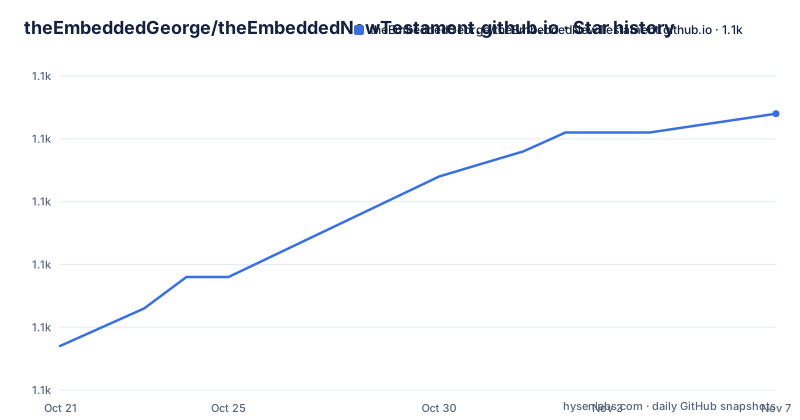
Star history
- theEmbeddedGeorge/theEmbeddedNewTestament.github.io1,124 ★ · +37
| Repository | 2026-10-21 | 2026-11-07 |
|---|---|---|
| theEmbeddedGeorge/theEmbeddedNewTestament.github.io | 1.1k | 1.1k |
37 Stars in the last 17 days, measured from the daily GitHub snapshot. Compare with other projects
Editorial analysis
The reading order is the editorial decision
The thing that makes this repository more than a list of links is that it tells you where to start. The preparation strategy is split into three tiers, and each one carries a claim about how often the topic comes up. The high priority tier, marked as 95 percent or more of interviews, points at C programming mastery, then hardware fundamentals, then communication interfaces and protocols. The medium priority tier, at 70 percent or more, moves to real-time systems and RTOS, then debugging and testing, then system integration. The advanced tier, at 50 percent or more for senior roles, covers advanced hardware, embedded security and performance optimization. For a candidate, that ordering saves the most valuable resource, which is the time before an interview, and it is a claim you can disagree with, since the percentages are an estimate rather than a measurement.
Twenty topic directories, each a set of markdown notes
The repository root is a directory per topic, and the naming is consistent, so the map is legible at a glance: Advanced_Hardware/, Bus_Protocol/, Communication_Protocols/, Computer_architecture/, Data_Struct_Implementation/, Debugging/, Embedded_C/, Embedded_Security/, HW_Module/, Hardware_Fundamentals/, IDE_Selection/, Interview/, Interview_Preparation/, Network/, Operating_System/, Performance/, Performance_Optimization/, Real_Time_Systems/, Resources/, Security/, System_Integration/, plus the README and a _config.yml. That last file is the tell that this is a published site rather than a plain repository, since a GitHub Pages site carries its theme configuration, and the repository name follows the .github.io pattern. There are also folders that are not topic notes at all, Interview/, Interview_Preparation/ and Resources/, which is where the templates, the question lists and the external links live, and IDE_Selection/ which is the unusual one, since choosing an IDE for embedded work is a question people ask and nobody answers systematically.
The C section, and where the weight sits
The Embedded_C/ directory is the largest, and its structure shows the emphasis. There is a core language block with C language fundamentals, pointers and memory addresses, type qualifiers, which the description ties to volatile, const and restrict in an embedded context, and bit manipulation for register work. Then a memory block, and the headings there are the interesting part, because they are the things that actually get asked: memory management covering stack versus heap and allocation strategies, structure alignment for layout and padding, memory models, memory-mapped I/O, memory pool allocation for deterministic allocation, memory fragmentation, and stack overflow prevention. The advanced block adds inline functions and macros with their code size trade-offs, compiler intrinsics, assembly integration, cache-aware programming, DMA buffer management with buffer alignment, shared memory programming for multi-core synchronisation, memory leak detection, memory protection with MPU usage, and aligned memory allocation. A candidate who can answer the memory questions can answer most of the C interviews, and the ordering reflects that.
Hardware, where timing and interrupts dominate
Hardware_Fundamentals/ is organised by the kind of problem rather than by the name of a peripheral, which is how the questions actually arrive. Digital I/O and GPIO cover pin configuration, modes and electrical characteristics, plus digital I/O programming. Timing and interrupts are marked as critical knowledge, with timer and counter programming including prescalers and overflow, external interrupts with interrupt setup and ISR design, interrupts and exceptions with exception handling and vectors, and pulse width modulation with duty cycle. Analog and power management cover ADC and DAC with signal processing, power management with sleep modes, clock management with clock trees and frequency scaling, and reset management with reset types and initialization. The last group is system reliability, with watchdog timers for system monitoring and recovery, and a hardware abstraction layer for portable hardware interfaces.
Communication protocols, described as the most tested topic
Communication_Protocols/ is labelled the most frequently tested topic, know these inside out. The serial section is marked as universal knowledge, with serial communication fundamentals covering basics, framing and timing, the UART protocol with implementation and baud rates, UART configuration and setup with hardware setup and flow control, and the RS232, RS422 and RS485 standards. Further down the directory, the same treatment is given to the bus protocols and the network topics, and the naming pattern stays consistent, so the section header says what the topic covers and the sub-bullet gives the specifics, which is the format that makes a directory listing usable as a revision checklist rather than a table of contents. It is also the format that lets you see the gaps, because a topic area with a thin sub-bullet list is visibly a gap.
The questions are ranked, the notes are not
The README points at an interactive site, EmbeddedInterviewLab, with 69 in-depth topic guides, more than 275 community-ranked interview questions and 75 coding problems with AI feedback, and the three entry points are knowledge topics, a question bank and coding practice. The featured item is the 82 most common embedded interview questions from the r/embedded list, with every question answered with a detailed model answer. The ranking is the important detail, because a question bank sorted by how often people are asked it is a measurement, while the topic notes in the repository are organised by an editorial judgement about priority that cannot be verified from the repository itself. The two together are a reasonable division of labour, with the bank telling you what is being asked and the notes telling you what to study, and the 82 question list being the oldest and most recognised artefact of the whole project.
What this kind of repository is good for, and what it is not
The honest scope is a revision aid, and the README says as much with the strategy section, which is a triage list rather than a curriculum. What it gives you is breadth with a defensible order, which is exactly the thing an interview preparation needs and exactly the thing a large personal notes repository does not. What it does not give you is depth, because the files are described as quick recaps with illustrative examples, and the code problems with feedback live on the separate site rather than in the repository. The maintenance picture is modest. There are no GitHub releases, the last push was on 2026-06-27, and the repository has a .DS_Store committed at the root, which is a small sign of a project maintained by one person in a hurry. If you are a hiring manager rather than a candidate, the value is different again, because a bank of 275 ranked questions with model answers is a description of what the market is asking, which is more useful than any single blog post's top ten questions.
Editorial conclusion
The embedded interview notes are worth using if you are preparing for embedded roles and want a defensible order of study rather than a pile of links, because the priority tiers are a real editorial judgement and the topic coverage runs from C fundamentals through memory management, timing, serial protocols and real-time systems to security and performance. It is the wrong tool if you are looking for depth on a specific part, since the files are quick recaps rather than manuals, and it is the wrong tool if you need worked examples you can run, since the code problems live on the separate site. Before you commit to it, look at one file in each tier and judge the depth against what your interviews actually ask, and treat the community-ranked question bank as the more current signal, since the questions are ranked by usage and the notes are not.
Frequently asked questions
How is the embedded interview knowledge base organised?
By topic, in around twenty directories such as Embedded_C, Hardware_Fundamentals, Communication_Protocols, Real_Time_Systems, Debugging, Embedded_Security and System_Integration, with each area listing markdown notes and the README giving a reading order: C, hardware and protocols first, then real-time systems, debugging and integration, then advanced hardware, security and performance.
What is EmbeddedInterviewLab and how does it relate to the repository?
It is the interactive site the README points to, with 69 in-depth topic guides, more than 275 community-ranked interview questions and 75 coding problems with AI feedback. Its featured item is the 82 most common embedded interview questions from the r/embedded list, each with a detailed model answer.
Which embedded C topics does the repository cover in depth?
The Embedded_C directory covers language fundamentals, pointers and memory addresses, type qualifiers, bit manipulation, and a large memory block with memory management, structure alignment, memory models, memory-mapped I/O, memory pool allocation, memory fragmentation and stack overflow prevention, then advanced topics including inline functions and macros, compiler intrinsics, assembly integration, cache-aware programming, DMA buffer management, shared memory programming, memory leak detection, memory protection and aligned memory allocation.
Is the repository actively updated?
It is not archived and the last push was on 2026-06-27, but there are no GitHub releases, and the repository is a GitHub Pages site with a _config.yml and a committed .DS_Store, which suggests a single maintainer working directly on the content.
Official sources
Add this badge to your README
If you maintain this project, the badge below links readers to this analysis and shows its maintenance status from the daily GitHub snapshot. Paste the markdown into your README; add ?metric=license or ?metric=stars to the image URL for a different field.

[](https://hysenlabs.com/projects/theembeddedgeorge-theembeddednewtestament-github-io)Star history chart for your README
[](https://hysenlabs.com/projects/theembeddedgeorge-theembeddednewtestament-github-io)Was this useful?