TheWhisper: Whisper models with 10 to 30 second chunks, built for NVIDIA GPUs and Apple Silicon streaming
Optimized Whisper models for streaming and on-device use
At a glance
- What is it?
- TheStageAI/TheWhisper is an MIT-licensed Python package of fine-tuned Whisper models with variable chunk lengths, a streaming pipeline, CoreML engines for Apple Silicon and TheStage AI engines for NVIDIA. Its two install paths pin conflicting library versions, and the fastest NVIDIA route needs an account token.
- Who is it for?
- TheWhisper suits teams that want low-latency Whisper transcription on a supported NVIDIA GPU or an Apple Silicon Mac, with streaming from a microphone and chunk lengths shorter than the original 30 seconds. It does not suit machines outside the listed GPUs and chipsets, or anyone who needs the fastest NVIDIA engines without creating an account token.
- Can I use it commercially?
- Yes. MIT is a permissive licence: you can use, modify and sell software built on it, as long as you keep its copyright and licence notices.
- Is it still maintained?
- Yes. The repository last received commits 25 days ago.
- What is it written in?
- Mainly Python, according to GitHub's language statistics.
Answers come from the project's GitHub data, last synced on November 25, 2026, and from our analysis. They are not legal advice.
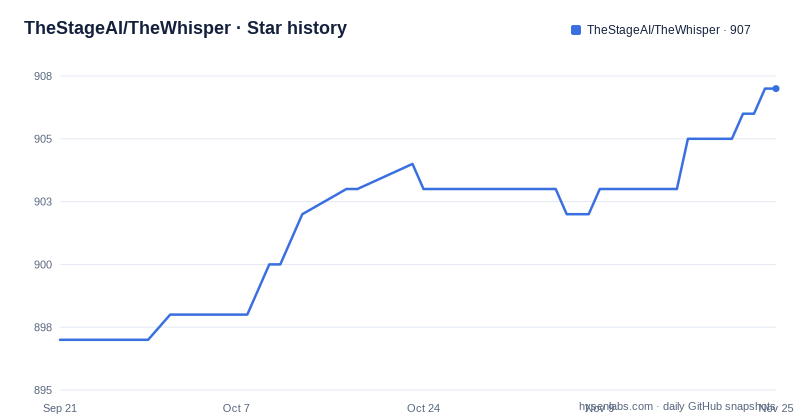
Star history
- TheStageAI/TheWhisper907 ★ · +10
| Repository | 2026-09-21 | 2026-11-25 |
|---|---|---|
| TheStageAI/TheWhisper | 897 | 907 |
10 Stars in the last 65 days, measured from the daily GitHub snapshot. Compare with other projects
Editorial analysis
Open weights with 10, 15, 20 or 30 second windows replace Whisper's fixed 30 seconds
The original Whisper models process 30 second chunks. TheWhisper publishes fine-tuned open weights on Hugging Face, for example thewhisper-large-v3-turbo, that support inference with 10, 15, 20 and 30 second windows. The support matrix marks streaming, acceleration, word timestamps, multilingual use and all four chunk modes as available for whisper-large-v3 and whisper-large-v3-turbo on both NVIDIA and Apple.
The point of a shorter window is lower latency in live use: you wait for 10 seconds of audio instead of 30 before the model has something to decode. The cost is less context per window, so accuracy on a given sentence can differ between settings. The README advertises latency, memory, power and ASR accuracy benchmarks in a benchmark folder, which is where to compare chunk modes on your language.
Apple and NVIDIA installs pin incompatible library versions, so use separate environments
After cloning, each platform has its own extra:
git clone https://github.com/TheStageAI/TheWhisper.git
cd TheWhisperpip install .[apple]pip install .[nvidia]The pyproject file shows what each pulls in. The apple extra pins torch 2.7.0, torchaudio 2.7.0, transformers 4.52.3, mlx 0.25.2 and coremltools 8.3.0. The nvidia extra needs torch between 2.9.0 and 2.10.0, transformers 5.13.1, accelerate 1.14.0 or newer and the TensorRT CUDA 12 packages at 10.13.3.9.
Those two sets cannot live in one environment. Install only the extra for the machine you are on, and keep a virtual environment per target.
The fastest NVIDIA route needs the TheStage AI engines and an API token
A third install adds the TheStage AI optimised engines through the thestage-elastic-models package, pinned at 0.2.4.post0, from a TheStage AI package index with extra index URLs for NVIDIA and PyPI. After installing the project and the thestage package, you create an access token in your profile on the TheStage AI Platform and set it:
thestage config set -t <YOUR_API_TOKEN>The features list says the engines are free for small organisations through ElasticModels. The consequence is that the headline speed figure of 220 tokens per second on an L40s for whisper-large-v3 depends on a vendor account and a licence tier. The plain nvidia extra, using Hugging Face Transformers, does not need it. Read the Enterprise License Summary section linked from the contents before deploying commercially.
Jetson-Thor needs a matching TensorRT before its own install command
For Jetson-Thor with the optimised engines, the README tells you to make sure tensorrt 10.13.3.9 is installed on the device first. The command then installs thestage-elastic-models with the thor extra at 0.2.4.post0, using a Jetson-specific package index and an extra index, followed by pip install . and pip install thestage.
This route is the most fragile of the three because it depends on a prior TensorRT install, two non-default indexes and an exact version pin. If the TensorRT on the device differs from 10.13.3.9, the pinned packages are the first place to look. Jetson-Thor is the only Jetson in the supported GPU list, which also names RTX 4090, RTX 5090, L40s, H100 and A100.
Hardware lists are strict: named NVIDIA GPUs, Ubuntu 20.04 or later, and M1 to M4 Macs
For NVIDIA the requirements are Ubuntu 20.04 or later, at least 2.5 GB of RAM with 5 GB recommended for large-v3, CUDA 11.8 or higher, driver 520.0 or higher and Python 3.10 to 3.12. For Apple Silicon, the supported chips run from M1 through M4 including Pro, Max and Ultra variants, with 2 GB of RAM minimum and 4 GB recommended, Python 3.10 to 3.12, and an operating system line that reads macOS 15.0 (Ventura) or later, iOS 18.0 or later.
The pyproject file declares Python 3.9 or newer, which is looser than the README range, so follow the README. The line pairs the number 15.0 with the name Ventura, so confirm your macOS version against the number before installing. Windows is not listed for either platform, and an Intel Mac is not among the chips.
Usage is a Python pipeline per platform, with a separate streaming pipeline for the microphone
On Apple, you build an ASRPipeline and call it on a file, asking for word timestamps:
import torch
from thestage_speechkit.apple import ASRPipeline

model = ASRPipeline(
    model='TheStageAI/thewhisper-large-v3-turbo',
    # optimized model with ANNA
    model_size='S',
    chunk_length_s=10
)

# inference
result = model(
    "path_to_your_audio.wav",
    return_timestamps="word"
)

print(result["text"])
On NVIDIA, the pipeline takes a chunk length of 10, 15, 20 or 30 seconds, a batch size and a device, and passes generate_kwargs to Transformers. Streaming uses a StreamingPipeline with MicStream, FileStream and StdoutStream classes, a stride set in seconds for the microphone, and a platform argument. Streaming is implemented for NVIDIA and macOS only. The repository also ships examples for Apple, NVIDIA, streaming and a server, and an Electron demo with a REST API.
There are no releases, the package is version 0.1.0, and the power figures are the project's claims
The repository has no GitHub releases, the pyproject version is 0.1.0, and the last push was on 2026-10-31. Treat it as an early package and pin to a commit.
The CoreML engines are described as using about 2 W of power and about 2 GB of RAM on a Mac, and the README claims the lowest power consumption in the world for macOS. Those are the vendor's statements about its own engines, and the text names no comparison system. Measure on your own machine before you plan battery life around them. The dependency list also includes silero-vad, librosa, fastapi, uvicorn and sounddevice.
Editorial conclusion
TheWhisper suits teams that want low-latency Whisper transcription on a supported NVIDIA GPU or an Apple Silicon Mac, with streaming from a microphone and chunk lengths shorter than the original 30 seconds. It does not suit machines outside the listed GPUs and chipsets, or anyone who needs the fastest NVIDIA engines without creating an account token. Before adopting it, pick the apple or nvidia extra in a clean environment, check your hardware against the support lists, and measure latency yourself.
Frequently asked questions
Which chunk lengths does TheWhisper support?
The fine-tuned models support inference with 10, 15, 20 and 30 second chunks, compared with 30 seconds for the original Whisper models.
Which hardware does TheWhisper support?
For NVIDIA it lists RTX 4090, RTX 5090, L40s, H100, A100 and Jetson-Thor. For Apple it lists M1 through M4 chips including the Pro, Max and Ultra variants.
Does TheWhisper support streaming?
Yes. Its streaming implementation covers NVIDIA and macOS, and the support matrix marks streaming as available for whisper-large-v3 and whisper-large-v3-turbo on both.
Official sources
Add this badge to your README
If you maintain this project, the badge below links readers to this analysis and shows its maintenance status from the daily GitHub snapshot. Paste the markdown into your README; add ?metric=license or ?metric=stars to the image URL for a different field.

[](https://hysenlabs.com/projects/thestageai-thewhisper)Star history chart for your README
[](https://hysenlabs.com/projects/thestageai-thewhisper)Was this useful?