Eighteen directories of AWS notes, and the folders nothing links to
Material em PT-BR para preparar a AWS Cloud Practitioner (CLF-C02), cobrindo fundamentos de nuvem, serviços core da AWS, boas práticas de segurança, finOps e casos de uso reais em empresas.
At a glance
- What is it?
- This repository is a Portuguese study base for the AWS Cloud Practitioner exam, arranged as 18 numbered module directories plus review, notes, flashcards and mock exams. The structure is public and MIT licensed, while the platform it advertises, CloudStudy, is behind a waitlist.
- Who is it for?
- Judgment: the repository is worth cloning if you read Portuguese and want a flat, local set of AWS notes, and not worth adopting as a curriculum on faith, because the sequencing is thinner than the file count suggests.
- Can I use it commercially?
- Yes. MIT is a permissive licence: you can use, modify and sell software built on it, as long as you keep its copyright and licence notices.
- Is it still maintained?
- Yes. The repository last received commits 67 days ago.
- What is it written in?
- Mainly HTML, according to GitHub's language statistics.
Answers come from the project's GitHub data, last synced on November 15, 2026, and from our analysis. They are not legal advice.
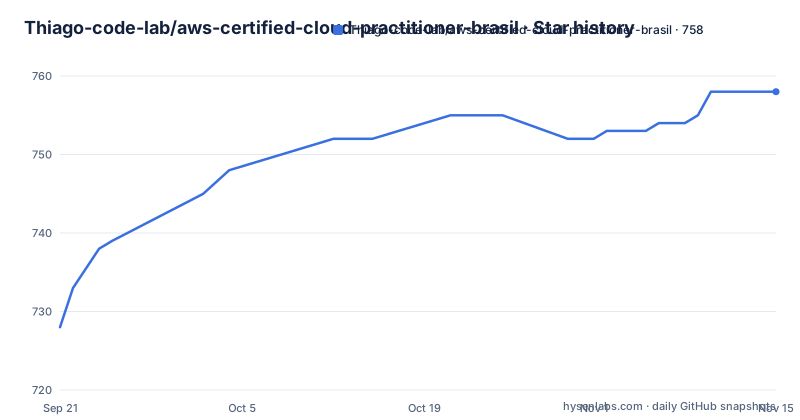
Star history
- Thiago-code-lab/aws-certified-cloud-practitioner-brasil758 ★ · +30
| Repository | 2026-09-21 | 2026-11-15 |
|---|---|---|
| Thiago-code-lab/aws-certified-cloud-practitioner-brasil | 728 | 758 |
30 Stars in the last 55 days, measured from the daily GitHub snapshot. Compare with other projects
Editorial analysis
Eighteen numbered directories, and storage appears twice
The repository body is 18 directories named with a two-digit prefix, and the numbering is the index. Module 01 is Introdução à Computação em Nuvem, 02 is Amazon EC2, 03 is Segurança e Conformidade, 04 is Amazon S3, 05 is Redes e Conectividade, 06 is Banco de Dados, 07 is Computação Serverless, 08 is Armazenamento, 09 is Monitoramento e Governança, 10 is Precificação e Suporte. Then 11 Migração e Inovação, 12 Cloud Adoption Framework, 13 Well-Architected Framework, 14 IA e Machine Learning and 15 Serviços para Desenvolvedor. The last three are not subject modules: 16 is Simulados e Questões, 17 is Glossário AWS and 18 is Recursos e Links. The overlap to watch is storage, which appears as module 04 for Amazon S3 and again as module 08 for Armazenamento, so the same subject has two entry points and the README never says which one it wants you to take.
The roadmap's middle band does not match the modules inside it
The study roadmap groups the 18 modules into four bands: 01 to 05 for cloud basics, security and networking, 06 to 10 for data services, storage and costs, 11 to 15 for adoption context, architecture and innovation, and 16 to 18 for consolidation, review and next steps. Check the middle band against the directory names and the mapping only partly holds. Module 06 is Banco de Dados and 08 is Armazenamento and 10 is Precificação e Suporte, which do fit data, storage and cost. Module 07 is Computação Serverless and 09 is Monitoramento e Governança, which fit neither of those three words. So a reader following the band order meets serverless and monitoring inside a band that does not mention them, and a reader who wants to jump straight to governance has to work out from the directory name that 09 is where it lives. The first band has the same looseness: 01 to 05 is described as cloud basics, security and networking while also holding Amazon EC2 and Amazon S3.
Five review layers, and only four of them are paths you can open
The review ecosystem is laid out as a table of five layers. Revisão por módulo is meant to fix exam signals in the module's own context, and it is the one row whose link is not a file: it points at an in-page anchor written with an accent, `#módulos`, rather than at a directory. Revisão por domínio goes to `quick-review/`, described as a way to correct recurring mistakes without rereading everything. Notas curtas goes to `notes/`, reinforcing essential concepts by topic. Flashcards goes to `flashcards/`, described as active recall with hidden answers. Simulados goes to module 16, `16-Simulados-e-Questoes/`, for commented questions. So the intended loop is: read a module, drill it per domain, keep short notes, recall with cards, then test yourself against commented questions. Four of those five layers are real directories in the tree. The anchor row is the one place where the table stops describing the filesystem.
The recommended route picks four modules out of eighteen
Rather than a reading order, the README offers a review route of five steps, each pairing a module with one quick-review file. Fundamentals is module 01 with `quick-review/fundamentos.md`. Security is module 03 with `quick-review/seguranca.md`. Storage is module 04 with `quick-review/armazenamento.md`. Costs is module 10 with `quick-review/custos.md`. The fifth step is a short consolidation pass over `quick-review/` plus `flashcards/`. That list is a useful priority order and it is also an admission: fourteen of the eighteen modules, including EC2, networking, databases, serverless, monitoring, migration and the two frameworks, get no slot in the recommended path at all. The storage row also inherits the naming collision from the module table, since module 04 is Amazon S3 while the review file it pairs with is called armazenamento.md, the same word as module 08.
The first screen is a marketing funnel, not a table of contents
Before any module link, the README spends its whole opening block on CloudStudy. The headline promises theory, flashcards, cheatsheets, commented questions and practical labs for the CLF-C02 exam. The next line asks readers to join the CloudStudy waitlist to receive early access to the platform. After that come two outbound links that have nothing to do with study material: a Udemy course, engenharia de dados na AWS do zero aos projetos reais, whose URL carries a referralCode parameter, and a WhatsApp group invite whose URL ends in mode=gi_t. Instagram and LinkedIn round out the block. So the repository presents itself as the open base and the platform as the product, and the repository's own homepage is set to cloudstudy.com.br rather than to a page describing these files.
labs, cheatsheets and diagrams sit in the tree with no link pointing at them
Beyond the 18 modules, the top level carries assets/, cheatsheets/, diagrams/, docs/, flashcards/, labs/, notes/ and quick-review/, plus an index.html and a .github/ directory. Four of those are named in the README's own promises and left dangling. Labs are promised twice, in the headline sentence and in the overview table's final block, which reads notas, cheatsheets, flashcards, labs e docs de fluxo de estudo, and a labs/ directory does exist. Cheatsheets are promised in the same headline and a cheatsheets/ directory exists, yet the review ecosystem table has no row for them, listing instead per-module review, per-domain review, notes, flashcards and mock exams. Diagrams and docs are both present as directories and neither appears in any table. The overview table's four blocks, Fundamentos, Serviços centrais, Revisão and Apoio, describe intent rather than link anything.
The repository is an HTML site as much as a set of notes
The recorded primary language is HTML, and the tree explains why: there is an index.html at the root next to assets/ and diagrams/, with no build manifest, no package file and no source directory. Nothing in the README explains what index.html renders or where it is deployed, and the homepage field points at the commercial site rather than at it. The .github/ directory is the only automation present; there is no CI workflow described, no contributing guide, no code of conduct and no changelog at the top level. The single licence file is MIT. That combination, numbered Markdown directories plus one HTML entry point plus a small automation folder, describes a hand-maintained study site whose build process, if it has one, lives outside the repository.
Two sibling repositories extend the same track, and there is no version
The study path continues in two other repositories by the same author: aws-certified-solutions-associate-brasil for the AWS Solutions Architect Associate, SAA-C03, framed as progression toward architecture decisions, scalability and solution design, and aws-certified-ai-practitioner-brasil for the AWS AI Practitioner, AIF-C01, framed as a complementary track on generative AI fundamentals and AWS AI services. Between them, three repositories form a sequence from practitioner to architect. What none of them carries is a version. There are no GitHub releases, no tags and no dated changelog, and the last push to this repository landed on 9 September 2026. For a set of study notes that is survivable, but it means an exam reference such as CLF-C02 has no history attached to it, so a reader cannot tell from the repository when a module was last corrected or whether it was corrected against an older exam outline.
Editorial conclusion
Judgment: the repository is worth cloning if you read Portuguese and want a flat, local set of AWS notes, and not worth adopting as a curriculum on faith, because the sequencing is thinner than the file count suggests. Three checks before you commit to it: pick the modules you actually need rather than reading 01 through 18 in order, since the roadmap's own band descriptions do not line up with the directories inside them; look for the labs and cheatsheets yourself, because both folders exist and no link in the README points at them; and treat the exam-code references as text to verify against AWS, not as a promise about which exam version is current. Anyone expecting a maintained course with dates, contributors and version history will not find it here.
Frequently asked questions
What is the aws-certified-cloud-practitioner-brasil repository?
A study base written in Brazilian Portuguese for the AWS Cloud Practitioner exam CLF-C02, organised as 18 numbered module directories plus quick-review, notes, flashcards, cheatsheets, labs and diagrams folders. The README is in Portuguese and the repository is MIT licensed.
Which modules does aws-certified-cloud-practitioner-brasil cover?
Eighteen, from Introdução à Computação em Nuvem in 01 and Amazon EC2 in 02 through Segurança e Conformidade in 03, Amazon S3 in 04 and Redes e Conectividade in 05, then back matter in 16 Simulados e Questões, 17 Glossário and 18 Recursos e Links. Modules 11 to 15 cover migration, CAF, Well-Architected, AI and developer services.
How does the CloudStudy review material fit together?
Five layers: per-module review, per-domain review under quick-review/, short notes in notes/, flashcards with hidden answers, and commented mock exams in module 16. A recommended route pairs module 01 with fundamentos.md, 03 with seguranca.md, 04 with armazenamento.md and 10 with custos.md, then adds quick-review and flashcards.
Is there a paid platform behind aws-certified-cloud-practitioner-brasil?
The README describes itself as the open base and asks readers to join the CloudStudy waitlist for early access to the platform. It also links a Udemy course whose URL carries a referral code, a WhatsApp group invite, and Instagram and LinkedIn accounts.
Are there other AWS certification tracks in this series?
Two sibling repositories by the same author, aws-certified-solutions-associate-brasil for SAA-C03 and aws-certified-ai-practitioner-brasil for AIF-C01. This repository itself has no GitHub releases and no tags, so there is no version to pin.
Official sources
Add this badge to your README
If you maintain this project, the badge below links readers to this analysis and shows its maintenance status from the daily GitHub snapshot. Paste the markdown into your README; add ?metric=license or ?metric=stars to the image URL for a different field.

[](https://hysenlabs.com/projects/thiago-code-lab-aws-certified-cloud-practitioner-brasil)Star history chart for your README
[](https://hysenlabs.com/projects/thiago-code-lab-aws-certified-cloud-practitioner-brasil)Was this useful?