J-Space V3.7 asks you to copy nine modules and a controller, and the tree has none of them
GLM-5.3-Flash × J-Space capability realization — benchmark presentation of the J-Space Cognition Suite
At a glance
- What is it?
- A model-agnostic inference-time Skill for long-horizon agent work, organized as one entry file, nine selectively loaded modules, four references and an optional standard-library controller. The benchmark table in the repository has one visible row, and on that row the suite moves GLM-5.3-Flash from 55.3 to 59.2 on a hard benchmark while a larger GLM variant scores 62.5.
- Who is it for?
- The idea here is worth reading whoever you are: an agent that externalises its working state, records what would settle an open question, and checks outgoing text for register leakage is a design most agent frameworks skip. As a distribution, though, this repository is a report and not the suite.
- Can I use it commercially?
- Check first. The repository uses a licence we do not classify automatically, so read its LICENSE file before any commercial use.
- Is it still maintained?
- Yes. The repository last received commits 82 days ago.
- What is it written in?
- GitHub does not report a main language for this repository.
Answers come from the project's GitHub data, last synced on November 25, 2026, and from our analysis. They are not legal advice.
Star history
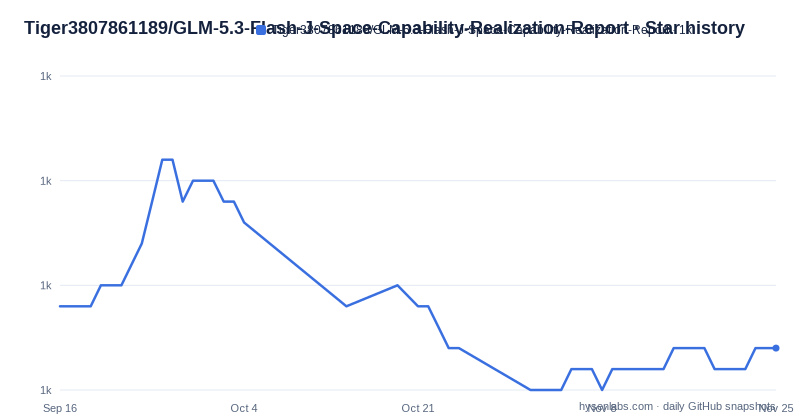
- Tiger3807861189/GLM-5.3-Flash-J-Space-Capability-Realization-Report1,017 ★ · -2
| Repository | 2026-09-16 | 2026-11-25 |
|---|---|---|
| Tiger3807861189/GLM-5.3-Flash-J-Space-Capability-Realization-Report | 1k | 1k |
-2 Stars in the last 70 days, measured from the daily GitHub snapshot. Compare with other projects
Editorial analysis
The install prompt names a different repository
There are two install routes and the second one points somewhere else. Option A is manual and stays inside this repository: download or clone it, find the user-level Skills directory your host uses, copy the complete j-space/ directory into it so the installed entry sits at that directory plus j-space/SKILL.md, then run the integrity check with whatever Python 3 command the host has, which it names as python, python3 or py -3, and reload the host if it discovers Skills at startup. Option B is a prompt you paste into an agent, and that prompt begins by naming an installation source at a repository called J-Space-Cognition-Suite-V3.7, which is not the repository this page lives in. The prompt also carries the safer half of the design: locate the correct directory first, preserve the known subdirectories, and if a j-space target already exists, compare it and ask before replacing anything.
The directory you are told to copy is not in the tree
The install steps assume a layout that the repository root does not have. The top-level entries are a Zenodo metadata file, a citation file, the license, an English README, a Simplified Chinese README, and one PDF. There is no j-space/ directory, no modules/, no references/ and no scripts/. The instructions go further and name a file the root also does not contain: the third-party notices file is stated to remain part of the distribution, and both it and the license are supposed to be included when redistributing the directory as a standalone package. Two of the claims reinforce each other. SKILL.md is said to route to relative paths under modules/, references/ and scripts/, so the directory has to stay intact, and the integrity check script is supposed to be run after installation. All of that presumes files that the tree listing does not show.
Three passes, and the gate picks one without being asked
The entry gate selects the lightest suitable pass automatically, which is the core economy of the design. There are three. The fast pass is for one step or a result checkable in a single glance, and it loads nothing extra. The full pass is for several dependent steps and one bounded deliverable, and it loads one or two relevant modules, with the ship command run before delivery. The loop pass is for work spanning multiple stages, files, turns, tools or persistent state, and it loads the ledger, the seams, the checkpoints, a register audit and recovery. The stated rule underneath is that a request for brevity changes the outer response length while verification stays aligned to the task's floor, so short work stays light and long work receives durable state only when it needs it. Three levels for one entry file is a smaller surface than it sounds, and the choice is made for the caller.
Seven mechanisms, none of them a fixed checklist
The mechanism table has seven rows and one explicit disclaimer underneath: they are selectively loaded, and they are not a fixed checklist for every request. Selective workspace loading keeps one or two load-bearing ideas active and externalises the rest. A broadcast hub gives dependent branches one shared source for names, values, constraints and style anchors. Dense Track carries long internal chains in compact decodable notation before returning to clean outer language. Bridge-before-conclusion reasoning makes required intermediates explicit before a conclusion consumes them. Metacognitive control routes confidence, inconsistency and failure signals into a concrete next action. Empirical escape and verification turns a stalled derivation into bounded tests with a named verifier and coverage. And first-person agency uses the pronouns I, we and let's to bind workspace state to later actions and checks, which is the one row that is a style rule as much as a mechanism.
The controller writes only under .jspace/ and needs no packages
The optional controller is a single script that externalises loop state into a .jspace/ directory in the current task workspace, and the boundary it promises is narrow on purpose. It uses the Python standard library, and it writes working state only under that directory. It records and reports state, and the solution choice stays with the model, so the controller is bookkeeping rather than a decision engine. The command set is one verb with several shapes plus three standalone ones. The note command opens the ledger with a goal and a first action, replaces the single next action after a checkpoint, records and swaps hub entries including a slot index, appends a checkpoint with a verifier and coverage, opens a question with what would settle it, and closes a numbered question against a new checkpoint. Then seam re-reads state and reports recent movement, ship inspects outgoing text for register leakage and failure signatures, and resume reloads the premise, the invariants and the full ledger after a long gap. The invocation shape is uniform, which is what makes it scriptable:
<python-command> <skill-root>/scripts/jspace.py note --goal "what done means" --next "first action"
<python-command> <skill-root>/scripts/jspace.py seam
<python-command> <skill-root>/scripts/jspace.py resume
On the one visible benchmark row the gap to a larger model stays open
The benchmark section is where a reader should slow down, and it is worth reading the visible row as a claim rather than as a conclusion. The table compares five things: GLM-5.3-Flash alone, GLM-5.3-Flash with the suite at version 3.7, GLM-5.3, Opus-5 and Fable 5.1. On the first row, a hard benchmark with tools enabled, the numbers are 55.3 for the flash model alone and 59.2 with the suite, which is a real gain of nearly four points. The same row reads 62.5 for the larger GLM variant, 64.7 for Opus-5 and 65.0 for Fable 5.1. So on the one row that is visible here, the suite improves the smaller model and does not bring it level with the next model up, let alone the two at the right of the table. The remaining rows are further down, and the presentation around the table is a capability comparison rather than a claim of parity.
Version 3.7 in the heading, release V4 in the tag
The version story is inconsistent across three places, and it is visible without opening anything. The page heading names the suite as version 3.7, the benchmark column header names the suite as version 3.7 as well, and the repository description frames the whole project as a capability realization report for one model paired with the suite. The single published release, however, is tagged V4 and named for the report rather than for the suite. The archive side is tidier: there is a DOI badge pointing at Zenodo and a citation file at the root, which is what you would expect from something meant to be archived, and the Simplified Chinese README is listed alongside the English one. The last commit to the default branch is dated 2026-09-05, the same day as that release, and the repository records no primary language at all.
Editorial conclusion
The idea here is worth reading whoever you are: an agent that externalises its working state, records what would settle an open question, and checks outgoing text for register leakage is a design most agent frameworks skip. As a distribution, though, this repository is a report and not the suite. The install steps name a different repository, the directory you are told to copy is not in the tree, and a third-party notices file is required and missing. Before trying to run it, find the actual suite repository, confirm the nine modules and the controller script exist there, and treat the benchmark table as one visible row rather than a case.
Frequently asked questions
What is the J-Space Cognition Suite?
A model-agnostic inference-time control system for deep reasoning, long-horizon work, tool use, verification and recovery, packaged as a Skill. Model weights and training are unchanged, and it works through one entry, nine selectively loaded modules, four references and an optional controller.
How do I install the J-Space Cognition Suite manually?
Copy the complete j-space/ directory into the user-level Skills directory your host uses, so the entry is at j-space/SKILL.md, then run scripts/verify_suite.py with an available Python 3 interpreter and reload the host. The directory has to stay intact because the entry routes to relative paths under modules/, references/ and scripts/.
What are the three operating passes in J-Space?
fast for one step or a glance-checkable result, loading nothing extra; full for several dependent steps and one bounded deliverable, loading one or two modules and running ship before delivery; and loop for multi-stage work, loading the ledger, seams, checkpoints, a register audit and recovery.
What does the J-Space controller change about the model?
Nothing about the model. It records and reports state, writes only under the task's .jspace/ directory, uses the Python standard library, and leaves the solution choice to the model. It opens and closes ledger questions, logs checkpoints, and can ship a file after inspecting it for register leakage.
Does J-Space bring GLM-5.3-Flash level with Opus-5?
On the one benchmark row visible in the repository, no. GLM-5.3-Flash goes from 55.3 to 59.2 with the suite, while the same row reads 62.5 for GLM-5.3, 64.7 for Opus-5 and 65.0 for Fable 5.1. The remaining rows are not visible here.
Official sources
Add this badge to your README
If you maintain this project, the badge below links readers to this analysis and shows its maintenance status from the daily GitHub snapshot. Paste the markdown into your README; add ?metric=license or ?metric=stars to the image URL for a different field.

[](https://hysenlabs.com/projects/tiger3807861189-glm-5-3-flash-j-space-capability-realization-report)Star history chart for your README
[](https://hysenlabs.com/projects/tiger3807861189-glm-5-3-flash-j-space-capability-realization-report)Was this useful?