TripleA: Java engine for maps, scenarios, AI, and multiplayer
TripleA is a turn based strategy game and board game engine, similar to Axis & Allies or Risk.
At a glance
- What is it?
- TripleA is an open-source Java engine for Axis and Allies-style strategy and board games. It suits players who want community maps, single-player AI, and lobby-based multiplayer, but the README does not document source builds, deployment, or rollback procedures.
- Who is it for?
- Players should adopt TripleA when they want downloadable community maps and an engine with documented single-player AI and live multiplayer support. Developers should first inspect `/docs/development/README.md` and `/docs/contribute.md`, because the README does not describe source installation, runtime requirements, server administration, or rollback.
- Can I use it commercially?
- Yes, with conditions. GPL-3.0 is a copyleft licence: if you distribute software that includes it, you must release that software's source code under the same licence. Running it internally without distributing it does not trigger that obligation.
- Is it still maintained?
- Yes. The repository last received commits 2 days ago.
- What is it written in?
- Mainly Java, according to GitHub's language statistics.
Answers come from the project's GitHub data, last synced on November 7, 2026, and from our analysis. They are not legal advice.
Star history
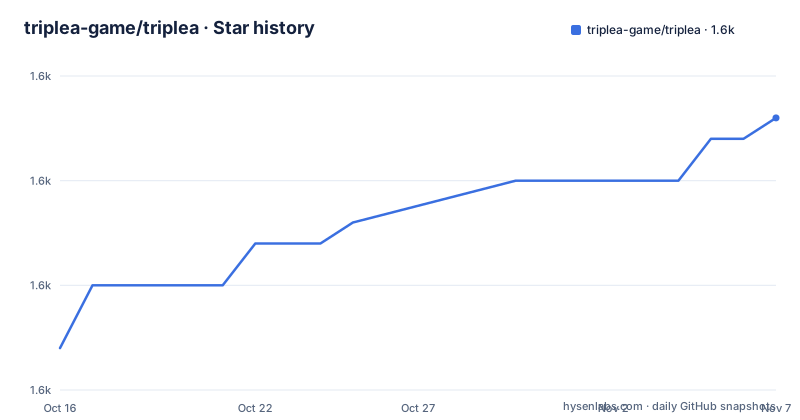
- triplea-game/triplea1,593 ★ · +11
| Repository | 2026-10-16 | 2026-11-07 |
|---|---|---|
| triplea-game/triplea | 1.6k | 1.6k |
11 Stars in the last 22 days, measured from the daily GitHub snapshot. Compare with other projects
Editorial analysis
What TripleA does for map-driven strategy players
TripleA addresses a specific extensibility problem: running turn-based strategy and board games whose rules are expressed through maps and scenarios rather than as separate native applications. The README describes gameplay in the Axis and Allies tradition, including territorial movement, combat, historical settings, and custom maps. Its audience includes people who want to play existing scenarios, creators who publish those scenarios, and developers who work on the Java game engine beneath them.
The content range is broader than its World War II topic label suggests. The README names a scenario about the Axis advance toward Moscow, Napoleon's march across Europe, and Rome's conflict with Carthage. It also mentions a fantasy setting based on Sauron's conquest of Middle Earth. That distinction matters because TripleA is presented as a game engine rather than one fixed campaign. A player can encounter different rule systems and maps through the same project, while a creator can target audiences beyond conventional historical war games.
The repository name and description use the terms strategy game, board game engine, Axis & Allies, and Risk as points of comparison. The README itself uses “Axis and Allies-style gameplay.” It does not provide a compatibility claim, compatibility matrix, or statement that maps from those other games can be imported. Those comparisons should therefore be treated as descriptions of the play style, not proof of interoperability.
TripleA also divides its stated capabilities across three use cases. Single-player users are served by what the README calls a well-developed AI. Multiplayer users are directed toward an active lobby. Scenario users receive community-created maps spanning history and fantasy. This makes the project relevant both as a consumer game client and as a base for contributors, although the README provides more detail about the player-facing scope than about the internal extension interfaces.
TripleA's repository structure and build surface
The repository layout identifies a Gradle-based Java project. The top level contains `build.gradle.kts`, `settings.gradle.kts`, `gradle.properties`, the `gradlew` and `gradlew.bat` launchers, and a `gradle/` directory. It also includes a `Justfile`, `mise.toml`, `format`, and `verify`, which indicate that development tasks are organized beyond the README shown here. The exact goals and task names of those files are not documented in the excerpt.
The application code appears under `game-app/`. Separate `http-clients/`, `lib/`, and `scripts/` directories indicate that network-facing code, dependencies, and repository utilities occupy distinct areas. This is a repository-structure observation, not a claim about runtime isolation or test coverage. The README does not provide a package diagram, dependency graph, event flow, save format, or network protocol, so a detailed runtime architecture cannot be confirmed from the project documentation available here.
Additional repository entries suggest that packaging and service concerns extend beyond the game code. The `.docker/` directory points to container-related assets, while `lobby_server.yaml`, `servers.yml`, and `triplea_maps.yaml` identify configuration associated with lobby services, servers, and maps. The documentation does not explain which component consumes each file, which settings are required, or whether a player needs to configure them. Those files should not be treated as turnkey server deployment instructions.
For contributors, the authoritative starting point named by the README is `/docs/development/README.md`. The README also points to `/docs/contribute.md` for contribution routes. The top-level presence of `AGENTS.md`, `CLAUDE.md`, `.pre-commit-config.yaml`, and `.github/` indicates additional contributor tooling, but the README does not explain the contents or required workflow of those files.
Downloading TripleA and making the first launch
The README's installation route is short. It directs users to the official download page at `http://triplea-game.org/download/`. It does not publish package names, Java commands, operating-system requirements, disk requirements, or checksum instructions. Consequently, there is no verified command sequence to reproduce for installing TripleA from the source repository.
For a first real use, start by downloading the version offered through that official page and selecting a downloadable map or scenario. The README does not explain how maps appear in the client, where a downloaded file is stored, or which action launches a map after installation. It also does not document whether accounts are required for single-player play or how a player enters the multiplayer lobby. Those interactions need to be confirmed from the downloaded application or the linked support forums.
A practical sequence is to obtain the desktop release from the official download page, obtain a map or scenario, then launch TripleA and load that content through the interface provided by the release. The README does not identify an exact menu path, so an invented interface sequence would not be reliable. The support route it names is the TripleA forums category for help questions at `https://forums.triplea-game.org/category/10/help-questions`.
For a confirmed defect, the repository provides a new issue form at `https://github.com/triplea-game/triplea/issues/new`. The README does not document how to reproduce a multiplayer failure, attach logs, save a game, or return to a previous state, so users should not assume that ordinary issue submission captures all diagnostic context.
Source-based adoption is a separate path. Although the repository includes `gradlew`, `gradlew.bat`, and Gradle configuration, the README does not show the Gradle task needed to compile the application or produce a distributable package. It would be unsafe to invent a command such as `./gradlew run` or `./gradlew build`. Contributors are directed to `/docs/development/README.md`, and `build.gradle.kts` is the next repository file to inspect for actual tasks and prerequisites.
AI, lobby multiplayer, and scenario boundaries
Single-player and online play are separate capabilities in the project's stated design. The README advertises a “well-developed AI for single-player experiences” and separately identifies an “active lobby for live multiplayer games.” That wording supports the conclusion that TripleA supports these modes, but it does not document AI difficulty settings, match search behavior, lobby dependencies, networking requirements, moderation, account rules, or server capacity.
The lobby reference matters for anyone evaluating hosted multiplayer. A player may need access to the lobby service to find or join live games, while the repository also contains `lobby_server.yaml`. However, neither the README nor the listed repository entries say whether this configuration is for developers, maintainers, or self-hosted operators. There is no documented port, deployment command, database requirement, reverse-proxy setting, or production checklist. The appropriate conclusion is not that self-hosting is unsupported, but that it is not documented here.
Scenario breadth also introduces compatibility work. A fantasy map can represent subject matter and mechanics very different from a World War II map, but the README does not identify a versioned map schema, editor, validation command, or backward-compatibility policy. Files named `triplea_maps.yaml`, `format`, and `verify` may be relevant to repository maintenance, yet the documentation does not connect them to an end-user publishing procedure. Map creators should verify the current repository documentation before designing automation around those paths.
TripleA is a poor fit for a user who wants only a small, self-contained modern game with a clearly documented API and cloud backend. Its documented appeal depends on community content, AI play, and multiplayer participation. It is more relevant when the availability of multiple maps and scenarios is part of the desired experience, but the README does not promise that every community map follows the same rules, quality controls, or compatibility level.
GPL-3.0 obligations and stated library permission
TripleA is distributed under the GNU General Public License v3.0, identified in the repository metadata and README. The repository contains a `LICENSE` file and links to it from the README. An organization considering modification, redistribution, or integration should review that license text and assess its obligations for the intended distribution. This is a project-specific licensing note, not legal advice.
The README also records an additional permission under GPL version 3 section 7 for conveying a resulting work that combines or links TripleA with Jakarta Mail or a modified version of that library. It identifies the library as group ID `com.sun.mail`, artifact ID `jakarta.mail`, and SPDX license ID `GPL-2.0-only`. The permission is framed around conveying the resulting combined or linked work and should not be generalized to unrelated dependencies.
The README does not list every third-party library, their versions, or all distribution notices. It also acknowledges YourKit Java Profiler and says the project received an open-source license for it. That acknowledgment is not the same as TripleA's own runtime license, and the README does not explain how that profiler is incorporated into a distributed build. Reviewers should use the repository's license and dependency files rather than infer the complete distribution position from the README alone.
Maintenance state and upgrade work
The repository is not archived. Its last push was on 2026-10-16. The listed releases include `2026-10.16.15815`, `2026-10.16.15813`, and `2026-10.16.15812`, all dated 2026-10-04. These records show repository activity and multiple releases around the same date, but they do not establish the project's full release cadence.
The version strings appear more specific than simple marketing labels, yet the README does not explain whether they represent nightly, experimental, stable, or packaging builds. It also gives no changelog contents, upgrade notes, migration guide, supported Java version, or compatibility statement between these releases. A player should check what changed between downloaded versions rather than assume that every build is interchangeable with existing maps or saves.
Upgrade cost is likely to matter to map authors, but the documentation does not identify a formal map-format migration process. It provides no deprecation schedule for configuration keys in `lobby_server.yaml`, `servers.yml`, or `triplea_maps.yaml`, and it does not document rollback. For contributors, changes in a Gradle-based Java project may require checking `build.gradle.kts`, `gradle.properties`, the Gradle wrapper, and `/docs/development/README.md` before applying updates. The wrapper filenames are confirmed, but the README does not state the Gradle version or supported Java runtime.
Editorial conclusion
Players should adopt TripleA when they want downloadable community maps and an engine with documented single-player AI and live multiplayer support. Developers should first inspect `/docs/development/README.md` and `/docs/contribute.md`, because the README does not describe source installation, runtime requirements, server administration, or rollback. Map authors should verify the supported map format before committing to a publishing workflow.
Frequently asked questions
How do I download and install TripleA?
The README directs users to the official download page at `http://triplea-game.org/download/`. It does not document operating-system requirements, source-build commands, or package dependencies.
Does TripleA support single-player games and multiplayer?
The README describes both a well-developed AI for single-player experiences and an active lobby for live multiplayer games. It does not provide AI settings, lobby account requirements, or networking configuration.
Can I create or modify maps for TripleA?
The project supports community-created maps and scenarios, but the README does not document an editor, map format, validation command, or publishing process. Contributors are directed to `/docs/contribute.md`, while developers are directed to `/docs/development/README.md`.
Official sources
Add this badge to your README
If you maintain this project, the badge below links readers to this analysis and shows its maintenance status from the daily GitHub snapshot. Paste the markdown into your README; add ?metric=license or ?metric=stars to the image URL for a different field.

[](https://hysenlabs.com/projects/triplea-game-triplea)Star history chart for your README
[](https://hysenlabs.com/projects/triplea-game-triplea)Was this useful?