uzu pins three installs to a release and tracks the main branch for the fourth
A high-performance inference engine for AI models
At a glance
- What is it?
- A Rust inference engine with bindings for Python, TypeScript and Swift, marketed around local deployment. The repository is more interesting than the marketing: seventeen of nineteen workspace crates are marked as due to be rewritten, model identifiers are structured registry strings, and the licence claim is backed by a dependency checker rather than a file alone.
- Who is it for?
- This is a young engine from a company rather than a research group, and the repository is candid in a way that is easy to miss. The internal structure is mid-rewrite and the documentation reflects that, so read the manifest before estimating the surface area.
- Can I use it commercially?
- Yes. MIT is a permissive licence: you can use, modify and sell software built on it, as long as you keep its copyright and licence notices.
- Is it still maintained?
- Yes. The repository received new commits within the last day.
- What is it written in?
- Mainly Rust, according to GitHub's language statistics.
Answers come from the project's GitHub data, last synced on November 25, 2026, and from our analysis. They are not legal advice.
Star history
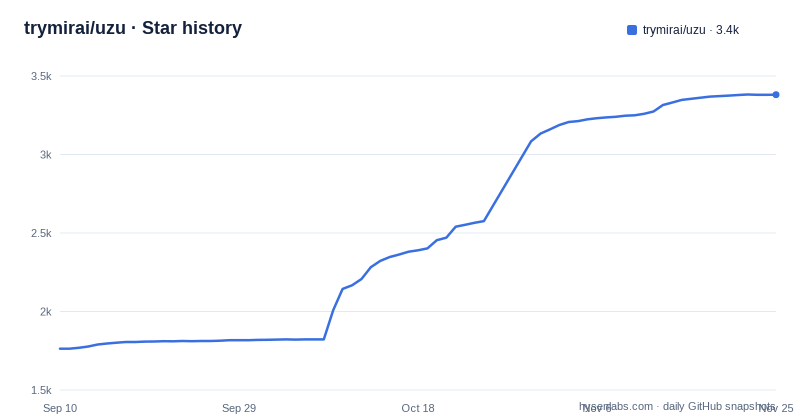
- trymirai/uzu3,381 ★ · +1,618
| Repository | 2026-09-10 | 2026-11-25 |
|---|---|---|
| trymirai/uzu | 1.8k | 3.4k |
1,618 Stars in the last 76 days, measured from the daily GitHub snapshot. Compare with other projects
Editorial analysis
Three installs pin a release and one tracks the moving branch
Four language sections in the quick start, and they are not equivalent.
The Python section installs an exact released version. The TypeScript section pins the same exact version of the package. The Swift section takes a version requirement that resolves to that release.
The Rust section does something different. It adds a git dependency pointing at the repository, naming the main branch explicitly, plus a package selector for when the repository holds more than one package:
[dependencies]
uzu = { git = "https://github.com/trymirai/uzu", branch = "main", package = "uzu" }
There is no version in that line at all.
So a reader following the Rust quick start is building against whatever is on the tip of the branch, while a reader in any other language is building against a fixed artefact. In the language the project is actually written in, the documented example is the least reproducible one.
That is a small thing in isolation and an annoying one in practice, because the Rust path is the first section on the page and the one a contributor is most likely to follow. Pinning it to a tag costs one character in the dependency line and makes all four sections agree.
Seventeen of nineteen workspace crates are marked to be rewritten
The workspace manifest is where this project's real state is visible, and it opens with a split.
Two crates are the new engine and a companion macro crate. Then there is a comment marking a block as due to be rewritten, followed by seventeen more crates nested under a directory named legacy. Everything that produces the language bindings lives in that older half.
The names in there are worth noting. Several are ordinary English words describing function. Several are Japanese words, which fits a team that has apparently used its own vocabulary for internal components rather than translating them.
What this means in practice is that the public API and the machinery behind it are on different generations of the same codebase. A contributor reading the crate list has to work out which half owns the code they want to change, and the answer for anyone touching bindings or the session layer is the half scheduled for replacement.
The bindings being the legacy part is the more awkward half of that arrangement, since the bindings are what most users of this project actually touch.
The licence claim is checked by a tool, not just a file
The repository declares MIT in the manifest and ships a licence file, and both are unremarkable.
What is more interesting is a configuration file for a dependency checker sitting at the root beside them. That file is what makes a licence claim mean something in a project of this shape: nineteen crates, four language bindings, and a set of external dependencies whose licences the project does not control.
It sits alongside a linter configuration, a formatter configuration, an analyser configuration and a pinned toolchain file. That is a repository that has decided to make its toolchain reproducible and to police its own dependency tree, which is more than most projects of this age do.
The presence of that file is also what makes the rewrite comment worth taking seriously. If the dependency checker is enforced, then a rewrite across seventeen crates has a licence dimension as well as a technical one, and the team has already built the tool to answer that question.
The manifest claims text-to-speech and the documentation never mentions it
The keyword list in the manifest names the domain in one line: graphics acceleration, inference, language models, and text to speech.
Nothing in the documentation matches that last one. The feature list covers a simple API, unified model configuration, traceable computation, unified memory on Apple hardware, and broad model support. All four quick starts download a chat model and open a chat session. The six documented example categories are chat in several forms, plus structured output and tool calls.
There is no speech example, no speech option, and no sentence about audio anywhere in the visible documentation.
That mismatch is small in isolation. A keyword is an aspiration as often as a description, and a company may well be building toward text to speech. But a reader choosing between this engine and another on the basis of scope will find the manifest promising something the documentation never delivers, and the framework for structured output and tool calling is described only through an example name rather than a paragraph.
The one substantive technical claim in the feature list, traceable computation checked against a reference implementation, also appears without elaboration.
Models are named by structured identifiers, not filenames
Every quick start asks the engine for the same model, and the identifier it passes is worth reading as a format rather than as a name.
It is a colon-delimited string naming a vendor, a model, a size, an organisation, and what appears to be a quantisation level. The same string appears in all four languages, byte for byte.
The engine then resolves that identifier, reports whether it found anything, and downloads it with a progress stream that the caller consumes. In two of the four snippets the download progress is printed to standard output, in one the caller iterates the stream directly, and in one the downloader is held in a variable that the truncated snippet does not go on to use.
That structure is the answer to why the project can claim unified model configuration. Adding a model is a registry entry rather than an integration, and the caller never handles a path, a filename or a format. Whether that pays off depends entirely on whether the models you want are in the registry, which is a list the documentation links to rather than one it reproduces.
Four languages, four different ways to handle the same error
The same condition, a model identifier that resolves to nothing, is handled four different ways across the quick starts.
The Rust snippet returns an error from main. The Python quick start returns from the coroutine without raising. The Python chat example raises a runtime error. The Swift snippet returns early from a throwing function. The TypeScript snippet throws.
Progress output is equally divergent. Rust writes a carriage return and an erase-line sequence by hand. Python formats a percentage and flushes explicitly. Swift calls the C library's flush function directly, which is not idiomatic for that language and exists purely because the buffered output would otherwise arrive in one lump at the end. TypeScript writes through the process's standard output stream.
None of this matters for a reader copying one snippet. It matters to anyone writing the bindings, because the conventions are not unified, and it is a hint about how the layers were written: each language appears to have been implemented against its own idioms rather than generated from one shared description of the interface.
The dev environment comes from a Nix flake and three editor configs
The root listing shows a repository configured for a specific way of working.
There is a Nix flake with a lock file, and beside it a directory-activation file, so the development environment is declared and pinned rather than assembled from a setup script.
There are also separate configuration directories for three editors, plus a shared configuration directory. That is a small thing, but shipping editor settings is a statement: the project expects specific formatting and key bindings, and it wants you working the way its maintainers do.
The Rust side is fully configured as well, with dedicated files for the linter, the formatter, the language server and the toolchain version, and the manifest requires a very recent compiler release. That floor is high, so a contributor on an older stable toolchain cannot build this without updating first.
One entry is harder to place: a C language formatter configuration, in a repository that declares Rust as its language and whose workspace members are all Rust. Something in the tree is native code, or was.
Examples are run through a cargo subcommand that takes a language and an example name, with six example categories available.
Editorial conclusion
This is a young engine from a company rather than a research group, and the repository is candid in a way that is easy to miss. The internal structure is mid-rewrite and the documentation reflects that, so read the manifest before estimating the surface area. If you evaluate it, hold the Rust dependency on a tag rather than a branch, because the four documented installs are not equivalent and the one that tracks the moving branch is the one written in the language the project is written in. Judge the claims about latency on your own hardware, and read the model identifier format first, since it tells you what adding support for a new model actually involves.
Frequently asked questions
What is uzu?
It is an inference engine for AI models written in Rust, with bindings for Python, TypeScript and Swift. It is marketed around deploying models inside an application with local execution for data privacy and no per-call inference cost, and it uses unified memory on Apple hardware.
How do I install uzu in each language?
Python and TypeScript pin the exact released version, and Swift takes a version requirement. The Rust quick start instead adds a git dependency pointing at the main branch with a package selector, so it builds against the tip of the branch rather than a fixed release.
How are models referenced in uzu?
By a structured colon-delimited identifier naming a vendor, model, size, an organisation and a quantisation level, the same string in every language binding. The engine resolves the identifier, reports whether it was found, and downloads it with a progress stream the caller consumes.
Is the uzu codebase stable?
The workspace manifest lists two engine crates and then seventeen crates under a legacy directory marked with a comment saying they are to be rewritten. The language bindings live in that legacy half, so the public surface and the code behind it are on different generations of the codebase.
Does uzu enforce its own dependency licences?
The repository carries a configuration file for a dependency checker at the root, alongside linter, formatter, analyser and pinned toolchain configuration. With nineteen crates and four language bindings, that file is what gives the MIT declaration in the manifest something behind it.
Official sources
Add this badge to your README
If you maintain this project, the badge below links readers to this analysis and shows its maintenance status from the daily GitHub snapshot. Paste the markdown into your README; add ?metric=license or ?metric=stars to the image URL for a different field.

[](https://hysenlabs.com/projects/trymirai-uzu)Star history chart for your README
[](https://hysenlabs.com/projects/trymirai-uzu)Was this useful?