WenShape keeps the novel in files and the facts in canon/facts.jsonl
WenShape (formerly NOVIX Writing): a deeply context-aware, agent-based novel creation system.
At a glance
- What is it?
- WenShape (文枢, formerly NOVIX 写作) is an agent-based writing system for Chinese-language novels that stores a book as YAML, Markdown and JSONL, then retrieves canon facts by BM25 and logarithmic chapter distance. The Windows release is one click, but the licence name and the shipped debug defaults are the first things to read.
- Who is it for?
- WenShape fits a writer who is drafting a long Chinese-language novel and wants state that outlives one chat window, on Windows where the packaged release works. It does not fit a commercial product without reading LICENSE first, or anyone without a Python 3.10 and Node.js 18 pair.
- Can I use it commercially?
- Check first. The repository uses a licence we do not classify automatically, so read its LICENSE file before any commercial use.
- Is it still maintained?
- Yes. The repository last received commits 43 days ago.
- What is it written in?
- Mainly Python, according to GitHub's language statistics.
Answers come from the project's GitHub data, last synced on November 15, 2026, and from our analysis. They are not legal advice.
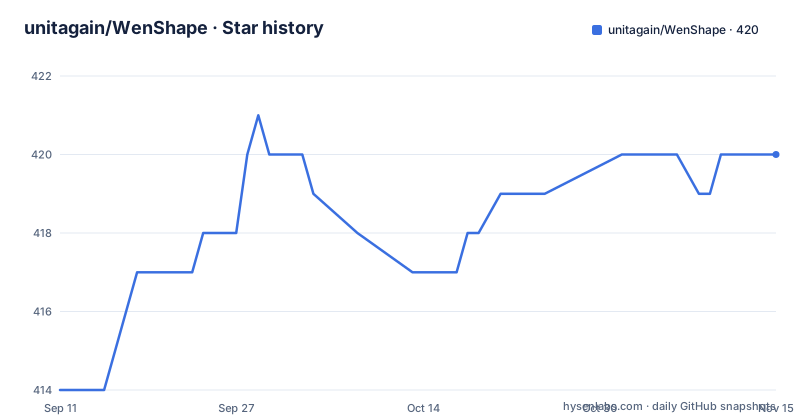
Star history
- unitagain/WenShape420 ★ · +6
| Repository | 2026-09-11 | 2026-11-15 |
|---|---|---|
| unitagain/WenShape | 414 | 420 |
6 Stars in the last 65 days, measured from the daily GitHub snapshot. Compare with other projects
Editorial analysis
WenShape keeps a novel in files, not in a chat window
WenShape treats a manuscript as a directory tree. Volume files sit in `volumes/*.yaml`, chapter and volume summaries in `summaries/*_summary.yaml`, and each chapter's finished text at `drafts/<chapter>/final.md` with a `scene_brief.yaml` beside it. Chapter order persists through an `order_index` field, so refreshing a batch of summaries cannot reshuffle the book. Backend work is split across `orchestrator`, `agents`, `context_engine` and `storage`, with agent roles named Writer, Editor and Archivist. Plain text is the point rather than a side effect: a reviewer can diff `drafts/` between commits, and a schema migration is a file edit instead of a database dump.
select_engine weighs facts by how far they sit from the current chapter
Handing a whole manuscript to a model is the failure WenShape is built against. Canonical facts live in `canon/facts.jsonl`, one record per line, and `evidence_service` builds the index that ties those facts back to the text they came from. Retrieval combines BM25 scoring with entity matching, chapter binding, and a distance term: `select_engine` applies a logarithmic decay on chapter distance, so a fact stated a few chapters back outweighs one stated forty chapters back, and a distant world-building fact is down-weighted rather than discarded. Because the curve is logarithmic, nearby facts dominate while far ones keep their weight slowly. Selection lives under `context_engine`, with the retrieval and binding helpers beside it in `services/`. Check the decay in your own project before blaming the model for ignoring canon.
World cards read description first and still merge the old rules field
Long-term setting assets split into three card types: `cards/characters/*.yaml`, `cards/world/*.yaml`, and a single `cards/style.yaml`. World cards are mid-migration. New records write a `description` field, while the loader still reads the older `rules` and `immutable` fields and merges them into the description text. Projects written before the change keep working, which is the point. The cost shows up when you script against these files: an old card and a new card that mean the same thing do not produce the same text handed to the model, so a diff between two projects can hide a real settings change behind a reordered merge.
Fan-fiction imports arrive as proposals, never as writes
The fan-fiction path runs in four steps: search, preview, crawl, propose. `search_service` queries Moegirl Pedia, Wikipedia and Fandom, and you can paste any `http/https` page address instead of searching. `crawler_service` handles body-text extraction, link recognition, and a multi-path fallback when one route returns nothing usable. The `fanfiction` router then hands the extracted page to the agents, which turn it into character and world card proposals. Nothing lands in the project directory on its own. Every import waits as a proposal you keep, edit or discard, which keeps the correction and cleanup work with a person rather than folding scraped wiki text straight into your canon.
llm_gateway plus per-agent provider overrides
Provider logic is concentrated in one module, `llm_gateway`, and the shipped `.env.example` shows how wide that surface is: OpenAI, Anthropic, DeepSeek, Gemini, Qwen, Wenxin and AI Studio, plus any OpenAI-compatible endpoint, with optional overrides that let the Archivist and the Writer use different vendors.
HOST=0.0.0.0
PORT=8000
DEBUG=True

# LLM Selection (deepseek, openai, anthropic, gemini, custom)
WENSHAPE_LLM_PROVIDER=custom

CUSTOM_BASE_URL=https://api.siliconflow.cn/v1
CUSTOM_MODEL_NAME=deepseek-ai/DeepSeek-V2.5

# WENSHAPE_AGENT_WRITER_PROVIDER=anthropic
Two defaults deserve a look before anything else. The backend binds `0.0.0.0` on port 8000 with `DEBUG=True` in that file, so a copied config serves debug responses to every interface on the network rather than only localhost. `WENSHAPE_LLM_PROVIDER=custom` is also the shipped default, aimed at a third-party aggregator rather than a vendor you picked.
start.bat checks your runtimes; WenShape.exe checks nothing
Two deployment paths, and they differ in what you must install first. From source you need Python 3.10+ and Node.js 18+:
cd WenShape-main
start.bat
`start.bat` hands off to `start.py` in the root, which verifies both runtimes, starts the backend and frontend, and fills in the base configuration on first run. The Windows release skips all of that: unzip the download from the Releases page, double-click `WenShape.exe`, and it starts with no Python or Node.js installed and opens the browser on its own. `build_release.py` produces that package into `dist/WenShape/`, bundling `config.yaml`, `.env`, `data/` and the static assets. Note the asymmetry: the repository also carries `start.sh` and `cleanup.bat`, and neither one appears in the README, so on Linux or macOS you are reading `start.sh` with no written procedure. A `GETTING_STARTED.md` sits in the root for that purpose, but the README never links to it, and the maintainers instead publish a reading order through the code itself.
PolyForm Noncommercial in the README, no recognised identifier in the metadata
Two facts sit awkwardly together. The README names `PolyForm Noncommercial License 1.0.0` with the full terms in `LICENSE`, and that name states its own limit, since a noncommercial grant does not cover commercial use. Meanwhile the repository's licence metadata resolves to no recognised identifier, so tooling that reads the licence field sees nothing it can act on. If you plan to put WenShape behind a paid product, read `LICENSE` yourself rather than trusting the field. Release cadence shows a similar gap between promise and artifact: the newest tag, v0.4.0, was published on 2026-04-07, and the last push landed on 2026-09-14, so commits have continued for five months past the last Windows build.
Where WenShape is the wrong tool
WenShape is a heavier answer than most sessions need. One long prompt in a chat window produces a chapter with none of this structure, no per-agent routing, and no card library. That is the right trade for a single scene and the wrong one for a book that must survive revision, because the state lives in the conversation instead of in files you can diff. WenShape earns its cost when the project is long enough that chapter order, canon facts and character cards need to outlive one sitting. Skip it if you cannot run a Python 3.10 and Node.js 18 pair locally, since the packaged path is Windows-only. The documentation is also Chinese-first, with `README.en.md` linked from the top rather than being the default.
Editorial conclusion
WenShape fits a writer who is drafting a long Chinese-language novel and wants state that outlives one chat window, on Windows where the packaged release works. It does not fit a commercial product without reading LICENSE first, or anyone without a Python 3.10 and Node.js 18 pair. Before anything else, read LICENSE, then change DEBUG=True and HOST=0.0.0.0 in the .env you copy, because those are the shipped values.
Frequently asked questions
What does WenShape need installed to run from source?
Python 3.10 or newer plus Node.js 18 or newer. You then run start.bat in the project root, which calls start.py to verify both runtimes, start the frontend and backend, and create the base configuration on first run.
Can I run WenShape without installing Python or Node.js?
On Windows, yes. The release package built by build_release.py lands in dist/WenShape/ with config.yaml, .env, data/ and static assets included, and WenShape.exe starts it and opens the browser on its own. Nothing equivalent is documented for other platforms.
Which model providers can WenShape talk to?
The llm_gateway module fronts OpenAI, Anthropic, DeepSeek, Gemini, Qwen, Wenxin, AI Studio, and custom OpenAI-compatible endpoints such as a local gateway. Optional WENSHAPE_AGENT_ variables let individual agents, including the Writer and Archivist, use a different provider.
How does WenShape pull in an existing fandom's setting?
search_service queries Moegirl Pedia, Wikipedia and Fandom, or you paste an http/https page address. crawler_service extracts the body text and the fanfiction router turns the result into character and world card proposals, which you keep, edit or discard. Extracted text never writes itself into the project.
What licence is WenShape released under?
The README names PolyForm Noncommercial License 1.0.0 and points to the LICENSE file for the terms. The repository's licence metadata does not resolve to a recognised identifier, so read the LICENSE file before any commercial use.
Official sources
Add this badge to your README
If you maintain this project, the badge below links readers to this analysis and shows its maintenance status from the daily GitHub snapshot. Paste the markdown into your README; add ?metric=license or ?metric=stars to the image URL for a different field.

[](https://hysenlabs.com/projects/unitagain-wenshape)Star history chart for your README
[](https://hysenlabs.com/projects/unitagain-wenshape)Was this useful?