usnistgov/macos_security: the dependency pins, the framework table and the parts that do not line up
macOS Security Compliance Project
At a glance
- What is it?
- mSCP turns NIST SP 800-53 controls into Apple platform profiles, DDM assets, documentation and compliance scripts. Its committed lock file pins eleven of fourteen direct dependencies exactly on their declared floor, and its framework table has more cells than it has headers.
- Who is it for?
- This project earns a place in a fleet tooling pipeline when you need profiles generated from published control baselines rather than hand written, and when Python 3.12 or newer is a condition you can meet.
- Can I use it commercially?
- Check first. The repository uses a licence we do not classify automatically, so read its LICENSE file before any commercial use.
- Is it still maintained?
- Yes. The repository received new commits within the last day.
- What is it written in?
- Mainly YAML, according to GitHub's language statistics.
Answers come from the project's GitHub data, last synced on November 24, 2026, and from our analysis. They are not legal advice.
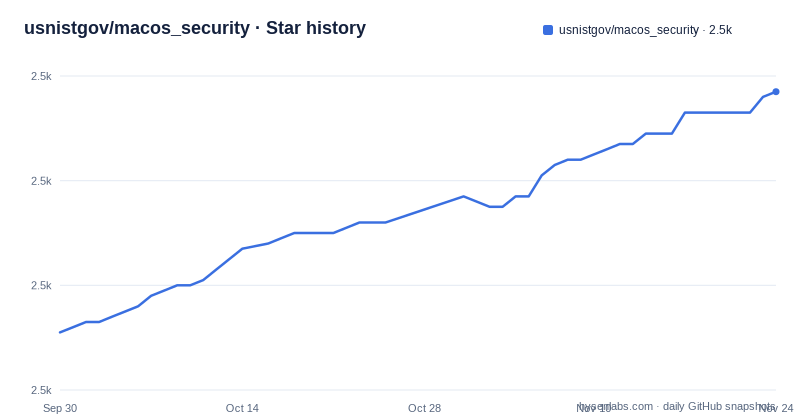
Star history
- usnistgov/macos_security2,537 ★ · +46
| Repository | 2026-09-30 | 2026-11-24 |
|---|---|---|
| usnistgov/macos_security | 2.5k | 2.5k |
46 Stars in the last 55 days, measured from the daily GitHub snapshot. Compare with other projects
Editorial analysis
Eleven of the fourteen direct dependencies are pinned exactly on their floor
The runtime dependency list in pyproject.toml is short enough to read line by line, and each line carries a floor and a ceiling. The committed requirements file then freezes one exact version per package. Comparing the two, eleven of the fourteen land precisely on the floor they declare: jinja2 at 3.1.6, loguru at 0.7.3, lxml at 6.1.0, openpyxl at 3.1.5, pandas at 2.3.3, pillow at 12.3.0, pydantic at 2.12.0, pyyaml at 6.0.2, jsonschema at 4.23.0, yaspin at 3.4.0 and babel at 2.18.0. Three resolve higher than their floor. numpy is declared as 2.3.0 or newer under 3 and pinned at 2.4.6, ruamel.yaml is declared from 0.19.0 with no ceiling and pinned at 0.19.1, and typst is declared from 0.14 up to 0.15 and pinned at 0.14.9. The lock file is generated, and says so in its first two lines:
# This file was autogenerated by uv via the following command:
#    uv pip compile pyproject.toml -o requirements.txt
That is the practical consequence to keep in mind. A consumer who installs from the packaging metadata gets whatever satisfies the ranges at that moment, which is a different outcome from the snapshot in the repository for those three packages, and identical for the other eleven.
Fifteen pinned packages have no dependency range in pyproject.toml at all
The requirements file carries twenty nine packages, and fourteen of them are the direct dependencies. The remaining fifteen arrive with no line of their own in pyproject.toml: annotated-types, attrs, et-xmlfile, jsonschema-specifications, markupsafe, pydantic-core, python-dateutil, pytz, referencing, rpds-py, six, termcolor, typing-extensions, typing-inspection and tzdata. Each is annotated in the file with a chain of via comments naming what pulled it in, which makes the resolution readable, for example ruamel-yaml and jsonschema both pointing at the project and jsonschema-specifications pointing at jsonschema, which in turn points at attrs and referencing, which points at rpds-py. Two of those frozen versions carry numbers shaped like calendar releases, pytz at 2026.1.post1 and tzdata at 2026.1, and python-dateutil arrives as 2.9.0.post0. These fifteen are the part of the environment the project itself never names, so an auditor reading pyproject.toml alone sees fourteen packages and an auditor reading requirements.txt alone sees twenty nine.
The dependency cooldown cites a renovate config that is not in the root listing
The build configuration carries a supply chain policy written as a comment:
# Dependency cooldown: the resolver ignores any release published less than a
# week ago, so `uv lock` / `uv add` / `uv sync` won't adopt a brand-new (and
# possibly compromised) version. Mirrors the 7-day cooldown in .renovaterc.json5.
# Accepts a friendly duration
The stated intent is narrow and reasonable: hold any release back for a week so a fresh publish cannot be adopted on sight. What it points at is the part worth checking. The repository root holds twenty two entries, and .renovaterc.json5 is not among them. So the cooldown the resolver honours is real and local, while the dependency update config it says it mirrors is not visible at the top level. Two other root entries raise the same question in a different form: .dockerignore sits there without a Dockerfile beside it, and .pre-commit-config.yaml sits there next to a requirements-dev.txt while the dev packages themselves are also declared as an optional extra under pyproject.toml, where they appear as pytest, pytest-cov, ruff and mypy.
The framework table has four cells per row under a three column header
The Supported Frameworks table is the centre of the project, and its markup is misaligned in a way that survives into the rendered page. The header declares Country of Origin, Framework Name and OS Supported, three columns. Every data row opens with an empty cell and then puts the organisation link in the second position, so each row carries four cells against three headers. The first column labelled country actually holds agency homepages: nist.gov for the SP 800-53, SP 800-171r3 and SP 800-171r2 rows, cisecurity.org for both CIS rows, disa.mil for the STIG, bsi.bund.de for BSI Indigo, BIO-overheid.nl for NLMAPGOV and 405d.hhs.gov for HICP. The BSI Indigo row is the odd one out in a second way: it has three cells instead of four and its platform cell closes with a stray parenthesis after the iOS link. Coverage is uneven below that. Seven of the ten rows carry three platform links for macOS, iOS and visionOS. CIS Benchmarks Level 1 and 2, from the same organisation as CIS Controls v8, carries two and has no visionOS. BSI Indigo and HICP, the row named Health Industry Cybersecurity Practices for large organizations, carry one each, iOS alone, even though the supported platforms line above the table names all three.
The Usage section is an acquisition mandate rather than an install step
There is no pip line, no brew line and no shell block anywhere on this page, and the section headed Usage is not about running the tool. It states that civilian agencies are to use the National Checklist Program as required by NIST 800-70, then quotes Part 39 of the Federal Acquisition Regulations, section 39.101 paragraph (c), which directs agencies acquiring information technology to include the appropriate security policies and requirements, including use of common security configurations available from the National Institute of Standards and Technology website at https://checklists.nist.gov. Read literally, that is a procurement obligation pointing somewhere other than a clone of this repository. For everyone else the page routes to the project website at pages.nist.gov/macos_security/ for learning more and to CONTRIBUTING.adoc for contributing, and it uses those same two links for the invitation to request a missing framework. The install instructions themselves live in install.md at the repository root. What the packaging does declare is a console entry point named mscp bound to mscp.__main__:main, a hatchling build backend, and a version field declared dynamic rather than written down.
CC-BY-4.0 by packaging, no asserted license by the repository, and a disclaimer that disclaims endorsement
Three license signals point in three directions. The packaging metadata states license = {text = "CC-BY-4.0"} with a license-files glob of LICEN[CS]E*, which matches the LICENSE.md sitting at the repository root. The repository metadata itself carries no license assertion at all. And the page describes the project as open source while closing with a disclaimer that any identification of commercial or open source software is done purely to specify the methodology adequately, and is not intended to imply recommendation or endorsement by NIST, nor that the software identified is necessarily the best available for the purpose. A Creative Commons attribution grant is what the build system will stamp on a wheel, so anyone redistributing generated artifacts inherits the question of how that grant applies to the profiles and compliance scripts, which is exactly the kind of question the disclaimer does not answer. Two smaller mismatches sit alongside it: the page links the project website over plain http while the packaging metadata records it over https, and the file the license glob matches is LICENSE.md while the glob pattern spells both LICENCE and LICENSE.
YAML leads because the rules are data and mscp.py is a single file at the root
The primary language reported for this repository is YAML, and the layout explains why: the substance lives in data directories rather than in code. The root carries mscp.py, then src/, rules/, baselines/, schema/, custom/, build/, scripts/ and tests/, with a .github/ directory for the workflow side. The page names four things a run produces, configuration profiles to apply the rules, Declarative Device Management assets for device management solutions that support declarative delivery, documentation to explain the setup, and compliance scripts to verify and enforce rules that profiles cannot. That last category is the one with no declarative equivalent: a profile can set a state, and a script has to go read it back and decide whether it held. The rules are described as derived from NIST SP 800-53 Revision 5, and the presence of schema/ beside a jsonschema dependency in the runtime list is where the shape of those baselines gets enforced. Vendors are also invited to use the project as a source for manifests and datapoints of their own, which means the schema is a contract other people build against, not just an internal detail.
Three release tags track three different axes and the classifier still says Beta
The three most recent releases do not measure the same thing. release_27.0 is named mSCP 2.0, Release 27.0 and was published on 2026-09-11. visionos26_rev3 is named visionOS 26 Guidance Revision 3.0, and tahoe_rev3 is named Tahoe Guidance Revision 3.0, and both were published on 2026-06-22, minutes apart. So one axis is the project version and another is the per operating system guidance revision, and two of the three newest tags are per platform revisions rather than a release of the generator. The main branch received a push on 2026-09-24, thirteen days after release_27.0. The packaging metadata still classifies the project as Development Status :: 4 - Beta while the release name says 2.0, and the repository is not archived with 2493 stars, 302 forks and 27 open issues. The author table lists thirteen names, of which three are NIST, four are NASA and one is DISA, and the rest sit at Jamf, Leidos, Coursera, Declarative IT GmbH and the State Department. The joint project named on the page is NIST, NASA, DISA and Los Alamos National Laboratory, and Los Alamos appears nowhere in that table.
Editorial conclusion
This project earns a place in a fleet tooling pipeline when you need profiles generated from published control baselines rather than hand written, and when Python 3.12 or newer is a condition you can meet. The things to check before committing to it are all visible in the repository rather than hidden: the committed requirements file freezes versions that the packaging metadata leaves open, the framework table advertises ten frameworks while two of them carry a single platform, and the license recorded by the packaging metadata is a Creative Commons attribution grant that sits awkwardly beside the open source claim on the page. Pin your own resolution, read the JSON schema under schema/ against the baselines you intend to enforce, and decide for yourself whether the federal checklist route described under Usage is a recommendation or a requirement for your organisation.
Frequently asked questions
What does usnistgov/macos_security generate from a set of rules?
Four kinds of artifact: configuration profiles to apply the rules, Declarative Device Management assets for device management solutions that support declarative delivery, documentation explaining the setup, and compliance scripts to verify and enforce rules that profiles cannot.
Which compliance frameworks does usnistgov/macos_security carry?
Ten rows are listed: NIST SP 800-53, SP 800-171r3, SP 800-171r2 (CMMC), CIS Benchmarks Level 1 and 2, CIS Controls v8, CNSSI 1253, DISA STIG, BSI Indigo, NLMAPGOV Base and Plus, and HICP for large organizations. Seven of the ten list macOS, iOS and visionOS.
What Python version does usnistgov/macos_security need?
The packaging metadata sets requires-python to >=3.12 and the classifiers stop at 3.12, 3.13 and 3.14, with MacOS X and POSIX Linux both listed as supported operating systems. The dev extra adds pytest, pytest-cov, ruff and mypy.
What license does usnistgov/macos_security use?
The packaging metadata declares CC-BY-4.0 with a license-files glob of LICEN[CS]E*, matching the LICENSE.md at the repository root, while the repository metadata carries no asserted license and the project page describes it as open source under an NIST disclaimer that naming software implies no endorsement.
Does usnistgov/macos_security cover visionOS?
The supported platforms line names macOS, iOS and iPadOS, and visionOS, and most framework rows list all three, but CIS Benchmarks Level 1 and 2 omits visionOS while BSI Indigo and HICP list iOS alone. Apple is cited as acknowledging the project on its macOS and iOS certification pages, with no visionOS page named.
Official sources
Add this badge to your README
If you maintain this project, the badge below links readers to this analysis and shows its maintenance status from the daily GitHub snapshot. Paste the markdown into your README; add ?metric=license or ?metric=stars to the image URL for a different field.

[](https://hysenlabs.com/projects/usnistgov-macos-security)Star history chart for your README
[](https://hysenlabs.com/projects/usnistgov-macos-security)Was this useful?