Public Sans: the typeface whose website outlived its maintenance
A strong, neutral, principles-driven, open source typeface for text or display
At a glance
- What is it?
- Public Sans is a US government typeface forked from Libre Franklin, licensed under the SIL Open Font License, with webfont, OpenType and experimental variable files in the repository. Its website has been retired and the font is not being developed, so adopting it is a decision about frozen artefacts rather than an active project.
- Who is it for?
- Use Public Sans if you want a neutral, tabular-figure sans for a US government or public sector interface and you are content to ship a frozen release, because the files in the repository are complete, licensed under the SIL Open Font License 1.1 and metrically close to the Apple and Google system fonts.
- Can I use it commercially?
- Check first. The repository uses a licence we do not classify automatically, so read its LICENSE file before any commercial use.
- Is it still maintained?
- Yes. The repository last received commits 45 days ago.
- What is it written in?
- Mainly Shell, according to GitHub's language statistics.
Answers come from the project's GitHub data, last synced on November 15, 2026, and from our analysis. They are not legal advice.
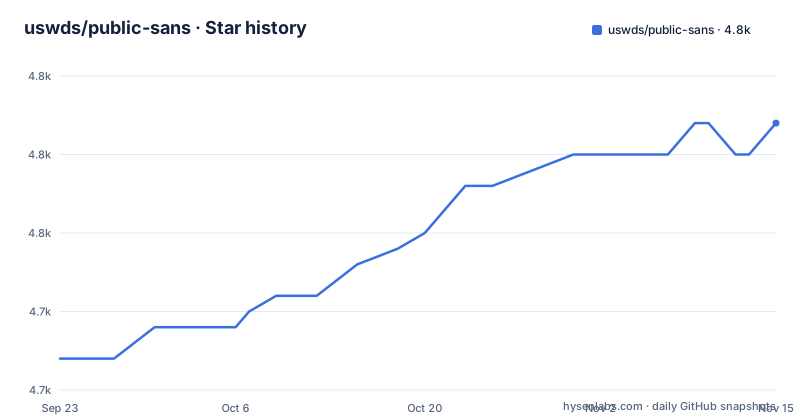
Star history
- uswds/public-sans4,757 ★ · +15
| Repository | 2026-09-23 | 2026-11-15 |
|---|---|---|
| uswds/public-sans | 4.7k | 4.8k |
15 Stars in the last 53 days, measured from the daily GitHub snapshot. Compare with other projects
Editorial analysis
The site is retired, the repository is not, and the font is not maintained
The first thing the README says is that the Public Sans website has been retired. The old address, public-sans.digital.gov, now redirects to a Digital.gov page on typography, which carries a note about Public Sans and its current unmaintained status. The Open Source Program Office of the Centers for Medicare and Medicaid Services has volunteered to create a mirror in the site's absence, and the README says only that more is to come on that.
What remains is the repository, and it still holds the source font files, currently Public Sans v2.001. The explicit statement is that Public Sans as a font is not currently being actively developed or maintained.
The version history explains why. v2.001 shipped on 2022-05-11, v2.000 on 2021-11-01 and v1.008 on 2020-01-08, so no new typeface has been released in over four years, even though the last push to the repository was on 2026-10-01. Commits continue, releases do not, and anyone depending on new glyphs or refreshed hinting should read that distinction carefully.
Four directories, and the variable fonts are marked experimental
The font files are organised by how you intend to use them, which is the practical part of the repository:
fonts/webfonts
fonts/otf
fonts/variable
sources
Webfonts are in `fonts/webfonts`, which is what a site loads. OpenType files are in `fonts/otf`, described as being for installing locally and for print applications, so that is the directory for a desktop install or a print workflow. Variable fonts are in `fonts/variable` and are explicitly flagged as something to consider experimental, which is the one place in the repository where a file set carries a warning rather than a recommendation.
The editable sources are in `sources`, in two formats: Glyphs files and UFO with Designspace.
For a team that just needs the typeface on a site, the webfont directory is the whole task, and nothing about the retired website changes that.
Seven specific departures from Libre Franklin
Public Sans is a fork of the SIL Open Licensed face Libre Franklin, and the README is unusually precise about how it differs, which makes it easy to judge whether the changes suit your text.
Vertically, Public Sans is about 2% shorter than Libre Franklin with slightly looser default line spacing. The lowercase `l` carries a hooked tail for disambiguation, and there is also an optional untailed `l`. Stroke weight is regularised against the conventional Franklin shape for a cleaner, more consistent letterform, especially at small sizes, and angled vertices are left non-rounded for a sharper, stronger form.
Horizontally, characters are narrower, especially rounded ones such as lowercase `e`, which helps reading flow in long texts, and letterspacing is relatively loose where Libre Franklin is compact. Curves are redrawn for consistency, with attention to the smooth shape of the counters.
The stated summary is a focus on longform reading and neutral UI applicability, taking inspiration from twentieth century geometric sans faces as well as the original nineteenth century Franklins, which the README calls a mongrel face that retains its American origin.
Sized between SF Pro Text and Roboto, deliberately
The design target is stated in system font terms, which is the most useful thing the repository says for anyone choosing a typeface. Public Sans is designed as a progressive enhancement webfont whose metrics are most similar to SF Pro Text, the Apple system font, and which falls somewhere between SF Pro Text and Roboto, the Google system font, in overall size and appearance.
The point of matching system metrics is the fallback. If a user's machine does not display webfonts, a site designed with Public Sans should still appear close to the designer's intention, because the line heights and character widths were chosen to sit near what the browser will substitute.
That also gives a migration answer. The README calls Public Sans a good option for sites currently using Open Sans, Tahoma, Libre Franklin, Arial or Helvetica, which is a list of existing decisions rather than a ranking.
One extra feature is called out separately: tabular figures, meaning monospaced numerals, for data design.
The principles put metrics and multilingual support above distinctiveness
Nine design principles are published, and read together they explain most of the letterform decisions.
The first is availability as a free, open source webfont on any platform. The second is metrics similar to common system fonts, for smoother progressive enhancement, which is the same idea as the SF Pro Text comparison above. The third is a broad range of weights and a good italic.
The fourth asks the face to perform well in headlines, text and UI, which is a deliberate refusal to specialise. The fifth is straightforwardness, having as few quirks as possible, and it is the principle that would block most display typefaces. The sixth is good multilingual support, the seventh is good data design with tabular figures, the eighth is that the face be strong and neutral, and the ninth asks for continuous improvement, striving to be better rather than perfect.
Only two of the nine are about appearance in the usual sense. That is the design brief of a government interface font rather than a brand typeface, and it is why the fork is subtle.
The build container is Python 3.8.11 and compiles woff2 from source
Building the fonts is a container job, and the container tells you what you are signing up for. It starts from `python:3.8.11-slim`, installs `requirements.txt` with pip, then installs `git rsync make g++ ttfautohint libz-dev` through apt.
Two compression tools are compiled from cloned repositories rather than installed from packages: Google's `woff2` and `bramstein/sfnt2woff-zopfli`, both added to `PATH` through an `ENV` line. The working directory is `/public_sans`, and the command that runs is the source build script:
./sources/build-font.shThe Python dependency list is a full font toolchain: `fontmake`, `fonttools`, `ufo2ft`, `ufoLib2`, `ufolint`, `defcon`, `glyphsLib`, `cu2qu`, `cffsubr`, `fontbakery`, `opentype-sanitizer`, `ttfautohint-py`, `statmake`, `compreffor`, `vttLib` and `gftools`, alongside web pieces such as `Flask`, `Jinja2`, `beautifulsoup4` and `PyGithub`.
Two details are worth flagging. Python 3.8.11 is long past end of life, so anyone rebuilding this today is doing the porting. And the last line pins `setuptools>=78.1.1` with a comment saying it is not directly required and is pinned by Snyk to avoid a vulnerability.
Latin only, and two licence files for one typeface
Two constraints come first. Public Sans is a Latin-only font, which matters for any agency with content outside that script. And it is licensed under the SIL Open Font License, Version 1.1, with `OFL.txt` in the root carrying that text.
The licensing has a wrinkle worth understanding rather than skimming. `LICENSE.md` is not simply a copy of the OFL: the licence of the USWDS modified version is based on the Libre Franklin section of that file, and the terms and conditions for the modifications USWDS made to the original font are also in `LICENSE.md`. If you are redistributing the typeface or modifying it, that file, not the OFL alone, is what governs the modified artefact.
The repository also carries the administrative files a font of this age accumulates: `FONTLOG.txt`, `AUTHORS.txt`, `CONTRIBUTORS.txt`, `CONTRIBUTING.md`, `SECURITY.md` and an `old/` directory, plus `build.sh` at the root and `.python-version` pinning the interpreter used locally.
The practical summary is that the artefacts are complete and permissively licensed, while the machinery around them has stopped moving.
Editorial conclusion
Use Public Sans if you want a neutral, tabular-figure sans for a US government or public sector interface and you are content to ship a frozen release, because the files in the repository are complete, licensed under the SIL Open Font License 1.1 and metrically close to the Apple and Google system fonts. Do not adopt it expecting new glyphs, hinting work or a maintained specimen site, since the website is retired, the Open Source Program Office of the Centers for Medicare and Medicaid Services is only volunteering a mirror, and the newest font release is v2.001 from 2022-05-11. Before you rebuild from source, check the `Dockerfile`, which is pinned to `python:3.8.11-slim` and compiles `woff2` and `sfnt2woff-zopfli` from source, so a modern toolchain is your problem now rather than the project's.
Frequently asked questions
what is public sans font
A strong, neutral, open source typeface for text or display, created for US government design systems and based on Libre Franklin. It is a Latin-only font licensed under the SIL Open Font License 1.1, with webfont, OpenType and variable files in the repository, and the README states it is not currently being actively developed or maintained.
how to download public sans font
The font files are in the repository rather than on a website: the Public Sans site at public-sans.digital.gov has been retired and now redirects to a Digital.gov typography page. Webfonts are in `fonts/webfonts`, OpenType files in `fonts/otf`, variable files in `fonts/variable`, and the editable Glyphs and UFO sources in `sources`.
how to install public sans font
For a local or print installation, use the OpenType files in `fonts/otf`, which the README describes as being for installing locally and for print applications. For a website, use the webfonts in `fonts/webfonts`. The variable fonts in `fonts/variable` are marked experimental.
is public sans free
It is open source. The typeface is licensed under the SIL Open Font License, Version 1.1, with `OFL.txt` in the repository root. Note that `LICENSE.md` carries the terms for the USWDS modified version, based on the Libre Franklin section, and that is the file to read if you modify or redistribute the font.
is public sans a google font
The repository does not describe it as one. Public Sans is a fork of Libre Franklin kept in the USWDS repository for US government design systems. Roboto appears in the documentation as the Google system font Public Sans is compared against, not as its origin.
public sans vs roboto
Public Sans is designed so its metrics are most similar to SF Pro Text, the Apple system font, and it falls somewhere between SF Pro Text and Roboto in overall size and appearance. Roboto is used in the comparison as a reference point, and the goal is that a site falls back gracefully when webfonts do not load.
Official sources
Add this badge to your README
If you maintain this project, the badge below links readers to this analysis and shows its maintenance status from the daily GitHub snapshot. Paste the markdown into your README; add ?metric=license or ?metric=stars to the image URL for a different field.

[](https://hysenlabs.com/projects/uswds-public-sans)Star history chart for your README
[](https://hysenlabs.com/projects/uswds-public-sans)Was this useful?