utooland/utoo: a Rust toolchain whose own manifest contradicts its license
A unified toolchain for web development
At a glance
- What is it?
- Utoo bundles a Rust package manager, a Turbopack based bundler and a browser build into one toolchain, and the details worth knowing are in the places the documentation disagrees with itself: five names for two programs, a self-pin that covers only half the commands, and a root package.json that declares ISC while the repository ships MIT.
- Who is it for?
- Utoo is worth a trial on a scratch repository if your problem is that two of your tools disagree, since one binary resolving dependencies and building is a real saving. Verify three things first.
- Can I use it commercially?
- Yes. MIT is a permissive licence: you can use, modify and sell software built on it, as long as you keep its copyright and licence notices.
- Is it still maintained?
- Yes. The repository last received commits 1 day ago.
- What is it written in?
- Mainly Rust, according to GitHub's language statistics.
Answers come from the project's GitHub data, last synced on November 25, 2026, and from our analysis. They are not legal advice.
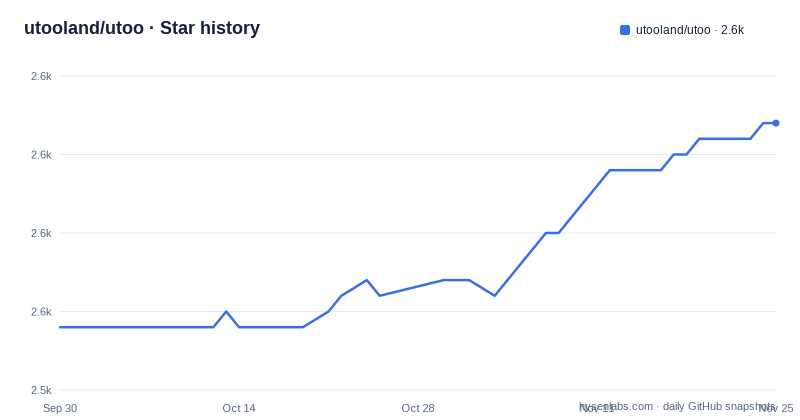
Star history
- utooland/utoo2,562 ★ · +13
| Repository | 2026-09-30 | 2026-11-25 |
|---|---|---|
| utooland/utoo | 2.5k | 2.6k |
13 Stars in the last 56 days, measured from the daily GitHub snapshot. Compare with other projects
Editorial analysis
Self-pinning redirects dependency commands but leaves scripts alone
The self-pin feature has the most moving parts in this repository. When a local dependency command runs under a different Utoo version than the one on your PATH, the client downloads the platform package matching the pinned version, verifies it against the registry checksum, caches it under `~/.cache/nm.utoo-self-pin/<platform>/<version>`, and hands the command off with the same arguments, working directory and exit behavior. Warm caches work offline, and an invalid cached release is never executed, instead being reprovisioned from the registry when the registry is reachable.
What the handoff covers is a shorter list than the project has commands. It applies to local install and add, uninstall, update, rebuild and deps. Scripts, `ut x`, query commands and global installs keep using the executable you already have, so a project pinned to one version can still run a script through another binary. `UTOO_SELF_PIN=0` turns the mechanism off for a single run. Two details are left implicit. The cache directory is named `nm.utoo-self-pin`, which does not begin with the tool's own name, and the docs speak of the matching supported platform package without ever listing which platforms qualify. The cleanup example implies an entry called `[email protected]`, so one platform and one version are the only ones the documentation shows.
Five names for two programs across three install channels
The install section offers a Homebrew tap formula, a global npm package and a Cargo install, and each channel uses a different name for the same client:
# Install the core toolchain (pick one)
brew install utooland/tap/utoo   # macOS / Linux via Homebrew
npm install -g utoo              # cross-platform via npm
cargo install utoo-pm            # build from source via Cargo

# Install the bundler in nodejs environment
ut install @utoo/pack --save-dev

# Install the bundler cli in nodejs environment(Optional)
ut install @utoo/pack-cli --save-dev

# Install the web version
ut install @utoo/web --save
The package is `utoo`, its alias is `ut`, the crate is `utoo-pm`, and the component list maps `utoo` to the `crates/pm` directory. The bundler adds two more: `@utoo/pack-cli` provides commands written `utx up`, and `up` is described as a shortcut alias for `utoopack`, a name that appears nowhere else in the install section. Even the self-pin paragraph switches between the two, showing a cleanup as `utoo clean [email protected]` in the same breath as commands written `ut install`. Note also that the two bundler packages are saved as dev dependencies while the web build is saved as a regular dependency.
The root manifest declares ISC while the repository ships MIT
Three places in the repository state licensing and they do not agree. The license line in the project description is MIT, the badge at the top of the page links a LICENSE file described as the MIT License, and the Cargo workspace declares `license = "MIT"` for every member. The npm manifest at the repository root says `"license": "ISC"`.
The same manifest carries other placeholders. Its version is `1.0.0` while the release tags for the client are on 1.1.x, its description, author and keywords fields are empty strings, and `main` points at `index.js`, which is not one of the entries in the root directory listing. The one populated field in that block is `engines`, which asks for `install-node` 22, and `packageManager`, which pins `[email protected]` for the repository's own scripts. That last value sits awkwardly beside the instruction the docs give consumers, which is to pin a Utoo release in the same field:
{
  "packageManager": "[email protected]"
}
The repository pins npm to manage itself; a project that follows the documentation pins Utoo to manage itself.
next.js is a submodule the Cargo workspace deliberately skips
The bundler's engine is not vendored in the ordinary sense. The project structure section describes `next.js/` as the Turbopack source integration and marks it as a Git submodule, the root listing carries a `.gitmodules` entry, and the Cargo workspace sets `exclude = ["next.js"]` right under its resolver declaration. Three consequences follow for anyone building from a clone. The submodule directory arrives empty until it is initialized, so a shallow clone gives you a Rust workspace whose upstream source is missing. The Cargo workspace explicitly steps around that directory rather than treating it as a member, which keeps the dependency graph at nine members: pack-api, pack-cli, pack-core, pack-napi, pack-schema, pack-tests, pm, ruborist and utoo-wasm.
Two other root entries point at an offline-friendly build. `Cargo.lock` is committed, and so is `vendor/`, alongside a `.cargo/` directory that can carry build configuration. Of the nine crates, the README names only a few: `crates/pm` for the package manager, the bundler core, and the WASM and NAPI bindings. `ruborist`, `pack-schema` and `pack-tests` appear in the workspace list with no description anywhere in the project page, and the root `bench/` directory plus a criterion 0.6.0 dependency suggest where some of that measurement happens.
Two release trains published three tags in one afternoon
The release page shows two independent version lines. The client runs on 1.1.x and the bundler on 1.5.x, and they are tagged separately: `utoo-v1.1.10`, `utoopack-v1.5.22` and `utoopack-v1.5.21`. All three were published on 2026-09-26, and two of them within about eighty minutes of each other, with the client tag landing last. Nothing in that sequence ties a client release to a bundler release, so a project that pins the client has still not pinned what builds its assets.
The pin example in the documentation makes the same point from the other side. `"packageManager": "[email protected]"` names a release two behind the current 1.1.10, so copying it verbatim gets you the older client. The repository is not archived and its default branch is `next` rather than `main`, which means the branch a clone lands on is not the branch the release tags are cut from by name, and the working tip on 2026-09-29 sits above all three tags. For the bundler half, the package name is `@utoo/pack` on npm while its tags carry the `utoopack-` prefix.
Two of the 23 example projects are missing from the workspaces array
The examples directory holds 23 demo projects, named for the thing each one exercises: `with-sass`, `with-tailwind`, `with-antd`, `with-less`, `with-postcss`, `with-library`, `with-react`, `with-nodejs`, `with-proxy`, `with-swc-plugin`, `with-server-references`, `webpack-compat`, `split-chunks`, `shared-runtime-async-module`, `inline-css`, `externals`, `resolve`, `define`, `config-js`, `multi-entries-heavy`, `expose-entry-exports`, `pack-esm-api` and `utooweb-demo`. The root manifest's workspaces array carries 21 of them alongside six real package paths: `packages/pack`, `packages/pack-shared`, `packages/pack-cli`, `packages/utoo-web`, `crates/pack-core/js` and `crates/pack/js`.
`split-chunks` and `with-proxy` are the two left out. Both sit in the tree, and neither appears in the workspaces list, which means the workspace-wide scripts at the root, all of which are turbo calls, do not reach them. The six package paths are also where the two halves of the project meet: a Rust crate exposing JavaScript through `crates/pack-core/js` and `crates/pack/js` is listed next to the TypeScript packages that consume it, which is also why the napi dependency appears with an explicit feature list in the Cargo workspace, where the comment notes that Lightningcss is the reason for several of those features.
The Webpack path is one flag and a partial support claim
Three bundler commands are documented, and one of them is an escape hatch:
utx up dev          # Start dev server with HMR
utx up build        # Production build
utx up build --webpack # Build using webpack.config.js
The third builds with Webpack instead of Turbopack. How far that goes is where the project's own two statements pull apart. The summary table promises a one step migration for existing Webpack setups, and the feature list two sections later, under the Webpack Friendly entry, calls the same thing partial support for existing Webpack configurations. The flag itself only says it reads `webpack.config.js`; there is no list of which loaders, plugins or resolve settings carry over, and no statement about what happens to a config it cannot read. `examples/webpack-compat/` is the only place in the repository where that question is answered with working code.
The browser half is a separate package. `@utoo/web`, mapped to `packages/utoo-web`, is described as the toolchain running through WASM in the browser, and its end-to-end tests have their own Playwright configuration at `e2e/utoo-web/playwright.config.ts`, wired to a `test:e2e:utooweb` script in the root manifest.
Four agent-instruction directories and a formatter that rewrites files
The root listing is crowded with tooling that no project page mentions. There are four places an agent could read instructions from: `.agents/`, `agents/`, `.claude/`, `.codex/`, plus `AGENTS.md` and `CLAUDE.md` as top-level files. Alongside them sit `.husky/` and a `prepare` script that runs husky, so a plain install wires up Git hooks, `.vscode/`, `biome.json`, `tombi.toml`, `.typos.toml`, `turbo.json`, `docs/`, `scripts/`, `bench/` and `e2e/`.
Two of those change files as a side effect of normal work. The root script named `biome` maps to `biome check --write .`, which rewrites the tree across the whole repository instead of only reporting, with biome itself pinned to 2.1.2 in devDependencies. The Cargo workspace even carries a formatting instruction for tombi, the TOML toolchain at version 0.7.32, in the form of a comment asking it to leave table key order alone. Development dependencies are otherwise modern and specific: Playwright 1.60.0 for browser tests, vitest 3.2.4 for unit tests, turbo 2.6.3 for task running, acorn 8.18.0 for parsing, and husky at 9.1.7. The project page itself points contributors at `CONTRIBUTING.md` and a generated wiki page, and says nothing about any of these.
Editorial conclusion
Utoo is worth a trial on a scratch repository if your problem is that two of your tools disagree, since one binary resolving dependencies and building is a real saving. Verify three things first. The self-pin is partial by design, so dependency commands follow your packageManager entry while scripts, ut x and global installs follow the binary on your PATH. The release page carries two independent version lines, utoo at 1.1.x and utoopack at 1.5.x, so pin both when you need reproducibility. And the bundler is Turbopack with a Webpack compatibility flag the project itself calls partial support, not a drop-in for an existing webpack.config.js. MIT in the repository and ISC in the published manifest is an inconsistency to raise with the maintainers, not to guess about.
Frequently asked questions
What is utoo?
Utoo is a frontend toolchain in two halves written mostly in Rust: a package manager published as `utoo` with the alias `ut` and implemented in `crates/pm`, and a bundler published as `@utoo/pack` in `packages/pack` that is built on Turbopack and supports hot reloading, TS and JSX, Less and Sass. A CLI package, `@utoo/pack-cli`, wraps it, and `@utoo/web` runs the toolchain in a browser through WASM.
Which license is utoo actually under?
The repository states three things at once: MIT in the project metadata, an MIT LICENSE file, and `license = "MIT"` in the Cargo workspace. The npm manifest at the repository root declares `"license": "ISC"`, which contradicts all three.
Does pinning packageManager to utoo pin every command?
No. The handoff covers local install and add, uninstall, update, rebuild and deps commands, which run against the downloaded and checksum-verified platform package cached under `~/.cache/nm.utoo-self-pin`. Scripts, `ut x`, query commands and global installs keep using the current executable, and `UTOO_SELF_PIN=0` bypasses the handoff.
Can utoo build an existing Webpack project?
There is one flag for it, `--webpack` on `utx up build`, and the project describes Webpack compatibility as partial support in its feature list. The compatibility example directory is `examples/webpack-compat/`, and no list of supported loaders, plugins or resolve settings is given.
Official sources
Add this badge to your README
If you maintain this project, the badge below links readers to this analysis and shows its maintenance status from the daily GitHub snapshot. Paste the markdown into your README; add ?metric=license or ?metric=stars to the image URL for a different field.

[](https://hysenlabs.com/projects/utooland-utoo)Star history chart for your README
[](https://hysenlabs.com/projects/utooland-utoo)Was this useful?