Vime keeps slime's training loop and moves vLLM into the rollout seat
An LLM post-training framework with vLLM for RL Scaling
At a glance
- What is it?
- Vime is an RL post-training framework in the vLLM organisation that inherits slime's training stack and data generation design and swaps the rollout backend to vLLM with its router, split across three modules for training, rollout and a data buffer. The details worth reading are the two router argument prefixes, the sandbox contract that lets the same agentic example run on E2B, Docker, Modal or a local VM, and a lint configuration whose line length is set to 320 with a note to fix it later.
- Who is it for?
- Vime fits a team that already trains with slime and wants its rollouts served by vLLM, or a team that wants an agentic RL example with a coding agent in the loop and a sandbox it can swap. It does not fit someone looking for a new training algorithm, since it inherits model support and the training paradigm rather than adding either, and it does not suit a machine without NVIDIA GPUs.
- Can I use it commercially?
- Yes. Apache-2.0 is a permissive licence: you can use, modify and sell software built on it, as long as you keep its copyright and licence notices.
- Is it still maintained?
- Yes. The repository last received commits 3 days ago.
- What is it written in?
- Mainly Python, according to GitHub's language statistics.
Answers come from the project's GitHub data, last synced on November 14, 2026, and from our analysis. They are not legal advice.
Star history
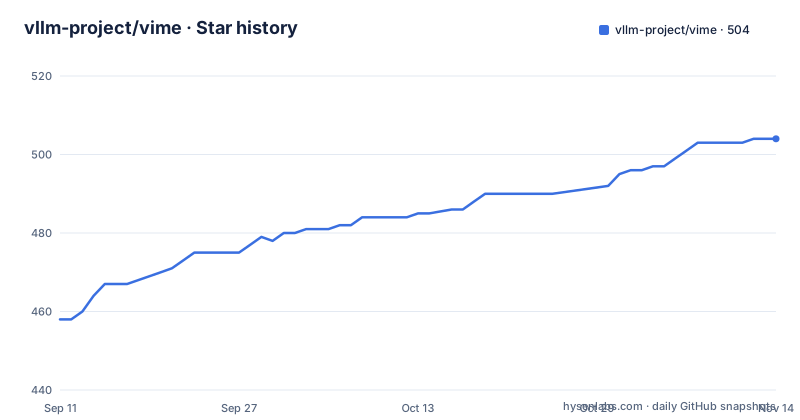
- vllm-project/vime504 ★ · +46
| Repository | 2026-09-11 | 2026-11-14 |
|---|---|---|
| vllm-project/vime | 458 | 504 |
46 Stars in the last 64 days, measured from the daily GitHub snapshot. Compare with other projects
Editorial analysis
Three modules, and parameters move one way
The architecture is three modules, and the dataflow between them is the whole design.
Training is Megatron's job. It runs the main training process, reads data from the data buffer, and synchronises parameters back to the rollout module after each training step. Rollout is the vLLM side: it launches vLLM inference engines and routes generation requests to them, and a custom generate function can wrap generation in a multi turn loop, tool calls, environment or sandbox interaction, and verifier based rewards. Between them sits the data buffer, a bridge that manages prompt initialisation, custom data, and the rollout generation methods, and which is also where agentic workflows produce their samples through the same interface.
The inheritance is explicit in the README's own words. Vime keeps slime's training stack and data generation design, and uses vLLM with vllm-router as the default rollout backend. Model support comes from the same place: the Qwen series, the DeepSeek V3 series and Llama 3 are listed as inherited rather than validated by this project.
So the pitch is a swap of one component in someone else's system, and the risk that comes with it is the mismatch between two projects on different release cycles. The README addresses that directly, saying the aim is a production ready bridge that aligns both projects' rapid release cycles.
Agentic work is a custom generate function, not a second framework
The agentic section opens by closing a door. Agentic workloads use the standard rollout and data buffer loop through the customization interfaces, and they are not a separate framework. That sentence is the design decision, and it is why there is no agent module in the architecture diagram.
Three examples carry the capability. The multi agent example does multi agent generation through a custom generate function path passed as a flag. The fully asynchronous example handles fully asynchronous rollout for long tail agent generation, and it has its own entry script in the repository. The coding agent example is the ambitious one: end to end coding agent RL with Claude Code or Codex, sandboxed tool use, test based rewards, and trajectory segments that are token correct.
The sandbox is the part that generalises. The coding agent example ships with a backend compatible with E2B, and the shared sandbox contract can be implemented for Docker, for Modal, or for local virtual machines. So the same training run can execute tool calls in a hosted sandbox, a container, or a virtual machine next to the training job, and swapping the backend is a contract implementation rather than a fork.
Test based rewards and token correct segments are the other two ideas in that example worth pulling apart, because they are what makes a coding agent trainable: the reward comes from running tests rather than from a model's opinion, and a trajectory that gets truncated or padded in the wrong place is excluded from the training signal.
The router has two argument prefixes, and they mean different things
Arguments fall into three categories, and the third one is where a first time user will lose an afternoon.
Megatron arguments are read as they are, so a Megatron option like the tensor model parallel size is passed straight through. vLLM arguments carry a prefix, so a server option like GPU memory utilisation becomes a vllm prefixed flag. Framework specific arguments are the shared orchestration flags, covering rollout GPUs, data paths and RL algorithm choices, and they live in a different file from the vLLM ones.
The router is the awkward case, and the README splits it deliberately. Options that belong to the router itself are passed with a router prefix, and the two named examples are a policy setting and a request timeout. Knobs that tell Vime where the router lives, its address and its port, use a different prefix that includes vllm. So a flag that begins with the router name might be configuring the router's behaviour or might be telling Vime the router's location, and those are different questions with different owners.
Two other arguments are worth knowing. The number of GPUs per rollout engine sets that engine's tensor parallel size, which is how a single integer connects your cluster layout to vLLM's parallelism. And the default rollout entry point is a named function in the vLLM rollout module, which is the thing you replace when you write a custom generate function, and which is why the agentic examples plug in at a path rather than a subclass.
The line length is 320 with a note to fix it later
The packaging configuration has one line that tells you how the project actually runs its linting.
The formatter is set to 119 characters, and the import sorter is configured to be compatible with that formatter, targeting Python 3.11 as its version. Then the linter is configured with a line length of 320, followed by the comment TODO, and the error for long lines is explicitly ignored with a second comment saying it will be handled later. So the enforced line length in practice is the formatter's 119, and the linter's own limit is switched off in favour of it.
That is a defensible arrangement and an honest annotation, since the two tools normally disagree and somebody has to pick one. The reason it is worth reporting is that a line length of 320 in a configuration file reads as carelessness until you see the comment, and a reader who does not will conclude the wrong thing about the codebase.
The test configuration is the disciplined half. Pytest always gets verbose output, durations sorted ascending so the slowest tests are visible, and strict markers, with the test path written out explicitly because, as the comment says, that avoids importing another module called tests. Several directories are excluded from discovery, including examples, docs, scripts and tools, which is how a repository with thirteen example directories keeps its test run from collecting them.
The Python floor is 3.10, from the setup script, with classifiers for 3.10 through 3.12 and an environment marker for NVIDIA CUDA, which is the shortest way to tell you this does not run on a laptop CPU.
No version pins in the requirements, and no Megatron in them
The dependency file is a plain list of names, and the absences in it are as informative as the entries.
There is one floor in the whole list, on the router package, and everything else is unpinned: the acceleration library, the Anthropic and OpenAI clients, the agents package, a compression library, blob storage, datasets, a sandbox provider, an HTTP client with HTTP2 support, the MCP command line extra, numba, a config system, Pillow, a LaTeX encoder, YAML, a vision language utility, Ray, safetensors, TensorBoard, transformers, a tracking library, zstandard. And a comment on the memory profiler says it is needed for debugging but is lightweight, and could be moved to a dev mode later.
Two entries are annotated with their purpose rather than their version. The vision language utility is there for the vision language models, and a hashing library is there for the checksum in disk based delta weight sync, which tells you the weight update path on disk is verified.
The absence that will surprise a reader is the training framework itself. Megatron is the training module, and the import sorter's configuration lists it as a known third party package, but it is not in the requirements file. So a fresh environment has to be told about the training stack separately from installing Vime, which is consistent with the project's own description of itself as inheriting slime's training stack rather than vendoring it.
The sandbox and agent dependencies are the other clue. They are runtime requirements of the examples, not optional extras, so a minimal installation pulls an agent framework and a sandbox client whether or not you use the coding agent example.
Two entry scripts, and thirteen examples
The repository root has two training entry points, one plain and one asynchronous, and the example directory has thirteen projects in it.
The two scripts are the visible form of a distinction the architecture makes elsewhere: a standard rollout loop, and a fully asynchronous rollout for the long tail of agent generation where waiting for every engine to finish is the bottleneck. The asynchronous one is a separate file rather than a flag, which is a heavier commitment than a switch and worth noticing before you start editing one of them.
The example list is a good index of what the framework is asked to do. There is a coding agent example, a multi agent one, a fully asynchronous one, a memory agent, a delta weight sync example matching the disk based weight update feature, a multi task evaluation example, and a helper whose name is a warning rather than a feature: it exists to investigate a mismatch between training and inference. There is a vision language example on a geometry dataset and a multi turn version of it, an on policy distillation example, and a tool use benchmark example.
That last group is the most telling. Vision language training, distillation, multi turn tool use and a train versus inference mismatch are four different problems, and an example directory that has one project for each is telling you the framework is a harness rather than a recipe.
The rest of the tree is ordinary and slightly large: a plugin package, the main package, tests, tools, scripts, a docker directory, documentation, both English and Chinese readmes, an agent instructions directory, and both a GitHub workflows directory and a Buildkite directory, so continuous integration runs in two places.
RL bugs are silent, so the test layers are split by cost
The correctness section opens with a problem statement rather than a feature list: reinforcement learning bugs can be silent. A training run that has gone wrong in a data flow does not crash, it just produces a worse model, which is the worst failure mode a research framework can have.
The answer described is structural rather than a test count. The dataflow is kept explicit, and there are separate debugging paths for rollout only and for train only, so a failure can be isolated to one side of the loop before anyone suspects the algorithm. The tests are layered to match: CPU unit tests, contract tests for the customization hooks, and GPU end to end suites, with each layer protecting a different part of the pipeline.
The customization hook contract tests are the layer that only makes sense for this design. If a user is expected to drop in a custom generate function, then a change to the signature of that hook has to fail a test rather than fail at three in the morning inside a rollout, and a contract test is what does that.
The rest of the project is positioned rather than claimed. The README lists the other post training frameworks the vLLM community supports, in alphabetical order, and describes Vime as the route for bringing the slime paradigm into that ecosystem rather than as a competitor to them. There is one release so far, v0.3.2 on 7 September 2026, a last push to main on 1 October, an Apache 2.0 licence, a Chinese translation of this page, and discussion split between a Slack channel and a WeChat group.
Editorial conclusion
Vime fits a team that already trains with slime and wants its rollouts served by vLLM, or a team that wants an agentic RL example with a coding agent in the loop and a sandbox it can swap. It does not fit someone looking for a new training algorithm, since it inherits model support and the training paradigm rather than adding either, and it does not suit a machine without NVIDIA GPUs. Before running anything, read the two router argument prefixes, since the same word means two different namespaces, and check which of the two entry points you want, because the asynchronous one is a separate script rather than a flag.
Frequently asked questions
What is Vime and how does it relate to slime and vLLM?
Vime is an LLM post training framework for RL scaling, built on slime. It keeps slime's training stack and data generation design while using vLLM with vllm-router as the default rollout backend, and inherits slime's model support, which it lists as the Qwen series, the DeepSeek V3 series and Llama 3.
What are the three modules in the Vime architecture?
Training is Megatron, running the main training process, reading from the data buffer and synchronising parameters to the rollout module afterwards. Rollout is vLLM plus the router, launching inference engines and routing generation requests. The data buffer is the bridge that manages prompt initialisation, custom data and the rollout generation methods, and is where agentic workflows produce samples.
How do I run an agentic RL workload in Vime?
Through the standard rollout and data buffer loop with a custom generate function, which the project says is not a separate framework. The bundled examples cover multi agent generation, fully asynchronous rollout, and an end to end coding agent example with Claude Code or Codex, sandboxed tool use and test based rewards, where the sandbox contract can be implemented for E2B, Docker, Modal or local machines.
What do the different Vime argument prefixes mean?
Megatron arguments are read directly, vLLM server and engine options carry a vllm prefix, and the router has two: options belonging to the router itself use a router prefix, while flags that tell Vime where the router lives use a vllm router prefix with an address and a port. Framework specific orchestration flags are documented separately in the project's own argument module.
What Python and hardware does Vime need?
The setup script sets a floor of Python 3.10 with classifiers for 3.10, 3.11 and 3.12, and an environment marker for NVIDIA CUDA. The import configuration targets 3.11 for style purposes, and the requirements file is a flat list of unpinned packages apart from a floor on the router library, with the training framework itself coming from elsewhere.
How does Vime test for silent reinforcement learning bugs?
It keeps the dataflow explicit and supports separate rollout only and train only debugging paths, so a failure can be isolated to one side of the loop. The test layers are split by cost as well: CPU unit tests, contract tests for the customization hooks, and GPU end to end suites, with the hook contract tests covering the case where a user's custom generate function changes shape.
Official sources
Add this badge to your README
If you maintain this project, the badge below links readers to this analysis and shows its maintenance status from the daily GitHub snapshot. Paste the markdown into your README; add ?metric=license or ?metric=stars to the image URL for a different field.

[](https://hysenlabs.com/projects/vllm-project-vime)Star history chart for your README
[](https://hysenlabs.com/projects/vllm-project-vime)Was this useful?