The star badge counts a different repository, and the changelog names the model that wrote each revision
Bilingual (Chinese + English) ML / LLM / diffusion / agent interview cheat sheets for China's AI recruiting season, generated by ARIS /interview-cheatsheet and rendered by /render-html into single-file HTML that reads anywhere, plus a CV-to-DBLP fact-checked academic homepage generator and hand-authored long-form blogs.
At a glance
- What is it?
- ARIS-in-AI-Offer holds 35 bilingual interview cheat sheets for Chinese AI campus recruiting, each with formula derivations, runnable PyTorch and 25 stratified questions. The sheets are generated output rather than hand written source, the build lives in another repository, the newest entry documents a corrected sign error, and no release ever pins a version.
- Who is it for?
- Treat this collection as generated study material with an unusually honest changelog rather than as a reference, and read the What's New entries before you trust a sheet. The dated entries tell you which model drafted a section, which model reviewed it, and where a previously published derivation was found to be wrong, which is more provenance than most collections of this kind offer.
- Can I use it commercially?
- Yes. MIT is a permissive licence: you can use, modify and sell software built on it, as long as you keep its copyright and licence notices.
- Is it still maintained?
- Yes. The repository last received commits 9 days ago.
- What is it written in?
- Mainly Python, according to GitHub's language statistics.
Answers come from the project's GitHub data, last synced on November 15, 2026, and from our analysis. They are not legal advice.
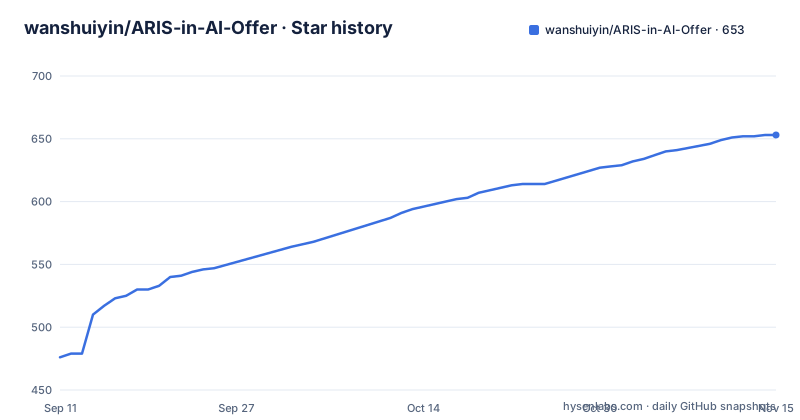
Star history
- wanshuiyin/ARIS-in-AI-Offer653 ★ · +177
| Repository | 2026-09-11 | 2026-11-15 |
|---|---|---|
| wanshuiyin/ARIS-in-AI-Offer | 476 | 653 |
177 Stars in the last 65 days, measured from the daily GitHub snapshot. Compare with other projects
Editorial analysis
The star badge at the top counts a different repository
The badge row near the top of the readme links to `wanshuiyin/Auto-claude-code-research-in-sleep/stargazers`. That is not this repository. This repository is `ARIS-in-AI-Offer`, and the badge that displays a star count is pointing at the main ARIS repository. The claim in the text below it is explicit about the size difference: the main repo has around ten thousand GitHub stars, was HuggingFace Daily Papers number one, won an AI Digital Crew Project of the Day, and ships 74 or more research skills across seven or more platforms. The numbers attached to this repository are much smaller, 547 stars and 19 forks, with 3 open issues.
So a reader who glances at the top of the page gets an order of magnitude impression that belongs to a sibling project. The same row also contains the HuggingFace papers link twice, the identical address appearing in two consecutive badge slots, which suggests the badge set was assembled by appending rather than curated.
Two site addresses are published as well, a short one at easyaioffer.github.io and the real site at wanshuiyin.github.io/ARIS-in-AI-Offer. The short address is described as a convenience for a phone bookmark. Both are GitHub Pages under the same account, so there is one deployment in two locations rather than a mirror with any independent purpose.
None of this makes the content wrong. It does mean the social proof at the top of the page is about a different artifact, which is worth knowing before you cite the popularity as evidence that these particular sheets are good.
The sheets are build output, and the build lives in another repository
The collection describes itself as auto-generated by the ARIS workflow, and it names the two commands: `/interview-cheatsheet` and `/render-html`. The claim is that every sheet here is the production output of that same workflow, rather than a preview or a sample. The main repository is where the skills live, 74 or more of them across seven or more platforms, and this repository holds the rendered result.
The file tree explains the split. There is `docs/`, which is where the tutorials and their HTML live, `assets/`, `skills/`, `tools/`, a pair of contributing guides in English and Chinese, and two readmes in English and Chinese. There is no source directory, no test directory and no package manifest, and no release has ever been published. Nothing in the tree looks like a program you would run to regenerate the sheets.
The consequence is a one way relationship. If you want to fix a sheet you cannot regenerate it here, and if you want to know how the renderer decided to lay out a section you would have to read the other repository. The other half of the output is described in the same breath: a generator that turns a CV into a fact checked academic homepage, checked against DBLP, with a live demo and a pipeline diagram described in the readme.
So this repository is an artefact store. That is a perfectly good thing to be, and it also means the only record of what changed is the dated list in the readme.
The changelog names the model that drafted each revision and the model that reviewed it
There is no changelog file and no release history. The changelog is a section called What's New, and its entries are dated single paragraphs, one per sheet, that describe the work in unusual detail. The entry for 2026-09-11, covering sheet number 35 on world models with a refresh of 3D generation and quantization, ends by describing how it was produced: research fanned out to Opus 5 with every arXiv ID fetched, and drafts reviewed by gpt-6-astra xhigh in two or three rounds each.
So the provenance of a section is a chain of model generations with a second model reviewing the first. The entry for the day before, sheet number 34, does the same for its own draft. Further down, a hand authored long form blog is described as written end to end via cross model discussion naming Claude Opus 4.7, Codex GPT-5.5 xhigh and Gemini auto-gemini-3.
Two things follow from reading those three descriptions together. The generation stack changed within the span of the visible entries, so a sheet written a week earlier was drafted by a different model than one written a week later, and the naming convention drifts too, with one entry naming a model by version and another by an alias that includes the word auto. And the phrase hand authored is applied to a document produced by three models in discussion, which is a description of who directed the writing rather than of who typed it.
For a study aid this level of disclosure is unusual and useful. It also means the sheet's authority depends on which pass of which model produced the section you are reading.
A documented sign error, a corrected KL, and five questions found to be duplicated
The correction record is the most valuable part of the changelog, and it is in the dated entries rather than in the sheets themselves.
Sheet number 34, dated 2026-09-10, covers modern diffusion post-training and is organised around one distinction, how the reward enters the gradient: a per step policy gradient on a marginal preserving SDE, group level DPO with the log Z cancellation, or a reflected two branch regression on the forward process. The entry then records that Flow-GRPO moved into this sheet from the diffusion post-training sheet, with its reverse SDE sign and closed form KL corrected on the way. That is a published derivation with two errors in it, found and fixed, and the fix is named in a sentence a reader would otherwise never reach.
Sheet number 35 records five duplicated L3 questions replaced. Duplication is the failure mode you would expect from generating a fixed count of questions per sheet, and the count is fixed at 25 for every sheet, stratified L1 essentials, L2 advanced and L3 top tier lab. A fixed count per sheet means the generator fills the stratum, and the strata closest to the frontier are where it repeats itself.
Also recorded in the same entry is that the selection rule for the world models sheet is stated inside the sheet itself, that influential representative major lab open weight work is the filter, and that the famous exclusions are listed with reasons rather than quietly dropped. Excluded work named on purpose is a stronger practice than omission, and it is the kind of thing that only survives review when the review is explicit.
The topic list is driven by feedback written in Chinese
The jump bar at the top lists 35 first party sheets across eight categories: general and foundations, post training and reasoning, LLM architecture and systems, generative models with theory and tokenizers, generation systems for image video and 3D with diffusion post training, multimodal, agents, and embodied AI with world models. Alongside them is a community contributed question bank.
The 2026-09-11 entry opens by quoting the feedback that prompted sheet 35, in the original Chinese: that 3D and world models are a bit thin or old, and that quantization practice mostly uses PTQ and QAT. Those two remarks are the entire brief for that sheet and for the rewrite of three sections. This is the collection's update loop made visible, and it runs through readers rather than a curriculum committee.
The world's model sheet then names what it covers and what it leaves out: latent dynamics from RSSM through Dreamer versions 1 to 4, MuZero and TD-MPC2; JEPA including I-JEPA, V-JEPA, V-JEPA 2 and 2.1 and DINO-WM; generative and interactive work from Genie through Genie 3, GameNGen, Cosmos 1 to 3, Matrix-Game 3.0 and Atlas; three embodied routes; and evaluation, described as the definition fight. The 3D section gained feed forward reconstruction from DUSt3R through VGGT to MapAnything and DA3 with a confidence loss derivation, feed forward 3D gaussian splatting, native mesh generation with tokenization budgets, and TRELLIS.2 and Hunyuan3D 2.x on a latent representation axis.
Read as a whole, the entries are closer to a research log than to a syllabus, and the emphasis on what was excluded and why is the part that makes them usable as a map.
Single file offline HTML, and a per reader read tracker that only works served
The rendering target is a single HTML file per sheet, readable offline with no backend. MathJax renders the formulas rather than screenshotting them, so they stay scalable, copyable and selectable, highlight.js colours the PyTorch blocks, the layout is responsive, and there is a sticky table of contents for long documents. The stated test is a phone on a subway, a tablet in a cafe and a laptop in a library, opening the same link.
That design goal and one site feature pull in opposite directions. The site version carries a language switch between Chinese and English, a dark mode, and a per reader read tracker, described in the readme in Chinese as a tracker of what has been read. Read state is per reader, which means it lives in the reader's browser or in an account somewhere rather than in the file. Open the downloaded HTML offline and there is no reader identity to attach state to, so the tracker is a feature of the served page and not of the artefact.
The single file decision is otherwise well matched to the content. Formula-heavy documents that need MathJax cannot be truly self contained in the strict sense, since the library has to come from somewhere, so an offline copy is offline once its assets are cached or local. What the file does guarantee is that there is no server dependency, no account and no per sheet backend, which is the right trade for material you intend to read on a commute.
35 sheets of 25 questions each, with no release to pin them to
The arithmetic of the collection is simple. 35 sheets, each with 25 questions, stratified into three levels, gives 875 questions from the sheets themselves, before the community bank is counted. Each sheet also carries formula derivations and from scratch PyTorch, and the newest one adds a runnable script that is described in unusually concrete terms: `code/world_models_toy.py` covers an RSSM balanced KL fixed point, a JEPA shortcut and a gridworld LAM, and it asserts against analytic answers rather than printing values for comparison. That is the only part of the generated output with a stated verification, and it is a meaningful distinction, because asserted against analytic answers is the difference between a test and an illustration.
What is missing is any way to pin a version. There are no GitHub releases and no tags in the project's own history, so a link to a sheet resolves to whatever the current file is. The last dated entry in the changelog is 2026-09-11, while the last push is dated 2026-09-23, so the most recent commit is not a new sheet and the changelog does not describe it. The repository also publishes a hand authored survey as a separate blog artefact outside the numbered sheets, which means content exists in the tree that the numbered scheme does not cover.
For the rest of the shape: MIT licensed, Python, default branch main, 3 open issues, 19 forks. The sheet is a publication, and publications are edited in place. Anyone citing one should record the date they read it.
Editorial conclusion
Treat this collection as generated study material with an unusually honest changelog rather than as a reference, and read the What's New entries before you trust a sheet. The dated entries tell you which model drafted a section, which model reviewed it, and where a previously published derivation was found to be wrong, which is more provenance than most collections of this kind offer. Three things to check. Confirm the revision date of the sheet you are relying on, since sheet numbering counts sheets rather than versions and there is no release to pin, so a link you saved months ago may have been silently rewritten in place. Treat the L3 top tier lab questions as the least stable content, because that is the stratum where duplication and obsolescence were found and corrected. And if you intend to reuse any of it, note that the generated code is the only part with a stated verification, since the toy scripts assert against analytic answers while the derivations are checked by model review.
Frequently asked questions
How are the ARIS-in-AI-Offer cheat sheets produced?
Auto-generated by the `/interview-cheatsheet` and `/render-html` workflow from the ARIS main repository, and the readme claims every sheet is production output of that workflow rather than a preview. Each sheet carries formula derivations, from scratch PyTorch and 25 questions stratified L1, L2 and L3.
Are the ARIS-in-AI-Offer sheets reviewed before publication?
The changelog entries record the generation stack per revision, including research fanned out to one model and drafts reviewed by another in two or three rounds. Corrections are logged too, such as a reverse SDE sign and a closed form KL fixed in sheet 34.
Can I download an ARIS-in-AI-Offer cheat sheet and read it offline?
Each sheet renders to a single file HTML with MathJax formulas, syntax highlighted PyTorch, a responsive layout and a sticky table of contents. The per reader read tracker described in the readme belongs to the served site rather than to the downloaded file.
How many cheat sheets and questions does ARIS-in-AI-Offer contain?
35 first party sheets across 8 categories, plus a community contributed question bank. With 25 questions per sheet the sheets alone account for 875 questions before the community contributions are added.
Does ARIS-in-AI-Offer publish releases I can pin to?
No release or tag is published, so a link to a sheet always resolves to the current file. The dated What's New entries are the only version record, and the newest entry is dated earlier than the last push.
Official sources
Add this badge to your README
If you maintain this project, the badge below links readers to this analysis and shows its maintenance status from the daily GitHub snapshot. Paste the markdown into your README; add ?metric=license or ?metric=stars to the image URL for a different field.

[](https://hysenlabs.com/projects/wanshuiyin-aris-in-ai-offer)Star history chart for your README
[](https://hysenlabs.com/projects/wanshuiyin-aris-in-ai-offer)Was this useful?