Wirasm/prp: Claude Code skills for PRDs and a /prp-loop that stops at --max-cycles
Prompts, workflows and more for agentic engineering
At a glance
- What is it?
- Wirasm/prp is a set of Claude Code skills built around the Product Requirement Prompt, a PRD plus codebase context plus validation commands. The pipeline runs from /prp-prd to a reviewed pull request, and /prp-loop automates it with one claude -p session per stage.
- Who is it for?
- Use Wirasm/prp if you already work in Claude Code and want a fixed route from PRD to plan to pull request to review, with /prp-loop as the unattended version. Skip it if you want a library or a framework with an API, since the repository is prompts and skills.
- Can I use it commercially?
- Yes. MIT is a permissive licence: you can use, modify and sell software built on it, as long as you keep its copyright and licence notices.
- Is it still maintained?
- Yes. The repository last received commits 37 days ago.
- What is it written in?
- Mainly Python, according to GitHub's language statistics.
Answers come from the project's GitHub data, last synced on November 7, 2026, and from our analysis. They are not legal advice.
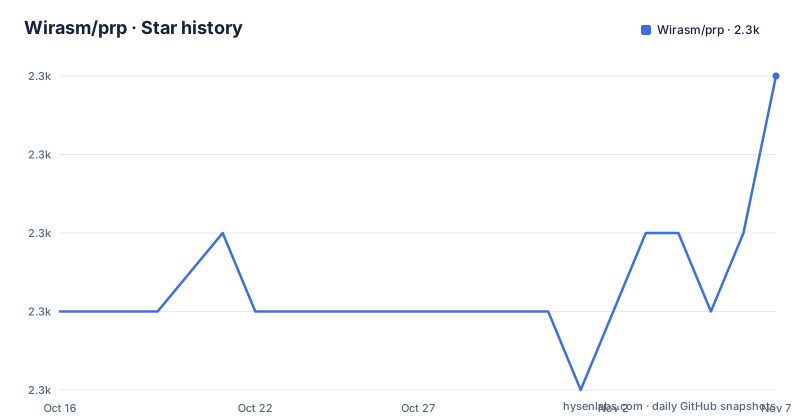
Star history
- Wirasm/prp2,267 ★ · +3
| Repository | 2026-10-16 | 2026-11-07 |
|---|---|---|
| Wirasm/prp | 2.3k | 2.3k |
3 Stars in the last 22 days, measured from the daily GitHub snapshot. Compare with other projects
Editorial analysis
A PRP is a PRD with file paths and commands attached
The README defines a Product Requirement Prompt as a PRD plus curated codebase intelligence plus an agent runbook. The stated goal is the minimum packet an AI coding agent needs to deliver a vertical slice of working software, no more and no less.
It contrasts this with a traditional PRD, which says what the product must do and why customers need it, but deliberately avoids how it will be built. A PRP keeps the goal and justification sections and adds three layers. Context means precise file paths, library versions and code snippet examples. Patterns means existing codebase conventions to follow. Validation means executable commands the AI can run to verify its work.
The third layer is the one that changes what an agent does: a PRP carries commands, so the agent can run them rather than guess whether its change worked. What the README does not provide is any measurement of how often a PRP produces a correct first pass. The claim in the definition is a design goal, and nothing in the README backs it with data.
Three install routes, and only one updates itself
Option 1 is the plugin, marked recommended. Enter these slash commands inside Claude Code, not in a system shell:
/plugin marketplace add Wirasm/PRPs-agentic-eng
/plugin install prp-core@prp-marketplace
The README says every skill is then available across all your projects as /prp-core:<name>, updated centrally. Option 2 copies skills into a single project. The example copies one folder into the project's skills directory:
cp -r /path/to/PRPs-agentic-eng/.claude/skills/prp-plan .claude/skills/Option 3 clones the repository:
git clone https://github.com/Wirasm/PRPs-agentic-eng.git
cd PRPs-agentic-eng
The trade is visible in the commands. A plugin install is central and shared across projects. A copied skill lives in one project and stays at the version you copied, with updates being your job. Note that all three commands use the name PRPs-agentic-eng, while this repository is Wirasm/prp, so check that you are pulling the repository you intend.
The core workflow runs from /prp-prd to a pull request
The skills sit in .claude/skills/ and are also distributed as the prp-core plugin. The core workflow is a short chain. /prp-prd is an interactive PRD generator with implementation phases. /prp-plan creates an implementation plan from a PRD or free-form input. /prp-implement executes a plan through validated commit and PR.
Three more belong to the same group. /prp-issue owns an issue, plan, document or idea through a reviewed PR and green CI. /prp-issue-contract creates an issue or checks its preconditions before agent automation. /prp-prd-update maintains PRD phase status and delivery links. /prp-companion produces a visual HTML companion of a plan or review beside its markdown.
The Git and review group has /prp-commit for a smart commit with natural language file targeting, /prp-pr for a PR with template support, and /prp-review for code review of a PR. The table gives one line per command and no examples of output, so what a plan or review looks like is only visible by running them.
/prp-loop spends one claude -p session per stage
The README describes /prp-loop as driving the full pipeline headlessly, with one claude -p session per stage. It loops review and fix until the PR review comes back clean. The invocation is a slash command with a quoted feature description:
/prp-loop "add user authentication with JWT"The five steps are plan, which writes ~/.prp/<project-key>/plans/<feature>.plan.md, implement, which executes and validates the plan, commits and opens the PR, pr compatibility, which opens the PR only if an older implementation run did not, review, which publishes the complete canonical review report to the PR, and cycle. In the cycle step the full report feeds a correction pass, then a push and a re-review, until the PR is ready or --max-cycles is reached.
Progress is tracked in ~/.prp/<project-key>/state/prp-loop.state.json. Because every stage is its own session, a loop that fails halfway leaves state on disk you can resume from. The cost is that you are running several Claude Code sessions per feature, and the README gives no estimate of how many cycles a typical review needs.
--until and --resume are the brakes on the loop
The usage block shows three forms to enter inside Claude Code:
# Run the full pipeline from a feature description
/prp-loop "add user authentication with JWT"

# Run through implementation and PR, then stop before review
/prp-loop "add user authentication with JWT" --until implement

# Resume a halted or in-progress loop
/prp-loop --resume
The tips section defines --until <stage> with the accepted values plan, implement, pr, review and fix. The loop halts once that stage completes, so --until implement stops after implementation and the PR. The README does not finish the tips list in the text available for this article.
In practice this means you decide how much unattended work to allow. Stopping at implement lets a human read the PR before any review-fix pass pushes more commits. --resume picks up a halted or in-progress loop from the saved state. The same section names --max-cycles as the cap on review cycles, but the README gives no default value, so set it explicitly if you want a known bound.
Skills that can comment on, label or close someone else's work
One skill carries a warning in its own section. /prp-maintainer-triage routes a contributor PR or reported issue through its lightweight maintainer triage workflow, and the README states that it requires explicit invocation because it can comment, label or close another person's contribution. That is a real side effect on a shared repository, and the skill is set up so it does not run unprompted.
/prp-orchestrate coordinates parallel workstreams running PRP skills in git worktrees, with review gates and merge sequencing. /prp-deliver sits under an In Process heading and is described as a manual-only, top-level multi-context delivery experiment, excluded from distribution and orchestration. Treat it as unfinished.
The research and authoring group holds /prp-codebase-question, which researches how the codebase works using parallel agents, /prp-research-team, /prp-meta-skill for authoring new skills or refactoring fat skills into lean SKILL.md plus references, and /prp-technical-writing. /prp-debug diagnoses a root cause and publishes the evidence to the matching GitHub issue, which also writes to GitHub.
Mostly prompts, with a thin Python wrapper and no releases
The repository is not a code library. The Python in it is the small PRP-library package: pyproject.toml declares version 0.1.0, requires Python >=3.12 and depends only on rich>=14.2.0. Its description reads "Library of assets and prompts for Ai Engineering". The top-level entries include .claude-plugin/, .claude/, .codex/, .agents/, plugins/, claude_md_files/ and old-prp-commands/, plus AGENTS.md, CLAUDE.md, CONTRIBUTING.md and a README-for-DUMMIES.md.
The presence of .codex/ and .agents/ next to .claude/ shows files for other agent setups, though the README text only covers Claude Code. The old-prp-commands/ folder holds the earlier command format, and the README does not say which are deprecated.
There are no GitHub releases, so no tags to pin, and the default branch is development. The license is MIT, the repository is not archived and the last push was on 2026-10-02. The README also carries a coffee-donation link and an advertisement for paid team workshops, which are the author's offers, not features of the skills.
Editorial conclusion
Use Wirasm/prp if you already work in Claude Code and want a fixed route from PRD to plan to pull request to review, with /prp-loop as the unattended version. Skip it if you want a library or a framework with an API, since the repository is prompts and skills. First install the plugin with the two /plugin commands, run /prp-prd on a small feature, and read what lands in ~/.prp before you let /prp-loop commit anything.
Frequently asked questions
What is PRP software?
In this repository, PRP stands for Product Requirement Prompt: a PRD plus curated codebase intelligence plus an agent runbook. It is a set of prompts and skills for Claude Code, not a standalone application.
How do I install the Wirasm prp skills in Claude Code?
Run /plugin marketplace add Wirasm/PRPs-agentic-eng and then /plugin install prp-core@prp-marketplace. Skills are then available as /prp-core:<name> across your projects.
How do I stop /prp-loop before the review stage?
Add --until implement, as in /prp-loop "add user authentication with JWT" --until implement. It runs through implementation and the PR, then stops before review.
Official sources
Add this badge to your README
If you maintain this project, the badge below links readers to this analysis and shows its maintenance status from the daily GitHub snapshot. Paste the markdown into your README; add ?metric=license or ?metric=stars to the image URL for a different field.

[](https://hysenlabs.com/projects/wirasm-prp)Star history chart for your README
[](https://hysenlabs.com/projects/wirasm-prp)Was this useful?