espurna: dated release tags, a retired support channel, and TLS only in custom builds
Home automation firmware for ESP8266-based devices
At a glance
- What is it?
- ESPurna is custom firmware for ESP8266 and ESP8285 switches, lights and sensors, built on the Arduino core for that chip, with a long feature list covering Wi-Fi modes, relays, MQTT, voice assistant integrations and a large sensor catalogue. Its release tags are dates rather than versions, its support notice points at a chat service its own operator has retired, and two of its integrations depend on services that no longer exist.
- Who is it for?
- ESPurna suits someone who has a specific board, knows its relay wiring, and wants features a general automation stack does not offer, such as per-switch boot state, relay synchronisation across devices, an analogue button input and a wide sensor catalogue including several CO2 modules.
- Can I use it commercially?
- Yes, with conditions. GPL-3.0 is a copyleft licence: if you distribute software that includes it, you must release that software's source code under the same licence. Running it internally without distributing it does not trigger that obligation.
- Is it still maintained?
- Yes. The repository last received commits 35 days ago.
- What is it written in?
- Mainly C++, according to GitHub's language statistics.
Answers come from the project's GitHub data, last synced on November 15, 2026, and from our analysis. They are not legal advice.
Star history
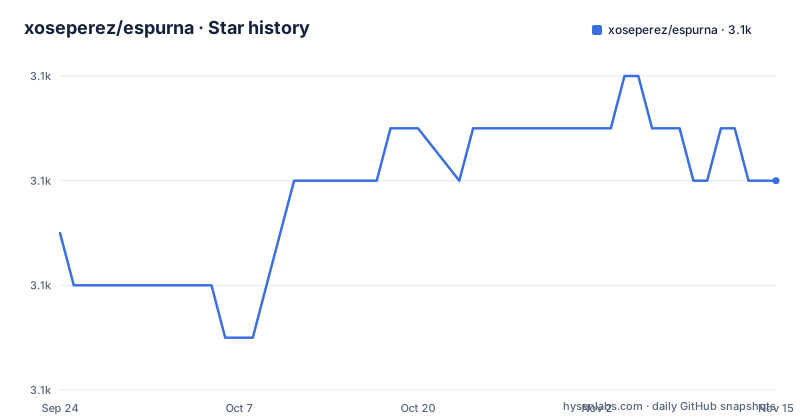
- xoseperez/espurna3,056 ★ · +1
| Repository | 2026-09-24 | 2026-11-15 |
|---|---|---|
| xoseperez/espurna | 3.1k | 3.1k |
1 Stars in the last 52 days, measured from the daily GitHub snapshot. Compare with other projects
Editorial analysis
The release tags are dates and the newest is ten months behind the branch
There are no version numbers in this repository's release history. The three most recent tags read like github250601, github250114 and github240830, and each release title is the words Snapshot build followed by the same string. So the tag is a build date in the form of a year, a two digit month and a two digit day, prefixed with the name of the hosting site, and there is nothing to compare versions against. The gaps between them are even for a while: five months from August 2024 to January 2025, then five more to June 2025. Then the pattern breaks. The last push on the default branch, which is named dev rather than master or main, is dated 2026-04-15, roughly ten and a half months after the newest snapshot. For firmware that is flashed to a device in someone's home, that gap is the first thing to weigh, because the tag a user downloads is not the code the author is working on.
The support notice routes everything to a chat room
Three blockquotes in the notice section set the rules for getting help, and the middle one is the whole policy. Please use the gitter ESPurna channel for support and questions, because you have better chances of getting fast answers there, and open an issue on the tracker only if you believe there is a bug or want to request an enhancement. So the channel you are told to use is a Gitter room, and Gitter is a service whose operator wound it down and moved its communities elsewhere, which means the project's mandated support path runs on infrastructure nobody is maintaining. Two other links in the same header point the same way: a Twitter follow link and the room permalink itself. There is a support document at the root of the repository as well, so the information exists in two places and the notice directs you to the one that is not a file. The donation link in the badge row carries the maintainer's email address inside its query string.
One build tip, three build guides, and one of the three is the tool the tip warns you off
The first notice opens with a piece of advice delivered as the only tip the author would give: use PlatformIO, and if that were the only tip for the future, it would be it. Then three wiki pages are linked for building from source, and they cover the PlatformIO IDE inside Visual Studio Code, the PlatformIO command line, and the Arduino IDE. So the recommended tool has two guides and the discouraged one has a guide of its own, which is generous rather than contradictory. What the page does not include is a command anyone can paste, a toolchain version, or a flash procedure; all three are delegated to the wiki. At the repository root there are two shell scripts named for installation and for the build, which is presumably how continuous integration does it, and the badge row points at a workflow file as well, so the build is described in two media and in neither on this page.
MQTT over TLS is not in the regular build and telemetry HTTPS is custom only
Two features a deployment would reasonably assume are present are marked as absent from the default build. The first is encrypted MQTT: SSL and TLS support is listed with the note that it is not on regular builds, and two issue numbers are linked rather than an explanation. Everything else about the MQTT client is configurable from the device's own web interface, including broker, user, password, quality of service, keep alive time, the retain flag and the client identifier, so the one thing you would add before putting a device on a broker you do not control is the one thing you have to build yourself. The second is the cloud telemetry integrations: the Thingspeak entry says HTTPS is available for custom builds, meaning the regular build sends telemetry to that service over plain HTTP. Two other integrations have the same shape: one depends on a library hosted on a Bitbucket repository, and the Google Assistant entry is built on a webhooks relay and names a messaging app that no longer exists.
Three neighbour discovery protocols run by default and one is named twice
The network visibility section lists what the device announces itself as. It supports multicast DNS in both server and client mode for local name resolution, and it supports NetBIOS, LLMNR and SSDP, the last of which is marked experimental. That is three separate broadcast-based ways for a device to announce itself on a local network, all enabled out of the box. Two details are worth reading closely. NetBIOS and LLMNR are both conditional on the same Arduino core version, which is the same condition attached to the Wi-Fi vulnerability claim elsewhere on the page, so one dependency version controls two unrelated behaviours. And the sentence names NetBIOS twice in two capitalisations, which is the kind of slip that suggests the list was assembled over years rather than rewritten, and is worth checking against the wiki before you rely on which protocols are actually on.
The RF bridge feature bypasses the vendor's microcontroller
One feature group targets a specific commercial device, a wireless bridge, and the description is unusually blunt about how it works. It provides multiple virtual switches, tested with up to sixteen. It provides a two-way bridge between MQTT and the radio so that codes do not have to be learned first, which means the device transmits commands it never recorded. It supports a third-party replacement firmware for the bridge's own microcontroller. And it supports direct control of the encoder and decoder while bypassing that microcontroller entirely, with a wiki page whose title ends in the word hack. That last mode is a hardware modification rather than a firmware feature, and it is the difference between running software on a device and driving its radio directly. The page links the documentation and stops there, which is the right amount of detail for something at that level.
One listed sensor needs a proprietary library and a vendor key
The sensor catalogue is long and organised by manufacturer rather than by measurement, which makes it easy to scan for the part you have. There are the DHT family variants, three Bosch pressure and humidity parts including one with pressure, humidity, temperature and gas, analogue temperature sensors, two families of temperature and humidity parts over I2C, OneWire sensors, several carbon dioxide sensors, one nitrogen dioxide sensor, a combined carbon monoxide and dioxide sensor, and two families of particulate matter sensor. One entry carries a different kind of warning from the others. The gas sensor is listed with support for the manufacturer's proprietary library for accurate indoor air quality monitoring, and that library requires a licence key obtained from the manufacturer. So one item on a list of otherwise open hardware sensors depends on a closed-source component you have to apply for, and the warning marker next to it points at the wiki rather than at the key.
The default branch is dev, the built artefacts are committed, and one collaborator is named
The repository layout is that of a long-lived embedded project rather than a library. The default branch is named dev, so a clone lands on the development branch rather than on a stable one. There is a gitmodules file, which fits the statement that the firmware uses a number of third party libraries, so some of them arrive as submodules rather than through a package manager. The source lives in a directory named code rather than src. Most unusually, a directory named dist is committed, which for firmware means the built binary images are in version control alongside the sources that produce them. There are two continuous integration shell scripts at the root as well as a workflow file referenced by the badge row, so the build is scripted twice. The readme also names exactly one collaborator and dates that collaboration from November 2018, and it explains that contributions arrive by issue, by email and through the chat channel rather than only as pull requests, which means the contributor graph understates the input.
Editorial conclusion
ESPurna suits someone who has a specific board, knows its relay wiring, and wants features a general automation stack does not offer, such as per-switch boot state, relay synchronisation across devices, an analogue button input and a wide sensor catalogue including several CO2 modules. It is a poor fit if you need a supported dependency graph, because the integrations that reach outside the device point at a Bitbucket-hosted library, a cloud service accessed over plain HTTP by default, a voice assistant that no longer exists and a chat service that has been wound down. Before you flash, read the feature list for the word custom next to anything you need, because the two features most likely to matter to a deployment, encrypted MQTT and HTTPS telemetry, are both outside the default build.
Frequently asked questions
What is ESPurna?
It is custom firmware for ESP8285 and ESP8266 based smart switches, lights and sensors, GPL-3.0 licensed, built on the Arduino Core for ESP8266 framework together with a number of third party libraries. The name is Catalan for spark, and the project's default branch is named dev rather than master or main.
How do I build ESPurna from source?
The readme's single recommendation is PlatformIO. Three wiki pages cover building: the PlatformIO IDE inside Visual Studio Code, the PlatformIO command line, and the Arduino IDE. The page itself contains no pasteable command, no toolchain version and no flashing procedure, and two shell scripts for installation and building sit at the repository root alongside a workflow file referenced by the badge row.
Does ESPurna support MQTT over TLS?
Not in the regular builds. The feature list marks SSL and TLS support for MQTT as unavailable outside custom builds and links two issue numbers rather than explaining. The rest of the MQTT client is configurable from the device's web interface, including broker, user, password, quality of service, keep alive time, retain flag and client identifier.
What sensors does ESPurna support?
The catalogue names specific parts grouped by manufacturer, including several DHT variants, three Bosch pressure, humidity and gas sensors, analogue and digital temperature sensors, OneWire sensors, a set of carbon dioxide and nitrogen dioxide sensors, and two families of particulate matter sensor. One Bosch gas entry requires the manufacturer's proprietary library for indoor air quality monitoring, which needs a licence key from the vendor.
How does ESPurna compare with Tasmota or ESPHome?
The page makes no comparison with either project and names neither. The only other software it links is a library used for one voice assistant integration, which is hosted on a Bitbucket repository rather than on a code host.
Official sources
Add this badge to your README
If you maintain this project, the badge below links readers to this analysis and shows its maintenance status from the daily GitHub snapshot. Paste the markdown into your README; add ?metric=license or ?metric=stars to the image URL for a different field.

[](https://hysenlabs.com/projects/xoseperez-espurna)Star history chart for your README
[](https://hysenlabs.com/projects/xoseperez-espurna)Was this useful?