Master-skill's README publishes 68.8%, then 89.9%, and names the gap between them
FoJin-powered Buddhist AI persona framework — source-grounded, boundary-aware, fidelity-tested, runtime-ready.
At a glance
- What is it?
- Master-skill is a Buddhist AI persona framework that ships 15 masters from four traditions as agent skills, with a fidelity harness of 211 fixtures, an offline citation audit and a two-stage review gate. Its own documentation is the interesting part: a 93% audit coverage, three fabricated citations it found in its output, a promptfoo layer covering three of fifteen masters, and a full evaluation archive named for a version the project has since moved past.
- Who is it for?
- Adopt Master-skill if you want persona behaviour with citations attached and a documented way to argue about whether the citations hold, because the framework's real contribution is its evaluation apparatus rather than its fifteen characters. Do not adopt it expecting a completeness guarantee: a third of the audited citations were never re-checked, the promptfoo layer covers three masters, and the live scores need a provider key.
- Can I use it commercially?
- Check first. The repository uses a licence we do not classify automatically, so read its LICENSE file before any commercial use.
- Is it still maintained?
- Yes. The repository last received commits 7 days ago.
- What is it written in?
- Mainly Python, according to GitHub's language statistics.
Answers come from the project's GitHub data, last synced on November 15, 2026, and from our analysis. They are not legal advice.
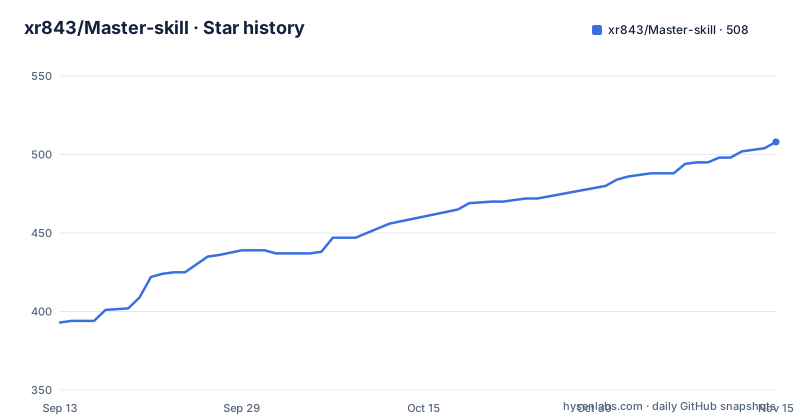
Star history
- xr843/Master-skill508 ★ · +115
| Repository | 2026-09-13 | 2026-11-15 |
|---|---|---|
| xr843/Master-skill | 393 | 508 |
115 Stars in the last 63 days, measured from the daily GitHub snapshot. Compare with other projects
Editorial analysis
The README puts a 68.8% grader score next to an 89.9% adjudicated one
The fidelity harness is 211 fixtures, at least ten per master and eighteen for the compare-masters meta-skill, checking mechanically whether expected keywords and citations appear and whether forbidden ones do not. Each scored answer then goes through a separate offline citation audit.
The published numbers are specific about their own denominator. The most recent full run scored 199 of 211, which is 94.3%, using DeepSeek `deepseek-v4-flash`; the twelve missing outputs were truncated and recorded as untested rather than failed, so they are excluded from every rate below rather than counted as passes.
The mechanical grader passed 137 of 199, or 68.8%. The README says why that number is soft: the check is substring matching, which cannot tell a paraphrase from a missing item, and cannot tell a correct refusal from a boundary violation. After per-item human adjudication the figure is 179 of 199, or 89.9%, split as 94.3% for doctrine, 85.9% for boundaries and 83.3% for holding citations under adversarial pressure. The adjudicators overturned 43 failures and also downgraded one pass to a fail, and each ruling quotes the answer it was based on.
The citation audit reached 93% of citations and found three fabrications
Coverage is stated with the same honesty as the scores. Re-auditing the same batch of answers offline covered 574 of 619 citations, which is 93%, across four source families: CBETA for the Chinese canon, BDRC and Toh for Tibetan, PTS and SuttaCentral for Theravada, and compiled collections of talks.
Three citations were judged fabricated. All three came from the same place: the curriculum mode recommending a passage by giving a catalogue number from a Chinese Buddhist canon, attributed to a specific master's collected writings, when the text is in fact a Qing-dynasty work by a different author. The same catalogue numbers appear in 23 of that master's own citations, and there they carry a FoJin link.
Two things follow. The audit is not complete, since forty-five citations in that batch were never re-checked, and the fabrication class is specific rather than random: a number that looks right is exactly what a language model will produce, and a catalogue identifier has no visible structure that would let a reader notice it belongs to someone else. That is the failure mode the HARD-GATE rule against fabricating source IDs is aimed at, and the audit found three instances of it anyway.
The two-stage review cannot prove two people reviewed anything, and the README says so
The write path is gated. Generation is supposed to be reviewed in two stages, doctrine first and style second, and the writing side demands two pass records from different stages. It also checks that the input hash each reviewer recorded still matches the current content, so an edit after review forces a new review rather than slipping through under an old signature.
Then the README limits its own claim. The records are written locally by the generation flow. They prevent the pattern where content is reviewed and then changed, and they cannot prove that two independent people actually performed the reviews; the review judgement itself remains the reviewer's own responsibility.
That sentence is the most useful line in the documentation, and it is worth reading as a design lesson rather than a caveat. Any local gate that records its own inputs can enforce a process invariant, because the hash comparison is mechanical and the identity of the reviewer is not. Teams building similar gates usually state the first half and imply the second.
The full evaluation archive is named for 0.11.0, and the package is at 0.12.16
The evidence the README leans on is versioned. The archived run behind the 199/211 figure is `eval/reports/0.11.0-06b8142-deepseek.json`, from commit `06b8142` on 2026-08-31, and the current package version in the manifest is 0.12.16. So the most recent full evaluation the project points to belongs to a version line well behind the one being published.
What landed in between is not cosmetic. The v0.12.14 release note reads that create-master no longer pre-approves any shell command, and v0.12.15 reads that Windows sessions never saw the masters. Both are fixes to the persona-generating path: a generated skill that arrived with shell commands already approved, and a generated skill that did not work at all on Windows. A framework whose headline claim is that generated personas respect boundaries changed its boundary defaults after the last time it scored itself end to end.
The releases are frequent, three of them in the twelve days before 2026-09-28, and each one is named after the behaviour it changed, which makes the gap between 0.11.0 and 0.12.16 easy to read and easy to miss if you only look at the newest tag.
The promptfoo layer covers three masters, and the live scores need your own API key
The evaluation stack has two tiers and they do not cover the same ground. The fixture suite runs across all fifteen personas. The promptfoo evaluation layers, named RAW, SPE and CUS, currently cover three: Huineng, Tsongkhapa and Ajahn Chah.
The other tier is not run by CI. Structural validation happens as a dry run on every pull request and on main, which checks the shape of the personas, the citation contract and the manifests. The scored run against a real model is a manual step before a release, with a `--provider` switch for Anthropic, DeepSeek or Gemini, and it needs that provider's key. So the 199/211 figure in the README cannot be re-derived from a clone by a third party: it needs a provider account, and the project says which one produced it.
The manifest shows how much of the repository is validation rather than behaviour. The `test` script is a chain of roughly fifteen Python entry points, beginning with a liveness check for the gates themselves, then citation template, self-audit source, citation contract, cross-critique, lore trigger, quote attribution, section reference and promptfoo config validators. Two other scripts run actual tests, one in bash for hooks and one with the Node test runner for the CLI. A pytest.ini sits in the tree that the test chain never invokes.
CBETA search returns nothing for simplified characters, so the toolchain converts first
The offline toolchain is three scripts: cite.py for CBETA lookup, query.py for keyword search with simplified and traditional forms normalised, and validate.py as a frontmatter linter. The dependency file is four packages, and one line explains the whole Chinese-text problem:
requests>=2.32.5,<2.33; python_version < "3.10"
requests>=2.34.2; python_version >= "3.10"
pypinyin>=0.55.0
pyyaml>=6.0.3
opencc-python-reimplemented>=0.1.7
The CBETA search only recognises traditional characters, so a citation written in simplified Chinese returns zero results, and opencc converts before the query runs. Without that step a persona that cites correctly can look like it cites nothing. The same file keeps a documented Python 3.9 floor by pinning requests to the last compatible 2.32 patch below Python 3.10 and using the current line above it.
Two design choices follow from the same concern for verifiability. The `sources/` directory holds key passages offline, so a citation still resolves when FoJin is unreachable. And live retrieval attaches a FoJin location link only when a real text identifier comes back, rather than formatting a link optimistically. The citation contract also states plainly that Theravada and some Tibetan sources have no per-paragraph numbering to begin with, which is why those families are cited at collection level.
Fifteen personas, one browser service, and five ways to install the same directory
Most readers are pointed at a web page instead of a package. The README opens with fojin.app/chat, where you pick a master from a menu in the corner of a chat page, with no install and no registration, backed by 10K+ texts, 678K+ semantic vectors and a knowledge graph of 110K+ entities. The offline path is the same repository with three scripts and whatever excerpts `sources/` happens to hold, which is a much smaller corpus. Those are two different products wearing one name.
Installing the local version is one command for Claude Code:
npx master-skill install master-zhiyiThe tree carries five platform entry points, a `.claude-plugin/` directory, `.codex/`, `.cursor-plugin/`, `.opencode/` and a `gemini-extension.json`, all serving one `prebuilt/` directory, and the README says the Codex, OpenCode and Gemini procedures were tested. The CLI itself is Node, exposed as `bin/cli.mjs`, while every validator in the same manifest is Python, so a checkout needs both runtimes before the `npm run validate` and `npm test` paths do anything.
A few things in the tree are not accounted for in the visible documentation: a `desktop/` directory, a `tools/` directory, a `prompts/` directory, and a licence that the repository does not resolve. A LICENSE file is present at the top level, yet the licence is recorded as undetermined and the README never names one, which is an odd gap in a project whose whole argument is source discipline.
Editorial conclusion
Adopt Master-skill if you want persona behaviour with citations attached and a documented way to argue about whether the citations hold, because the framework's real contribution is its evaluation apparatus rather than its fifteen characters. Do not adopt it expecting a completeness guarantee: a third of the audited citations were never re-checked, the promptfoo layer covers three masters, and the live scores need a provider key. Verify first by reading LICENSE at the top level, because the licence is recorded as undetermined, then run `npx master-skill install master-zhiyi` and compare the offline CBETA lookup in `scripts/cite.py` against fojin.app/chat before you rely on either.
Frequently asked questions
What is Master-skill?
A framework for Buddhist AI personas, with 15 pre-built masters drawn from Indian, Chinese, Tibetan and Theravada traditions, delivered as agent skills for Claude Code, Cursor, Codex CLI, OpenCode and Gemini CLI. Each persona declares its own sources, and doctrine claims are gated on citing them. It is published to npm as master-skill.
How good are the Master-skill personas, according to its own tests?
The mechanical grader passed 137 of 199 scored answers, 68.8%, and the README attributes that to substring matching, which cannot distinguish a paraphrase from a missing item. After per-item human adjudication the figure is 179 of 199, 89.9%, with 94.3% for doctrine, 85.9% for boundaries and 83.3% for holding citations under pressure. Twelve of 211 fixtures were truncated and counted as untested, not failed.
Can I reproduce the Master-skill fidelity scores myself?
Not from a clone alone. CI runs a structural dry run on every pull request, while the scored run against a real model is a manual step that needs an API key for Anthropic, DeepSeek or Gemini through the --provider switch. The published run used deepseek-v4-flash at commit 06b8142 on 2026-08-31, and its archive is named for version 0.11.0 while the manifest is at 0.12.16.
Does Master-skill work without the FoJin service?
Partly. The sources/ directory holds key passages from core texts for offline citation, and three scripts work locally: cite.py for CBETA lookup, query.py for offline keyword search with simplified and traditional forms normalised, and validate.py as a frontmatter linter. Live retrieval only attaches a FoJin link when it returns a real text identifier, so the full 10K+ text and vector corpus is only reachable through the hosted service.
What licence is Master-skill released under?
The repository does not resolve one. A LICENSE file sits at the top level, yet the licence is recorded as undetermined and the README never names a licence, so the file itself is the only place to look before copying a persona definition into another project.
Official sources
Add this badge to your README
If you maintain this project, the badge below links readers to this analysis and shows its maintenance status from the daily GitHub snapshot. Paste the markdown into your README; add ?metric=license or ?metric=stars to the image URL for a different field.

[](https://hysenlabs.com/projects/xr843-master-skill)Star history chart for your README
[](https://hysenlabs.com/projects/xr843-master-skill)Was this useful?