Open CoreUI: a lightweight desktop and server chat client
Open CoreUI - A rewritten Open WebUI in Rust, significantly reducing memory and resource usage, requiring no dependency services, no Docker, with both a server version and a Tauri-based desktop client. (formerly Open WebUI Lite)
At a glance
- What is it?
- Open CoreUI is an early-stage rewrite of Open WebUI v0.6.32 with a Rust backend, a Svelte frontend, and separate desktop and CLI server distributions. It removes the original project's Docker, Python, PostgreSQL, and Redis service requirements, but currently implements only basic chat functionality.
- Who is it for?
- Open CoreUI fits evaluators and users who want a lightweight Open WebUI-derived chat interface on a personal computer or a simple server, but it does not yet fit deployments that require the wider feature set of Open WebUI. Before adoption, verify that basic chat is sufficient, confirm the target operating system and architecture have a release, inspect the unknown license, and consult CLI.md for server configuration options.
- Can I use it commercially?
- Not without permission. GitHub finds no licence file in the repository, and without a licence all rights are reserved by default: you may read the code but not reuse it. Check the README, or ask the authors, before using it.
- Is it still maintained?
- Activity is slowing. The repository last received commits 7 months ago.
- What is it written in?
- Mainly Svelte, according to GitHub's language statistics.
Answers come from the project's GitHub data, last synced on November 7, 2026, and from our analysis. They are not legal advice.
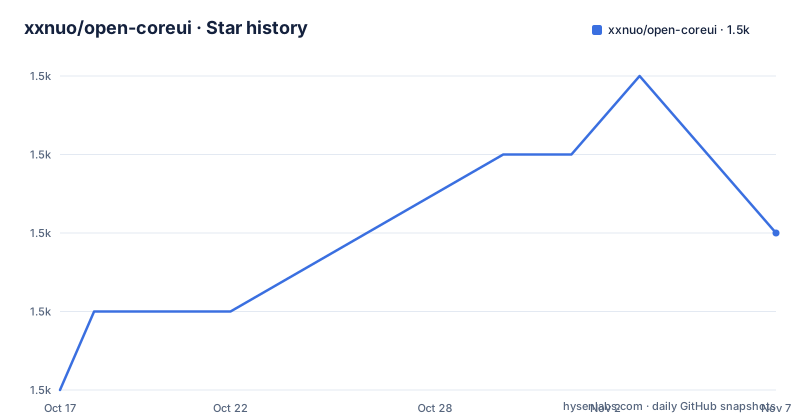
Star history
- xxnuo/open-coreui1,541 ★ · +2
| Repository | 2026-10-17 | 2026-11-07 |
|---|---|---|
| xxnuo/open-coreui | 1.5k | 1.5k |
2 Stars in the last 21 days, measured from the daily GitHub snapshot. Compare with other projects
Editorial analysis
What Open CoreUI replaces in an Open WebUI deployment
Open CoreUI targets a specific operational problem: running an Open WebUI-derived chat interface without assembling the original stack of Docker, Python, PostgreSQL, and Redis. Its repository identifies it as a rewritten lite fork of Open WebUI v0.6.32, not an official Open WebUI release. The intended audience includes people who want the recognizable original frontend in a lighter standalone package, whether that package is a desktop application for one computer or a CLI server reached through a browser.
The project makes two separate distribution choices. The desktop application is intended for personal-computer use and runs without a separate server. The backend server is intended for deployment on a server and for multi-user browser access. The README calls these clients "completely independent," so choosing one does not require adopting the other.
This is not yet a feature-complete Open WebUI replacement. The project explicitly labels itself an early development stage and says that only basic chat functionality is implemented. Other Open WebUI capabilities are described as gradually under development. That boundary matters more than the lower resource claims because an operator choosing between the projects may need a capability that is absent from Open CoreUI.
The README claims lower memory use, lower hardware requirements, and better performance from its Rust backend than the original version. It provides no benchmark figures, test conditions, or measured comparison in the README, so those claims cannot be translated into a specific capacity estimate. The supported decision-level facts are narrower: it packages a frontend and backend together, offers standalone binaries, and removes the named external service dependencies.
Open CoreUI's frontend, Rust backend, and two delivery models
Based on the repository layout and README, Open CoreUI separates the interface from its Rust backend while presenting two deployment forms. The primary language is Svelte, and the project says it retains the original Open WebUI frontend. The backend was rewritten in Rust. The repository includes separate `backend/` and `open-webui/` directories, which is consistent with that division, although the README does not describe internal APIs, storage formats, model-provider adapters, or request routing.
In desktop mode, the application supplies a native window and is delivered as a single executable download according to the README. No separately operated server is required. The repository description identifies this client as Tauri-based, but the README does not provide its build configuration or explain which OS services it accesses. A prospective user should therefore treat the release package as the authoritative deployment unit rather than assume that a Tauri development setup is required for normal use.
Server mode launches the backend from the command line and directs the user to a browser address. The README says this mode is suitable for server deployment and multi-user access. It also calls the server independent of the desktop client. This arrangement avoids requiring a desktop window on the host, but the README does not describe authentication, authorization, persistent data storage, network exposure, TLS termination, backup, or multi-tenant behavior. Those omissions prevent a confident production-readiness assessment.
The project claims reduced resource use because it removes dependency services and uses a Rust backend. That architecture should make the deployment footprint smaller than a multi-service setup in principle, but the README does not specify process memory, database files, supported concurrency, or startup requirements. Engineers should measure the exact release artifact against their own traffic and model backend rather than rely on the comparative wording.
Installing Open CoreUI from its GitHub releases
Open CoreUI does not document installation through Cargo, npm, Docker, or a source build in the README. It directs users to the GitHub Releases page and offers Windows, macOS, and Linux builds for the `x86_64` and `aarch64` architectures. Because the project has no homepage listed on the repository, the releases URL is the specific acquisition point.
For the desktop application, download the package that matches the operating system and processor architecture, install or open it as applicable, and launch Open CoreUI. The README describes the desktop client as ready to use and independent of a server. It does not provide package-specific installer commands, signing information, or checksums.
For the CLI server, download the appropriate binary and follow the documented Linux or macOS sequence. The wildcard in these commands represents the selected release filename, not a literal file that should be typed unchanged:
chmod +x open-coreui-*
./open-coreui-*
The first command grants execute permission on Linux or macOS. The second starts the selected backend binary. The documentation says to open the address displayed by the process, which is usually `http://localhost:8168`. No Windows server launch command is supplied.
The macOS README section gives a specific remedy for an "app is damaged" error. It asks users to remove the quarantine attribute from the installed desktop application:
sudo xattr -d com.apple.quarantine "/Applications/Open CoreUI Desktop.app"This command changes macOS quarantine metadata and uses administrator privileges. It is presented specifically for the stated launch error and is not a general installation step. The README refers to `CLI.md` for configuration options and environment variables, but does not reproduce them, so this article cannot document ports beyond the usual address or invent environment settings.
Starting a real Open CoreUI chat workflow
The first documented use is intentionally basic because basic chat is the only functionality the project confirms as implemented. On desktop, install and open the application, then use the interface to start a chat. The README does not state how to configure a model provider, enter API credentials, import conversations, select tools, or attach files. Those operations should not be presented as available features on the basis of the original Open WebUI project from which this code is forked.
For the server path, start the downloaded binary and visit the address printed by the process. The README gives `http://localhost:8168` as the usual local address:
./open-coreui-*After opening the displayed address in a browser, the expected result is access to the web interface from the same machine. For multi-user deployment, the README says the backend is suitable for that purpose, but it does not provide a reverse-proxy example, firewall rule, account setup, or hardening configuration. The safe conclusion is limited: server deployment and browser access are documented, while production network controls are not.
Users should also expect an interface that is derived from Open WebUI v0.6.32. The repository contains an `open-webui/` entry and says the original frontend is used, but "original frontend" does not imply complete behavioral parity with the upstream release. The explicit early-stage warning controls that expectation. Any workflow involving conversation import, administration, model management, extensions, or other non-chat features needs direct verification against the selected release.
Open CoreUI's current feature and release constraints
The largest limitation is declared rather than inferred: Open CoreUI is in early development, and only basic chat functionality is implemented. This makes it a poor fit for teams selecting a platform on the basis of the full Open WebUI feature set. It may also be a poor fit for users who expect feature parity because of the shared frontend lineage and project name.
Release history provides two recent named versions, `v0.9.6` dated 2025-11-17 and `v0.9.5` dated 2025-11-16. These version numbers do not by themselves communicate API stability, compatibility with Open WebUI data, or production readiness. The README does not provide a migration guide, upgrade procedure, rollback procedure, database format, or compatibility statement for conversations and settings.
The last push was on 2026-04-02, so this repository is not archived, but that fact alone says nothing about release cadence or support policy. Upgrade cost can include rechecking behavior because only basic chat is confirmed, obtaining a new release binary for the correct OS and CPU architecture, and reading `CLI.md` again for server configuration changes. Desktop users also face platform-specific concerns such as the documented macOS quarantine issue.
The repository reports an unknown license. That is a direct adoption constraint. Without an identified license grant, source availability alone does not establish permission to use, modify, self-host, or redistribute the code or binaries. This article does not offer legal advice, but it cannot treat commercial or organizational use as permitted until the project publishes applicable license terms.
Open CoreUI versus a full Open WebUI or service-based deployment
The clearest alternative is the original Open WebUI stack from which Open CoreUI was forked. Open CoreUI's documented approach is a Rust rewrite packaged without Docker, Python, PostgreSQL, or Redis. The original project is not described here with operational details beyond those dependencies, but its separate infrastructure gives teams a different model: they operate multiple services rather than using one of Open CoreUI's standalone release artifacts.
That difference matters most when operational simplicity is the priority. Open CoreUI offers a single desktop executable or an independent CLI server, while retaining the original frontend. It is a better fit for evaluating a lightweight local client or a simple browser server. The README's lower-resource positioning is also more relevant in that context, although no quantified results are available.
A full Open WebUI deployment may be the more appropriate choice when the required workflow depends on features that Open CoreUI has not yet implemented. The fork's explicit warning prevents an equivalence claim. Migration is another differentiator: Open CoreUI does not document import of an existing Open WebUI database, so moving an established installation cannot be assumed from the shared frontend.
A source build is not a documented alternative route in the README. Neither is Docker deployment. Engineers who need reproducible source builds, documented dependency pinning, or a container image should check `backend/`, `.gitmodules`, and the build workflow before assuming that the release workflow is sufficient for their requirements.
Editorial conclusion
Open CoreUI fits evaluators and users who want a lightweight Open WebUI-derived chat interface on a personal computer or a simple server, but it does not yet fit deployments that require the wider feature set of Open WebUI. Before adoption, verify that basic chat is sufficient, confirm the target operating system and architecture have a release, inspect the unknown license, and consult CLI.md for server configuration options.
Frequently asked questions
How do I install Open CoreUI on Windows, macOS, or Linux?
Download the matching release for your operating system and `x86_64` or `aarch64` architecture from the GitHub Releases page. The README documents standalone desktop and CLI distributions rather than installation through Docker or a package manager.
Does Open CoreUI require Docker, Python, PostgreSQL, or Redis?
No. The README says the desktop application and backend server can run independently without Docker, Python, PostgreSQL, or Redis dependency services.
Is Open CoreUI feature-complete compared with Open WebUI?
No. The project identifies itself as an early-development lite fork and states that only basic chat functionality is currently implemented.
How do I start the Open CoreUI server?
On Linux or macOS, make the downloaded binary executable and run it. Then open the displayed browser address, which is usually `http://localhost:8168`; the README refers to `CLI.md` for configuration details.
What license applies to Open CoreUI?
The repository information identifies the license as unknown, and the README does not state license terms. Usage and redistribution rights therefore require confirmation from the project maintainers.
Official sources
Add this badge to your README
If you maintain this project, the badge below links readers to this analysis and shows its maintenance status from the daily GitHub snapshot. Paste the markdown into your README; add ?metric=license or ?metric=stars to the image URL for a different field.

[](https://hysenlabs.com/projects/xxnuo-open-coreui)Star history chart for your README
[](https://hysenlabs.com/projects/xxnuo-open-coreui)Was this useful?