VoiceMem's manifest says 0.2.3, its newest tag says v0.0.2, and its dependency list documents a silent failure
a real-time and empathetic memory system for voice assistants
At a glance
- What is it?
- A Python memory system for real-time voice agents, split into a left brain for facts and a right brain for personality and emotion, with streaming retrieval during speech. The dependency manifest is the most unusual artefact in the repository: it explains which packages exist because their absence degrades a headline feature silently rather than raising an error.
- Who is it for?
- Judge this as a research release rather than a library, which is what the version numbers and the artefact layout both say. It ships as a paper with code, models, a dataset and a benchmark harness, and the honest numbers are the ones it prints about itself: 430 memory tokens per query against thousands for the baselines, 134 ms against a second and a half, and a retrieval accuracy figure that comes from the authors' own evaluation rather than an independent one.
- Can I use it commercially?
- Yes. Apache-2.0 is a permissive licence: you can use, modify and sell software built on it, as long as you keep its copyright and licence notices.
- Is it still maintained?
- Yes. The repository last received commits 73 days ago.
- What is it written in?
- Mainly Python, according to GitHub's language statistics.
Answers come from the project's GitHub data, last synced on November 25, 2026, and from our analysis. They are not legal advice.
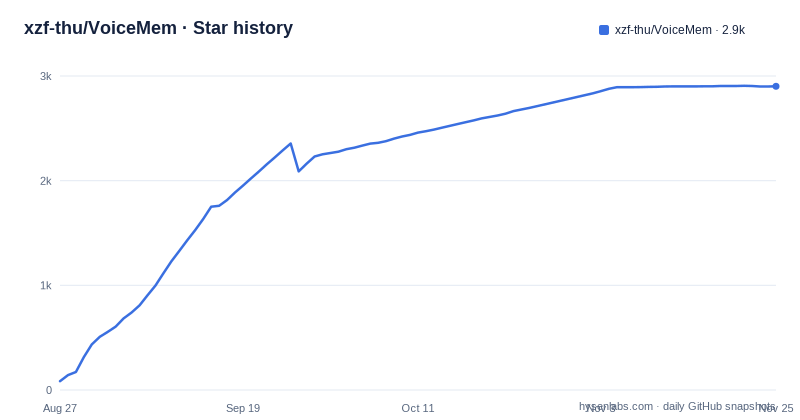
Star history
- xzf-thu/VoiceMem2,902 ★ · +2,818
| Repository | 2026-08-27 | 2026-11-25 |
|---|---|---|
| xzf-thu/VoiceMem | 84 | 2.9k |
2,818 Stars in the last 90 days, measured from the daily GitHub snapshot. Compare with other projects
Editorial analysis
The manifest is three minor versions ahead of the newest tag
The package metadata says version 0.2.3. The release history tops out at v0.0.2. There is no v0.0.3, no 0.2.x tag, and nothing between them, so the source tree has moved through three version bumps that were never published as a release. Both existing tags carry the same timestamp to the second, one second apart on 2026-09-01, which means they were pushed together rather than released apart, and the news section above them dates the first release to 2026-08-27 and the second to 09-01. So there are three different chronologies on one page: the tags, the news list and the manifest. The practical consequence is that the version you report is not a fact about the code. If you install from the package index you get whatever the index holds, which is not v0.0.2, and if you clone you get 0.2.3 with no tag anywhere pointing at it.
Three dependencies are declared because their absence fails silently
The dependency list carries explanatory comments that read like an incident report, and the important one is about a package that is not this project's own. A comment on the vision library says the transformers integration needs it to load a video processor for one of the open omni models, and that if it is missing nothing raises an error: the emotion attributer quietly retreats to a purely acoustic quadrant, an utterance like I like strawberries gets classified as sad, and the entire right brain becomes inaccurate. The same note is attached to the acceleration library, needed by the emotion model when it spreads weights across devices, where absence is again silent degradation rather than a crash. A third package is declared because the ASR library imports it internally without declaring it itself. This is the opposite of the usual pinning instinct. The list is not there to control versions, it is there to stop an import error that nobody would think to look for.
An extra called slm was renamed because nobody guessed ASR lived in it
Above the dependency list sits a comment explaining why everything is now in the base install. The audio components, the speech recognition, the voice activity detector, the voiceprint, the scene and emotion models and the local embedding, plus the web demo and the examples, were previously split into an optional extra. The comment says the result was that users who installed the base package following the readme still hit a missing module error for the speech recognition library, and it names the reason in plain terms: the extra was called slm, and nobody would guess that speech recognition was inside it. So the base package now installs the full stack, and the small extra that survives is the one the readme offers as optional, which is their fine-tuned Qwen reply model. It is a small packaging story with a large usability lesson attached, and the comment is worth keeping for that reason alone.
The model key is used on write, and retrieval stays local
Both usage examples construct the object with an API key, which reads badly until you read the comment attached to the export line in the agent section: the key is used only when writing memories, for fact extraction, and memory retrieval runs entirely locally. That is the privacy shape of this system in one sentence, and it is a reasonable one, since the expensive and latency-sensitive half, search, never leaves the machine, while the expensive-and-latency-insensitive half, turning speech into structured facts, does. The generator is replaceable in one line, since you pass a reply function that receives the text and the memory context, and the documentation notes a synchronous function is fine because it is moved to a thread for you. The examples directory backs the claim up with a file named for a fully local run on a single accelerator, alongside one that wires a realtime hosted model and one that reads from the microphone.
The memory engine is declared replaceable and shipped as a hard dependency
The architecture paragraph says every component, including the underlying memory engine, can be swapped. The base dependency list, however, includes a third-party memory package unconditionally, and the left brain is described as keeping that library's full performance under a top-three retrieval limit. So the decoupling is a design intention rather than an install-time option: you can replace it in code, but you cannot avoid installing it. The base install is one command, and the default model weights arrive in a second:
pip install voicemem
hf download zhifeixie/VoiceMem_Default_Models_Env --local-dir ./models
The split itself is the interesting part. Facts are organised by schema and entity for precise retrieval, while personality, emotion and relationships live in separate nodes with cross-entity links, and the second release notes say the redundant right-brain memory categories were removed. Both halves come back from a search, which is what makes the pairing awkward to ignore: a query that should have matched a fact and a query that should have matched a feeling go through the same call.
Two token counts and two accuracy figures for the same claims
The summary and the feature list do not agree, and both are self-reported. The summary says a single-turn query costs about 300 tokens. The feature list says each use costs 430 memory tokens, against 6,956 for the comparison system and 1,899 for a third. Both numbers are of the right order and neither is wrong in a way you can detect from outside, but a reader quoting the headline will quote one of them. The accuracy figures behave the same way. The feature list claims 91.2 percent on one memory benchmark, while the example output block printed in the readme shows 139 of 152 correct, which is 91.4 percent, on a smaller sample of ten conversations with a per-category breakdown underneath. The second figure is reproducible because the command is in the page and the sample data ships in the repository; the first is the full dataset result. Both are the authors' own runs, which is normal for a research release and worth saying plainly.
Interruption handling is two-stage and tuned by two environment variables
The demo handles people talking over the assistant, which is the part of a voice system that quietly decides whether it feels alive. The design is two-stage. Voice activity detection first pauses playback and keeps the audio queue; only an explicit stop command or a stable transcription confirmation clears that queue and cancels the reply, and acknowledgements, echoes, sounds with no words and single-syllable fragments resume playback instead. Two environment variables tune it, one for the silence window that rejects a candidate and one for the longest wait before giving up. Output timing is handled separately and is stated as a real constraint: both reply modes share a sample-position timeline, the browser reports its real render progress, and on an interruption only the part already played is kept, with text alignment supplied by backends that can return timed chunks and estimated from segment length and speech rate for those that cannot.
The demo needs a clone, and every run leaves a log behind
The installed package is only the library, which the page says outright, so the quick start's clone step is load-bearing rather than decorative if you want the demo. That runs from a script and serves on port 8787, and by default it writes the terminal output, including framework logging, to a file under the results directory whose name carries a timestamp and a process id, with per-line markers for the two output streams. There are flags to point that file somewhere else or to turn it off. The same section explains the session lifecycle: each turn sits in an in-memory buffer, and a turn leaves that buffer only once the asynchronous write has completed and confirmed that a persistent memory was actually produced, so turns that produce nothing stay until the session ends. Different memory spaces and different websocket sessions are isolated from each other, which matters because the whole system is a long-lived memory by design.
Editorial conclusion
Judge this as a research release rather than a library, which is what the version numbers and the artefact layout both say. It ships as a paper with code, models, a dataset and a benchmark harness, and the honest numbers are the ones it prints about itself: 430 memory tokens per query against thousands for the baselines, 134 ms against a second and a half, and a retrieval accuracy figure that comes from the authors' own evaluation rather than an independent one. Two things to check before you build on it. First, which version you actually installed, since the manifest, the tags and the news section disagree about the chronology. Second, what your emotion accuracy is worth, because the manifest itself documents that one missing transitive dependency makes the emotion attributer fall back to an acoustic-only quadrant with no error raised, and a feature that fails quietly is the one you have to test for yourself.
Frequently asked questions
What is VoiceMem?
It is an Apache-2.0 licensed Python memory system for real-time voice assistants, split into a left brain that organises facts by schema and entity and a right brain that handles personality, emotion and relationships. Retrieval happens while the user is still speaking, and the whole flow is streaming, from audio segmentation and transcription through to structured memory writes.
How do I install VoiceMem?
Clone the repository, then `pip install voicemem`, which installs the full stack including speech recognition, voice activity detection, voiceprint, scene and emotion models, and the local embedding model, plus the web demo and examples. An optional `pip install "voicemem[slm]"` adds their fine-tuned Qwen reply model, and the default models are then fetched from a Hugging Face repository into a local models directory.
Do I need an OpenAI key to use VoiceMem?
The usage examples pass an API key, and the page states it is used only when writing memories, for fact extraction, while memory retrieval runs entirely locally. You can also replace the generator by passing your own reply function, which receives the text and the memory context, and the examples directory includes a fully local run on a single accelerator.
What are VoiceMem's reported benchmark numbers?
Self-reported by the authors: 91.2 percent on a memory benchmark against 61.68 percent for the compared system using only top-five memories, 69.44 percent on a persona benchmark, 134 ms response time against 1,440 ms, and 430 memory tokens per query against 6,956 and 1,899 for the two other systems. The readme also prints a reproducible sample run of 139 correct out of 152 questions on ten conversations.
Can I fine-tune my own VoiceMem adapter?
Yes. The page pins the training framework exactly and then points at the training script, with the default configuration matching the released adapter checkpoint. The data format, the GPU memory requirement and how to swap the base model are documented in the fine-tuning readme inside the repository rather than on this page.
What can VoiceMem remember from audio?
The project says it can remember speech, the speaker, sound events, multi-party conversation and music from real-world audio, not only what was said but also who the user is and how they feel. It also publishes the model families that can read and understand those memories during a conversation, plus a dataset of four hundred thousand memory-grounded conversations.
Official sources
Add this badge to your README
If you maintain this project, the badge below links readers to this analysis and shows its maintenance status from the daily GitHub snapshot. Paste the markdown into your README; add ?metric=license or ?metric=stars to the image URL for a different field.

[](https://hysenlabs.com/projects/xzf-thu-voicemem)Star history chart for your README
[](https://hysenlabs.com/projects/xzf-thu-voicemem)Was this useful?