zapplyjobs/New-Grad-Data-Science-Jobs-2027: every apply link is a redirect
2027 entry-level data science & ML jobs — analytics, AI, quant & machine learning US roles
At a glance
- What is it?
- A single static page listing data science, analytics and ML roles aimed at new graduates in the United States, with a Posted column, a visa sponsor flag and an Apply column that routes through the operator's own domain. Useful as a scanning surface, but the freshness claims, the blank cells and the duplicate requisitions are all things to read before you trust a row.
- Who is it for?
- Treat this repository as a lead list rather than a source of truth. It earns a look for volume and for the sponsor column, which most aggregators drop, but three things have to be checked per row: whether Posted says something other than Date unknown, whether the apply link's redirector still resolves to the requisition you expected, and whether the role is genuinely entry level, since manager and postdoctoral titles sit in the same table.
- Can I use it commercially?
- Check first. The repository uses a licence we do not classify automatically, so read its LICENSE file before any commercial use.
- Is it still maintained?
- Yes. The repository received new commits within the last day.
- What is it written in?
- Mainly HTML, according to GitHub's language statistics.
Answers come from the project's GitHub data, last synced on October 22, 2026, and from our analysis. They are not legal advice.
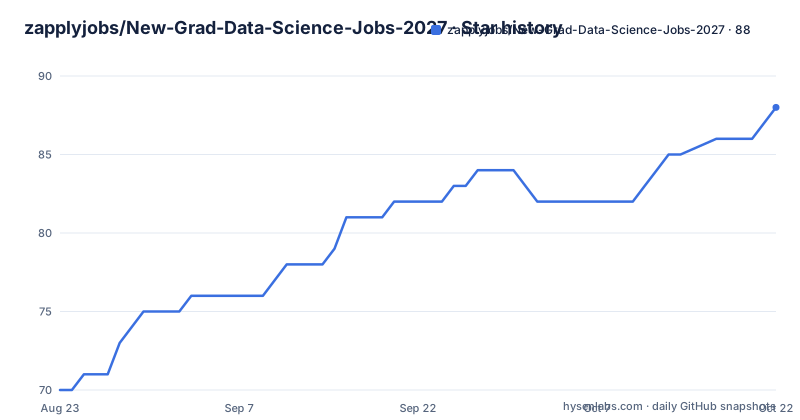
Star history
- zapplyjobs/New-Grad-Data-Science-Jobs-202788 ★ · +18
| Repository | 2026-08-23 | 2026-10-22 |
|---|---|---|
| zapplyjobs/New-Grad-Data-Science-Jobs-2027 | 70 | 88 |
18 Stars in the last 60 days, measured from the daily GitHub snapshot. Compare with other projects
Editorial analysis
Every apply link goes through zapply.jobs first
The Apply column never points at an employer's own careers page. Each cell is a URL of the form `zapply.jobs/l/d/...` followed by a tracking parameter, and the path segment names the applicant tracking system the role came from. The Crowe row uses a workday prefix with an external careers requisition number, the Carnegie Mellon SEI rows use workday, Handshake and OpenAI use ashby, Axon and Flagship Pioneering use greenhouse, AbbVie and ServiceNow use an sr prefix, and AMD and Google have their own forms. Two consequences follow. You are applying through an intermediary rather than at the source, so a broken or stale redirect is a failure mode you have no control over. And the slugs themselves leak a small amount of structure, since the requisition identifiers are readable in the URL and can be compared across rows.
Posted runs from 1h to Date unknown
Freshness is the headline claim and the Posted column is where you can check it. The README says the list is updated every 10 minutes, and the rows carry relative ages: 1h for the newest entries such as the Crowe Machine Learning Engineer role and the Carnegie Mellon SEI Associate Data Scientist listings, then 2h, 3h, 6h, 7h, 8h, 10h and 22h, with a 1d on the NVIDIA New College Grad 2026 row. Two rows break the pattern entirely and say Date unknown instead: the Parsons Data Scientist listing in MacDill Air Force Base and the Google Research Scientist, Gemini Vision, DeepMind entry. A blank freshness field means the age could not be established, which is different from old and different from new, so those two deserve a direct check at the employer.
The Visa column is a sponsor flag, not a decision
Each row either shows a check with the word Sponsor or leaves the cell empty, and the split is informative rather than random. KLA, Intel, Merck & Co., Elevance Health, Capital One, Booz Allen Hamilton, Thermo Fisher, Vanguard, AMD, AbbVie, CACI, ServiceNow, Google, OpenAI and NVIDIA all carry the sponsor mark in the visible portion of the table. Crowe, Carnegie Mellon SEI, Boys Town, American Fidelity, the University of Texas at Austin, Handshake, Axon, Parsons and Flagship Pioneering leave it blank. An empty cell is not a refusal, it is an absence of a claim, and the two are easy to confuse when scanning quickly. If sponsorship is the deciding factor for your search, treat the marked rows as worth a form and the blank rows as worth an email.
The same title appears twice under different requisition numbers
Duplicates are visible in the table and they are not always the same job listed once. Carnegie Mellon SEI posts two Associate Data Scientist rows in Pittsburgh with different requisition identifiers, 2025156 and 2024499, both at 1h. Capital One posts three McLean rows at 2h, and two of them share the identical title Manager, Data Scientist, Recommendation and Personalization Systems with the identifiers R1002604 and R1002564, alongside a separate Manager, Data Science row. Whether that reflects distinct requisitions at one employer or one opening mirrored twice, the effect on a reader is the same: counting rows gives an inflated sense of how many openings exist, so track applications by requisition identifier rather than by company and title.
New grad in the repository name, manager in the table
The framing and the contents do not line up. Alongside genuine new graduate entries, such as the NVIDIA Research Scientist, Fundamental Generative AI, New College Grad 2026 role in Santa Clara and the Flagship Pioneering bioinformatics co-op in Cambridge, the table lists a Capital One Manager, Data Scientist, a Merck & Co. Postdoctoral Researcher in Integrative Genetics and Multi-Omics Data Science, and an OpenAI Data Scientist, B2B Generalist. Note also that the newest NVIDIA row is labelled 2026 while the repository is named for 2027, so the graduation cycle is mixed. The listed roles are overwhelmingly United States based, from Chicago and Pittsburgh to Bellevue and Santa Clara with one Remote entry, and there is no salary column, so neither compensation nor location flexibility can be compared from the page itself.
It is one static page that also sells an autofill extension
The repository is a site, not a dataset. The top level holds index.html, an images/ folder, llms.txt for crawlers, .gitattributes, .github/, CONTRIBUTING-GUIDE.md, CONTRIBUTORS.md, CODE_OF_CONDUCT.md and a LICENSE, with HTML recorded as the primary language and no clear license, recorded as NOASSERTION. Above the job table sits the commercial part: a link to an onboarding page, a Chrome extension that autofills job applications, a dedicated job board, user accounts with multiple profiles for different resume types, application tracking with streaks and commitment awards, and a Discord and LinkedIn presence. The list is the funnel. That does not make the data wrong, but it does mean the incentives around what gets listed and how fresh it claims to be belong to the operator.
One collapsible block per role family, and only one is visible
The table is wrapped in a details and summary element headed Data Scientist, which means the page repeats that structure per role family and collapses each one until you open it. Only that first category is visible in what is published here, so the shape of the other sections, and how many there are, cannot be confirmed from this file. The columns inside are fixed: Company, Role, Location, Posted, Visa, Apply. That schema is what makes the page scannable, and it is also what limits it. There is no column for salary, seniority, remote eligibility, team or application deadline, and no filter control is described, so narrowing a search of any size means reading rather than querying. The operator's job board is where the extra filtering lives.
Editorial conclusion
Treat this repository as a lead list rather than a source of truth. It earns a look for volume and for the sponsor column, which most aggregators drop, but three things have to be checked per row: whether Posted says something other than Date unknown, whether the apply link's redirector still resolves to the requisition you expected, and whether the role is genuinely entry level, since manager and postdoctoral titles sit in the same table. And read the licensing position before reusing anything, because the repository records no clear license and the page doubles as the front door to the operator's job board and autofill extension.
Frequently asked questions
How fresh is the job list in zapplyjobs/New-Grad-Data-Science-Jobs-2027?
The README states the list is updated every 10 minutes, and each row carries a Posted value such as 1h, 2h or 1d. Two rows show Date unknown instead, including the Parsons Data Scientist listing and the Google Research Scientist, Gemini Vision, DeepMind entry.
Do the apply links on this data science job list go straight to employers?
No. Every Apply cell points at zapply.jobs/l/d/ with a tracking parameter, and the path segment names the applicant tracking system the role came from, such as workday, ashby, greenhouse, sr, google or amd. Applying means passing through that redirect first.
What does the Visa column mean in this job list?
It is a sponsor flag. Rows marked with a check and the word Sponsor indicate the employer sponsors, while many others, including Crowe, Carnegie Mellon SEI, Boys Town, American Fidelity, Handshake, Axon and Parsons, leave the cell empty rather than marking it as no.
Does the list contain only entry-level data science roles?
Not consistently. The table includes Capital One manager roles, a Merck & Co. postdoctoral researcher position and an OpenAI Data Scientist, B2B Generalist, alongside genuine new grad entries such as the NVIDIA New College Grad 2026 research scientist and a Flagship Pioneering bioinformatics co-op.
What is in the repository besides the job table?
A single index.html page, an images/ folder, an llms.txt file for crawlers, .gitattributes, .github/, CONTRIBUTING-GUIDE.md, CONTRIBUTORS.md, CODE_OF_CONDUCT.md and a LICENSE, with the license recorded as NOASSERTION and HTML as the primary language.
Official sources
Add this badge to your README
If you maintain this project, the badge below links readers to this analysis and shows its maintenance status from the daily GitHub snapshot. Paste the markdown into your README; add ?metric=license or ?metric=stars to the image URL for a different field.

[](https://hysenlabs.com/projects/zapplyjobs-new-grad-data-science-jobs-2027)Star history chart for your README
[](https://hysenlabs.com/projects/zapplyjobs-new-grad-data-science-jobs-2027)