Vivid for Android: sideloading an IRL streaming app that is still catching up to Moblin
Android version of the open-source Moblin IRL streaming app. Vivid lets you broadcast high-quality live video to platforms like Twitch, YouTube, Facebook, Kick or your own SRT server, with advanced features like multi-network bonding, OBS WebSocket control, configurable overlays, and full I18n support.
At a glance
- What is it?
- Vivid is a Kotlin Android app that aims to match the Moblin IRL streaming app feature for feature. This guide covers how you install it from GitHub Releases, which APK to pick, how to verify the download, and which features should not be trusted for production streams yet.
- Who is it for?
- Vivid suits streamers who want a Moblin-style IRL client on Android and are comfortable sideloading APKs and following a nightly build cadence. It is the wrong choice if you need a Google Play install, a finished Moblin feature set today, or a stable build you never have to think about.
- Can I use it commercially?
- Yes. MIT is a permissive licence: you can use, modify and sell software built on it, as long as you keep its copyright and licence notices.
- Is it still maintained?
- Yes. The repository received new commits within the last day.
- What is it written in?
- Mainly Kotlin, according to GitHub's language statistics.
Answers come from the project's GitHub data, last synced on November 6, 2026, and from our analysis. They are not legal advice.
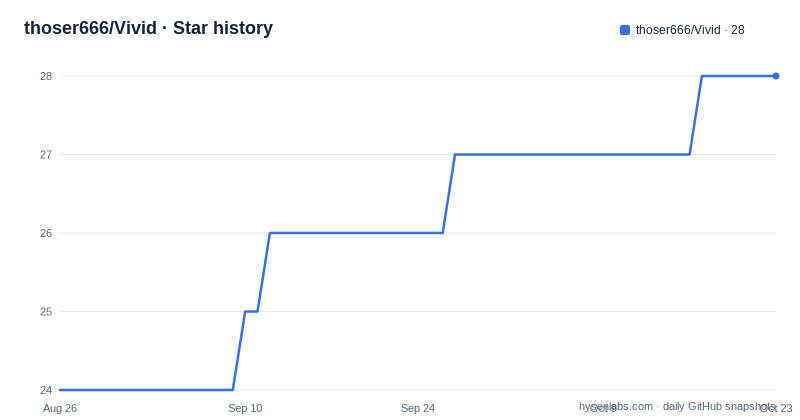
Star history
- thoser666/Vivid29 ★ · +5
| Repository | 2026-08-26 | 2026-11-06 |
|---|---|---|
| thoser666/Vivid | 24 | 29 |
5 Stars in the last 72 days, measured from the daily GitHub snapshot. Compare with other projects
Editorial analysis
Feature parity with Moblin is a goal, and planned features are not shipped
Vivid is an Android implementation of the open-source Moblin IRL streaming app, written in Kotlin with Compose and RootEncoder. The stated end goal is to be at least functionally equivalent to Moblin, so every feature Moblin offers should eventually work in Vivid, adapted to Android.
The repository does not claim that point has been reached. A parity status table and a PARITY.md file track what is implemented, in progress and planned, and the project warns that features marked planned are not shipped yet and should not be relied on for production streaming until they land.
The repository description lists broadcasting to Twitch, YouTube, Facebook, Kick or your own SRT server, multi-network bonding, OBS WebSocket control and configurable overlays. Another passage in the README describes the client as built for Twitch over RTMP and RTMPS. When the two disagree on your platform, check PARITY.md for your exact target before you plan a show around it.
Installation means sideloading from GitHub Releases, because Google Play is not an option yet
Vivid is not on Google Play. APKs are published as GitHub Releases, and the project offers three paths: a permanent direct download link for the latest stable build at releases/latest/download/app-standard-release.apk, the Releases list, or an F-Droid repository that provides automatic updates for APK 24 and later.
Because the install is outside the Play Store, Android blocks it at first. You open the downloaded file, tap Settings in the Install unknown apps dialog, allow your browser or file manager to install unknown apps, return and tap Install. If your browser warns about the file type, confirm Download anyway.
All official APKs are signed with the same release key. If Android shows App not installed, the README suggests a corrupted download, so delete the file and fetch it again. The cost of this route is that updates are your responsibility unless you add the F-Droid repository.
Stable, nightly and alpha channels trade tested builds for fresh ones
Three release channels exist. Latest or Stable uses v* tags and carries auto-generated release notes, and the project points to daily use. Nightly is a prerelease that rebuilds every new feature and is updated daily, aimed at testers and early adopters. Alpha uses v*-alpha tags as the first stage of versioned releases and is for previewing upcoming features.
The release list shows how fast nightlies move. Three nightlies were published on 31 October, 1 November and 2 November 2026, with version strings 0.5.49-nightly.663, 0.5.49-nightly.678 and 0.5.49-nightly.685. The counter rose by 15 and then 7 across those days, so each nightly includes real changes, and the last push to the develop branch was on 2 November.
That pace is good for testers and a risk for anyone going live on a schedule. Pick Stable for an actual broadcast, and keep nightly on a spare device. Versioning rules, including versionName, versionCode and stage criteria, are documented in RELEASE.md.
Two APK flavors differ in whether Sentry is included
The release assets include app-standard-release.apk and app-foss-release.apk. The standard flavor adds optional Sentry, while the foss flavor is fully open source and is the Sentry-free variant for F-Droid. Files named mapping.txt and output-metadata.json are for developers only and can be ignored.
If you want to build the app yourself, the README gives one command for the foss debug build, using the Gradle 9.4 wrapper and JDK 25.
./gradlew assembleFossDebugThe project documents a Sentry opt-out proof as part of its release-grade security rules, so crash reporting is described as optional rather than forced. Still, the practical advice is simple: if you do not want any telemetry code in the binary, install the foss APK or use the F-Droid route instead of the direct standard link, which the README presents as the default download.
Verifying a download uses SHA256SUMS and a sigstore bundle
Each release ships a SHA256SUMS.txt file, and downloads are checked with sha256sum -c. Stable releases additionally ship a keyless signature from sigstore and cosign in SHA256SUMS.txt.bundle, a bundle holding the signature, the certificate and the transparency-log entry. This authenticates the checksum file itself, so the chain runs from the signed checksum file to the APK you downloaded.
The point of the extra step is that a checksum file served from the same place as the APK proves little on its own. The signature ties the checksum to the release pipeline. The README sends you to docs/distribution.md for the details, which also cover cadence and the F-Droid repositories.
A separate Security-Loop guard script, scripts/check_security_loop.sh, runs in the pre-push gate, in CI and in the release pipeline. It keeps rules such as keystore hardening, signature checks, reproducibility and the Sentry opt-out proof structurally present. Vulnerabilities go to SECURITY.md for private reporting.
Going live asks for camera, microphone and a persistent notification
Vivid requests camera and microphone permissions when you tap Go Live. On Android 13 and later it also asks for notifications, because they power the streaming status notification.
While you stream, a persistent notification reading Vivid is streaming, with a Stop action, keeps the stream alive when you leave the app or turn the screen off. The encoder runs independently of the camera preview surface in what the README calls a GL-free pipeline, so the stream continues when the preview surface goes away.
The consequence for IRL use is that the phone can sit in a pocket or on a gimbal with the screen off. The consequence for permissions is that denying notifications on Android 13 or later takes away the status notification that the background behavior is described around, so grant it. The user guide is available in English, French and German, with tutorials, an FAQ and troubleshooting pages.
The Gradle modules split streaming, chat, widgets, OBS control and settings
The repository is organized as separate Gradle modules: app, core, data and domain, plus feature-chat, feature-obs-control, feature-settings, feature-streaming and feature-widgets. That layout maps onto the features users see, such as the chat overlay and AI chat bot, widgets, scenes, replays and OBS WebSocket control.
Contributors work against the develop branch, which is the default, and send code as pull requests. CONTRIBUTING.md describes the workflow, the required checks and a local pre-push gate. The repository also carries a fastlane directory, an fdroid directory, a Renovate configuration and a Snyk file, which fit the distribution and dependency story above.
The license is MIT and the repository is not archived. Because the default branch is develop and nightlies are cut from fast-moving work, the code you read on GitHub may be ahead of the stable APK in your pocket, so match documentation to the release you installed.
Editorial conclusion
Vivid suits streamers who want a Moblin-style IRL client on Android and are comfortable sideloading APKs and following a nightly build cadence. It is the wrong choice if you need a Google Play install, a finished Moblin feature set today, or a stable build you never have to think about. Read PARITY.md before going live, and test your platform connection off-stream first.
Frequently asked questions
Is Vivid available on Google Play?
No. Vivid is not on Google Play yet, and APKs are published as GitHub Releases. You can also add the F-Droid repository for automatic updates.
What is the difference between the Vivid standard and foss APKs?
The standard flavor adds optional Sentry. The foss flavor is fully open source and is the Sentry-free variant used for F-Droid.
How do I build Vivid from source?
The README gives ./gradlew assembleFossDebug, using the Gradle 9.4 wrapper and JDK 25. The foss flavor is fully open source.
Does Vivid already match every Moblin feature?
Not yet. Full feature parity is the stated goal, and PARITY.md tracks what is implemented, in progress or planned. Planned features are not shipped and should not be relied on for production streaming.
Official sources
Add this badge to your README
If you maintain this project, the badge below links readers to this analysis and shows its maintenance status from the daily GitHub snapshot. Paste the markdown into your README; add ?metric=license or ?metric=stars to the image URL for a different field.

[](https://hysenlabs.com/projects/thoser666-vivid)Star history chart for your README
[](https://hysenlabs.com/projects/thoser666-vivid)Was this useful?