cyber-doctor: one Gradio entry point over a dozen model, graph and speech paths
Cyber Doctor ("Cyber Huatuo") is a multimodal LLM-based agent for easily setting up a local personal doctor with one click. Connected to medical knowledge graphs and knowledge bases, it offers preliminary diagnosis, medical record analysis and professional Q&A, helping spread medical resources across regions.
At a glance
- What is it?
- A Southeast University course project bolts Zhipu, DeepSeek and Ollama endpoints, a Neo4j medical graph, Whisper speech and document generation behind a single Gradio app. The setup steps are specific, but the clone URL points at a different account and the graph retrieval ships no relation filter.
- Who is it for?
- cyber-doctor suits students and small teams who want a working Gradio shell that ties a medical Neo4j graph, Whisper speech, document generation and several Chinese vendor APIs together in one place, and the OpenKG dump gives you a populated graph without writing any Cypher.
- Can I use it commercially?
- Yes, with conditions. GPL-3.0 is a copyleft licence: if you distribute software that includes it, you must release that software's source code under the same licence. Running it internally without distributing it does not trigger that obligation.
- Is it still maintained?
- Yes. The repository last received commits 19 days ago.
- What is it written in?
- Mainly Python, according to GitHub's language statistics.
Answers come from the project's GitHub data, last synced on November 15, 2026, and from our analysis. They are not legal advice.
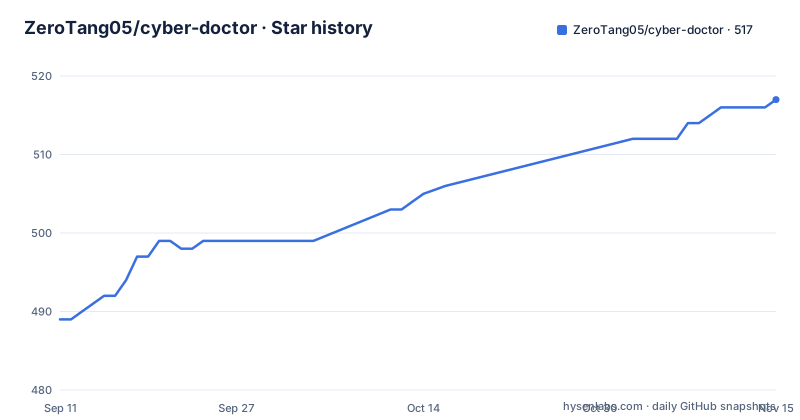
Star history
- ZeroTang05/cyber-doctor517 ★ · +28
| Repository | 2026-09-11 | 2026-11-15 |
|---|---|---|
| ZeroTang05/cyber-doctor | 489 | 517 |
28 Stars in the last 65 days, measured from the daily GitHub snapshot. Compare with other projects
Editorial analysis
One app.py builds the whole Gradio surface
app.py is the only command you run. Its own file note says it builds the Gradio interface, handles multimodal input, and leaves both the ASR model and the interface adjustable. The capability set is laid out as a table: image recognition aimed at medical records and drug package inserts, image and video generation, plain-text PPT and Word output in a fixed format, multi-turn chat where the entire conversation is replayed to the model as history, file upload into the same input box, microphone capture, spoken output through edge-tts with several dialects, grounding over a Neo4j graph, a private knowledge base of many file formats, and crawler-backed web search. An agent is meant to classify the task first and then route it to whichever model fits.
Both clone commands resolve to a different account
The setup step opens with a mismatch worth catching early. The repository you are reading is ZeroTang05/cyber-doctor, and both clone lines point at Warma10032/cyber-doctor instead.
git clone https://github.com/Warma10032/cyber-doctor.gitThe star history badge is generated from that same other account, and the contributor block links to the other account's contributor page while listing four team members by name. Nothing marks the difference as deliberate, so treat it as an open question rather than assume which remote is canonical. Forking or cloning from the URL in the setup section lands you somewhere other than the repository this article describes.
.env.example pins Zhipu and comments out five rivals
Model access is environment driven. One base URL is active and points at Zhipu; five more sit commented out, covering DeepSeek, Qwen through DashScope, SiliconFlow, Volcengine Ark, and a local Ollama API on port 11434. The default model name is glm-4-flash, with Chinese vendor models listed beneath it. Anything speaking the OpenAI SDK is meant to work. Two variables are narrower: image generation and video generation are documented as Zhipu only, pinned to cogview-3-flash, glm-4v-flash and cogvideox-flash. Web search carries its own key, YOUCOM_API_KEY. PY_ENVIRONMENT = web selects config/config-web.yaml, which is also where Neo4j credentials belong.
LLM_BASE_URL = https://open.bigmodel.cn/api/paas/v4
MODEL_NAME = glm-4-flash
PY_ENVIRONMENT = web
IMAGE_GENERATE_MODEL = cogview-3-flash
IMAGE_DESCRIBE_MODEL = glm-4v-flash
VIDEO_GENERATE_MODEL = cogvideox-flash
requirements.txt carries a Django leftover and two whisper packages
Dependencies are pinned exactly, 33 lines of them, which makes installs reproducible and slow. The heavy end is torch 2.4.1 with transformers 4.45.2, then langchain 0.3.3 alongside langchain-community 0.3.2, gradio 4.44.1, modelscope 1.17.0, and py2neo 2021.2.4 for the graph side. Two entries deserve a second look. django 5.1.1 and pymysql 1.1.1 came from the Django and Vue layer that was split out, so they install even though the Gradio app has no use for them. Both whisper 1.1.10 and openai-whisper 20240930 appear in the same list, and the two packages register overlapping entry points. edge-tts is the single loose pin, written as 7.0.0 or newer.
torch==2.4.1
transformers==4.45.2
langchain==0.3.3
gradio==4.44.1
django==5.1.1
openai-whisper==20240930
Loading the OpenKG medical graph takes two admin commands
The knowledge graph path is the least documented step, and the author flags that correct instructions were hard to find on the Chinese web. The suggested source is the OpenKG graph of common household diseases, chosen because it needs no edit to config/config-web.yaml. Rename the dump to your database name, stop the service, load it, start again. Two flags carry real consequences: --from-path names the folder holding the dump, and --overwrite-destination replaces whatever is already in that database. If the load ends with a message about format AF4.3.0 not being supported, a migrate command has to follow.
neo4j-admin database load <database-name> --from-path=/path/to/dump-folder/ --overwrite-destination=trueneo4j-admin database migrateGraph retrieval matches every relation of a matched entity
The retrieval logic gets an unusually honest note. Grounding currently matches all entities plus the relations directly connected to each one, with no judgement on relation type, and adding that filter is named as the next change so irrelevant edges stop crowding the prompt. The same note calls the repository a large stew of stitched-together features and says each individual implementation still has room to improve. The layer offering login, registration and per-user knowledge base CRUD was built inside an earlier Django and Vue version by someone else, and the maintainer says he does not know how to walk anyone through configuring it. The top-level tree shows the same split, with kg/, rag/, qa/, model/, audio/, client/ and ppt_docx/ sitting beside config/ and tests/.
GPL-3.0, no releases, last push on 2026-08-16
Three facts frame any reuse decision. The licence is GPL-3.0. There are no GitHub releases, so nothing to pin beyond the commit you cloned, and the last push to main was on 2026-08-16. Provenance is a summer training course project from Southeast University, with the demo video hosted on Bilibili and BinNong/meet-libai credited as the reference implementation. Before relying on it, check which remote the clone command resolves to, whether your Neo4j build matches the dump format, and what each vendor key in .env costs you per call. Its value is as a readable example of graph and retrieval wiring, not as clinical software.
Editorial conclusion
cyber-doctor suits students and small teams who want a working Gradio shell that ties a medical Neo4j graph, Whisper speech, document generation and several Chinese vendor APIs together in one place, and the OpenKG dump gives you a populated graph without writing any Cypher. Skip it if you need a production service, an account system, or any promise about answer quality: the login and knowledge base layer was split out and its configuration path is undocumented, the clone command in the setup section resolves to a different GitHub account than the repository itself, and the graph step feeds every relation type to the model. Verify the remote, the Neo4j version match, and your per-call vendor costs before committing a weekend to it.
Frequently asked questions
What does cyber-doctor actually run when you start it?
Starting the app runs python app.py, which builds a Gradio interface served on http://localhost:7860. That layer covers text chat, file upload, microphone input and spoken output, and app.py is the file that sets the ASR model and the interface options.
Which language models does cyber-doctor support?
Any endpoint that speaks the OpenAI SDK, including Zhipu, Doubao, SiliconFlow, DeepSeek and Qwen, plus a local Ollama API. The .env.example file defaults to glm-4-flash and leaves DeepSeek, DashScope, SiliconFlow, Ark and Ollama base URLs commented out. Image and video generation are documented as Zhipu only.
Is Neo4j required to run cyber-doctor?
Neo4j is a prerequisite for the knowledge graph retrieval feature rather than the whole app. The graph layer expects py2neo 2021.2.4, credentials filled into config/config-web.yaml, and a dump loaded with neo4j-admin database load, followed by neo4j-admin database migrate if the version message appears.
What licence and release history does cyber-doctor have?
The repository is GPL-3.0 and has no GitHub releases, so there is no published version to install. Tracking happens through commits on the main branch, and the last push was on 2026-08-16.
Official sources
Add this badge to your README
If you maintain this project, the badge below links readers to this analysis and shows its maintenance status from the daily GitHub snapshot. Paste the markdown into your README; add ?metric=license or ?metric=stars to the image URL for a different field.

[](https://hysenlabs.com/projects/zerotang05-cyber-doctor)Star history chart for your README
[](https://hysenlabs.com/projects/zerotang05-cyber-doctor)Was this useful?