EasyEdit: two generations in one repository, and a Dockerfile that expects a file the tree does not list
[ACL 2024] An Easy-to-use Knowledge Editing Framework for LLMs.
At a glance
- What is it?
- EasyEdit is a knowledge editing framework for large language models, and it now carries two of them, a parameter-editing version and a real-time steering version, documented in two separate readme files. The build configuration is where the two generations collide: the container clones the repository from GitHub at build time and then copies a conda environment file that is not among the repository's entries.
- Who is it for?
- EasyEdit is worth using if your research question is specifically about changing what a model knows or steering what it does at inference time, and it is a poor fit as a library to vendor, because there are no releases to pin, the dependency file pins exact versions, and the container image builds from whatever the default branch looks like that day.
- Can I use it commercially?
- Yes. MIT is a permissive licence: you can use, modify and sell software built on it, as long as you keep its copyright and licence notices.
- Is it still maintained?
- Yes. The repository last received commits 8 days ago.
- What is it written in?
- Mainly Jupyter Notebook, according to GitHub's language statistics.
Answers come from the project's GitHub data, last synced on November 15, 2026, and from our analysis. They are not legal advice.
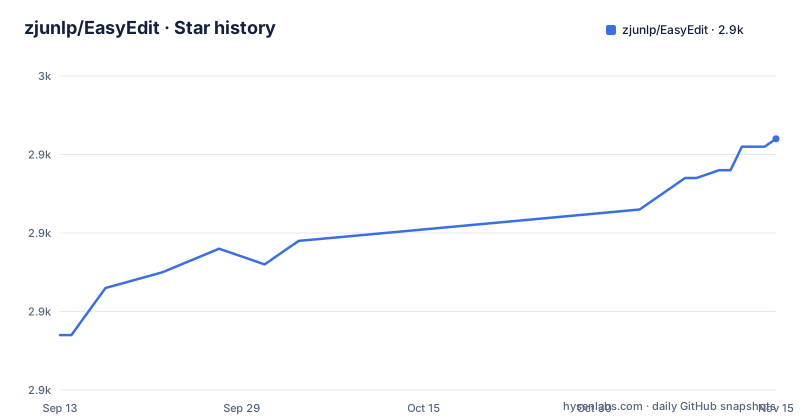
Star history
- zjunlp/EasyEdit2,942 ★ · +25
| Repository | 2026-09-13 | 2026-11-15 |
|---|---|---|
| zjunlp/EasyEdit | 2.9k | 2.9k |
25 Stars in the last 63 days, measured from the daily GitHub snapshot. Compare with other projects
Editorial analysis
Two generations of the framework ship in one repository
The readme is for EasyEdit 1.0 and says so only obliquely. The Update block announces that EasyEdit 2.0 is published, and describes the difference in one sentence: unlike EasyEdit1.0, which achieves knowledge editing by updating internal parameters or introducing additional parameters, EasyEdit2 enables real-time steering of LLMs during inference, providing a unified framework for controllability without retraining. The detail for 2.0 lives in a second file, README_2.md, linked from that announcement, and the top level of the tree carries both, plus a separate requirements_2.txt and a steer/ directory next to easyeditor/. So one repository holds a parameter-editing framework, a steering framework, three requirement files including a colab_requirements.txt, and two entry points that overlap in name, with edit.py and steering.py sitting side by side at the root.
The Dockerfile clones from GitHub at build time and copies a file the tree does not list
The container build has two ordering decisions worth reading. The first is that the repository is not copied in from the build context, it is fetched from the network mid-build:
RUN git clone https://github.com/zjunlp/EasyEdit.git && \
    cd EasyEdit
No commit, branch or tag is named, so the image is built from whatever the default branch contained at the moment the build ran, and two builds a week apart are two different images with the same Dockerfile. The second is what comes after. The build copies a file called environment.yml into the cloned directory and creates a conda environment from it:
COPY environment.yml /app/EasyEdit/
RUN conda env create -f /app/EasyEdit/environment.yml
The top level of the repository does not list environment.yml. What it lists is requirements.txt, requirements_2.txt and colab_requirements.txt. So the conda environment step in the documented container path depends on a file that is not among the repository's entries.
tokenizers is pinned beside a transformers release that is far newer
requirements.txt pins every entry with an exact equality, which makes the file readable as a snapshot. Most of the pins are recent: torch at 2.9.1, transformers at 5.5.4, datasets at 4.8.5, numpy at 2.2.6, pandas at 2.3.3, huggingface_hub at 1.17.0, openai at 2.8.1, peft at 0.18.0, sentence-transformers at 5.5.1. One of them sits oddly beside its neighbours: nltk is pinned at 3.6.5 next to matplotlib 3.10.7, scipy 1.15.3 and scikit-learn 1.7.2. Others are older still without being obviously so: gpustat at 1.1, iopath at 0.1.10, fairscale at 0.4.13, rouge at 1.0.1. Since the file uses equality rather than ranges, each of them is a deliberate choice that a user has to accept or edit by hand.
The dependency list covers vision, audio and a model vendor, but not vLLM
The tail of requirements.txt shows how much wider than knowledge editing this environment is. There are opencv-python, av, timm, iopath and qwen_vl_utils, among the pins. There is zhipuai pinned at a version carrying a date in it, a vendor SDK alongside the openai one. The file also pins pyarrow, sentencepiece, rouge, hydra-core with omegaconf, and higher. What is not there is vllm. The news entry dated 2026-07-08 lists expanded vLLM support among the improvements in that upgrade, alongside Transformers 5.x compatibility, more reliable multi-GPU editing and faster multi-worker deployment. The dependency file in the repository root does not name it.
Six runnable scripts sit at the repository root
The top level is not a package, it is a set of entry points. The top-level Python scripts are axbench.py, edit.py, multimodal_edit.py, multimodal_steering.py, steering.py, vectors_apply.py and vectors_generate.py. Alongside those sit the easyeditor/ package directory, the hparams/ directory, examples/, demo/, tutorial-notebooks/, figs/, and a tutorial.pdf. There is also an examples/ directory whose SteerEval.md is linked from the 2026-03-04 news entry as a hierarchical benchmark for evaluating controllability across behavioural domains and granularity levels. Nothing in the readme's table of contents tells a new user which of these seven scripts to run first.
The news list is the release history because the repository has no releases
There are no GitHub releases for this repository and no version tags to speak of in the release list, so the chronological news block at the top of the readme is the only record of what changed. It is detailed, and it is where a user has to look to know what a given checkout contains. The 2026-07-08 entry covers the Transformers 5.x compatibility, new models, multi-GPU editing, multimodal pipelines, the unified EasyEdit2 steering workflow and multi-worker deployment. The 2025-07-24 entry names three new unstructured long-form datasets, AKEW, LEME and UNKE, and two incorporated unstructured methods, UNKE and AnyEdit. Earlier entries add CORE in June 2025 and NAMET in May 2025, the latter credited to a specific contributor for introducing noise during memory extraction as a one-line modification to MEMIT. The 2026-07-13 entry records selection for an open source incentive programme. The project is not archived and the last push is dated 2026-10-04.
An x86_64 Ubuntu 22.04 container with a Miniconda latest download and a Jupyter port
The rest of the container is conventional and worth reading for what it does not pin. The base is FROM ubuntu:22.04 with a comment calling it the official image. The Miniconda installer is fetched as Miniconda3-latest-Linux-x86_64.sh, so both the version and the architecture are open, and the image is therefore x86_64 only. The apt step installs wget, git, bzip2, g++, make and the X and GLib runtime libraries, which is consistent with the opencv and av pins in the requirements. The shell is switched to run inside the named conda environment, and requirements.txt is installed with pip using --no-cache-dir. The exposed port is 8888, with a comment naming Jupyter Notebook as the reason, and the default command is bash. The licence file in the tree is LICENSE, and the repository licence field reads MIT, matching the ACL 2024 knowledge editing framework described in the project description.
Editorial conclusion
EasyEdit is worth using if your research question is specifically about changing what a model knows or steering what it does at inference time, and it is a poor fit as a library to vendor, because there are no releases to pin, the dependency file pins exact versions, and the container image builds from whatever the default branch looks like that day. Before you build anything on it, read requirements.txt rather than the news list, decide which generation you actually want since the two are documented separately, and confirm the container path works at all, because the Dockerfile's conda environment step depends on a file the repository root does not contain.
Frequently asked questions
what is easy edit
EasyEdit is a knowledge editing framework for large language models from zjunlp, described in the repository as an easy-to-use knowledge editing framework for LLMs and tagged ACL 2024. The repository is MIT licensed. It is not a general purpose text editor.
What is the difference between EasyEdit 1.0 and EasyEdit 2.0?
EasyEdit1.0 achieves knowledge editing by updating internal parameters or introducing additional parameters. EasyEdit2 enables real-time steering of LLMs during inference, providing a unified framework for controllability without retraining and integrating various steering methods. The detail for version 2 is in README_2.md, and requirements_2.txt sits beside requirements.txt.
How do I install EasyEdit?
The table of contents lists both a pip installation section and a uv installation section, plus a section on editing GPU memory usage, and the commands are in the Requirements section of the README. What the repository does pin is requirements.txt, with exact versions including torch 2.9.1, transformers 5.5.4 and datasets 4.8.5.
Does EasyEdit have tagged releases I can pin to?
No. The repository has no GitHub releases. The chronological news block at the top of the readme is the record of changes, with entries dated 2026-07-13, 2026-07-08, 2026-03-04 and earlier.
What datasets and editing methods does EasyEdit include?
Three unstructured long-form knowledge editing datasets were added on 2025-07-24, named AKEW, LEME and UNKE, along with two unstructured editing methods, UNKE and AnyEdit. EasyEdit2 supports the representation steering method RePS and provides initial support for AxBench-style evaluation, and a KnowEdit benchmark dataset is published on Hugging Face.
How do I run EasyEdit in Docker?
The Dockerfile starts from ubuntu:22.04, installs Miniconda, git clones the repository from GitHub, then creates a conda environment from an environment.yml file and pip installs requirements.txt. That environment.yml is not among the repository's top-level entries, which list requirements.txt, requirements_2.txt and colab_requirements.txt instead. The container exposes port 8888 and defaults to bash.
Official sources
Add this badge to your README
If you maintain this project, the badge below links readers to this analysis and shows its maintenance status from the daily GitHub snapshot. Paste the markdown into your README; add ?metric=license or ?metric=stars to the image URL for a different field.

[](https://hysenlabs.com/projects/zjunlp-easyedit)Star history chart for your README
[](https://hysenlabs.com/projects/zjunlp-easyedit)Was this useful?