0xProject/0x-monorepo: What the Repository Contains
0x protocol monorepo - includes our smart contracts and many developer tools
At a glance
- What is it?
- 0xProject/0x-monorepo is a deprecated TypeScript monorepo for 0x smart contracts and developer tools. Its README directs users to the separate 0xProject/protocol and 0xProject/tools repositories, so this repository is mainly useful for historical inspection or existing integrations.
- Who is it for?
- Adopt the separate 0xProject/protocol or 0xProject/tools repository for new 0x work. Do not start new integration work against this monorepo unless an existing dependency requires it.
- Can I use it commercially?
- Check first. The repository uses a licence we do not classify automatically, so read its LICENSE file before any commercial use.
- Is it still maintained?
- Yes. The repository last received commits 57 days ago.
- What is it written in?
- Mainly TypeScript, according to GitHub's language statistics.
Answers come from the project's GitHub data, last synced on November 7, 2026, and from our analysis. They are not legal advice.
Star history
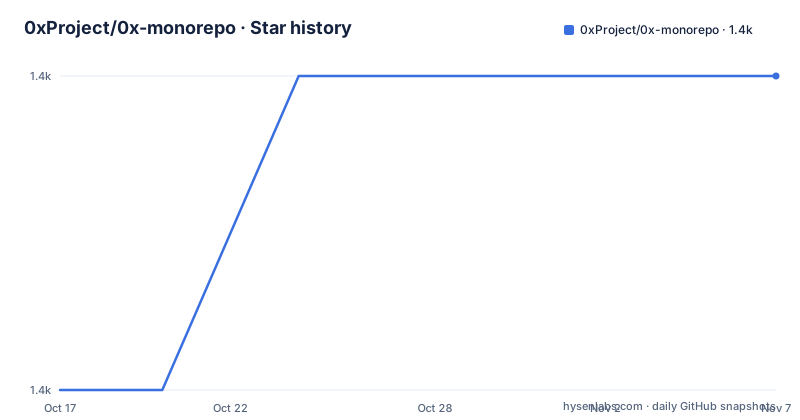
- 0xProject/0x-monorepo1,408 ★ · +1
| Repository | 2026-10-17 | 2026-11-07 |
|---|---|---|
| 0xProject/0x-monorepo | 1.4k | 1.4k |
1 Stars in the last 21 days, measured from the daily GitHub snapshot. Compare with other projects
Editorial analysis
Why the 0x monorepo existed
The repository addressed the implementation side of 0x, an open protocol for trustless, low-friction exchange of Ethereum-based assets. It combined protocol smart contracts with developer-facing packages rather than limiting itself to one application. The intended users were engineers building or integrating exchange functionality, including people working with order creation, signing, validation, contract artifacts, and relayer APIs.
The scope is broad. The README lists Python packages such as `0x-contract-addresses`, `0x-contract-artifacts`, `0x-contract-wrappers`, `0x-json-schemas`, `0x-order-utils`, and `0x-sra-client`. It also lists Solidity packages for exchange logic and ERC20, ERC721, ERC1155, and asset proxy contracts. Each public sub-package was described as independently published to NPM, while the Python packages were distributed through PyPI.
That packaging arrangement matters for adoption decisions. An application did not necessarily need to consume the entire repository as one library. It could depend on a focused package, such as an order utility or contract wrapper. However, the README now carries an explicit deprecation warning and says that the project is no longer maintained. It points users to `0xProject/protocol` and `0xProject/tools` instead. New development should therefore be based on those destinations, not this repository.
The package structure and 0x order flow
The repository layout reflects a monorepo built around independent public packages. The top-level `packages/`, `contracts/`, and `python-packages/` directories separate TypeScript tools, Solidity packages, and Python utilities. The root `package.json` declares workspaces for `packages/*` and `contracts/*`. It also contains monorepo scripts for building, linking, testing installation, formatting, publishing, and starting Ganache.
The order-related path is visible in the package descriptions. `0x-order-utils` provides functions for generating, parsing, signing, and validating 0x orders. `0x-sra-client` provides a Python client for servers that conform to the Standard Relayer API specification. The contract side supplies exchange and token-related packages, including `contracts-exchange`, `contracts-erc20`, and `contracts-erc721`.
The README does not present a complete end-to-end program or deployment procedure for this monorepo. It refers readers to the 0x protocol specification for protocol details and to the developer portal for the package list. Consequently, the exact data flow cannot be confirmed from the README alone. What can be confirmed is the division of responsibility: order utilities handle order data and signatures, relayer clients communicate with conforming servers, and Solidity packages expose contract implementations and token behavior. An integrator would need to verify the replacement repository before combining these pieces in a current deployment.
Installing the repository and running its scripts
The README does not provide a fresh installation tutorial for new users. It explicitly says that the project is deprecated and directs users to `0xProject/protocol` and `0xProject/tools`. It also says that each public sub-package is independently published to NPM, so consumers normally need the package relevant to their integration rather than the complete deprecated repository.
The repository's root `package.json` does document the workspace-level Yarn command used by its scripts. It declares a Node engine requirement of `>=6.12`, workspaces for `packages/*` and `contracts/*`, and an `install:all` script. The following command is the repository-level dependency installation command shown in the package manifest. It is useful for inspecting the old source tree, but it is not an endorsement for a new deployment.
yarn installThe manifest also exposes a local Ganache command for a development chain. It uses port `8545`, gas limit `10000000`, network ID `50`, and the `npm_package_config_mnemonic` configuration value.
The package manifest does not document a required `mnemonic` configuration value in the excerpt, and it does not provide a complete application startup sequence. A reader should therefore expect to consult the historical package documentation and contract README before attempting a local exchange workflow.
License and maintenance boundaries
The repository metadata reports no GitHub archive status, but the README says that the project is deprecated and no longer maintained. The repository's last push was on 2026-09-11. That date does not override the README's warning: a recent push can occur without making a deprecated project suitable for new adoption.
The repository description identifies the license as custom, while the README badge displays Apache 2.0. Because the repository metadata points to a `LICENSE` file that GitHub cannot classify, the license should be checked from that file before copying code or distributing a package. The discrepancy makes the actual text more important than the badge. This is a repository-level observation, not legal advice.
The release history in the repository information lists releases from 2020. The README does not describe a migration plan for old packages, a compatibility matrix, or a deprecation timeline beyond pointing to successor repositories. It also does not document rollback or upgrade procedures. Those omissions matter for teams with deployed integrations because the path from an old package to a current replacement is not defined here.
Limitations for current Ethereum integrations
The clearest limitation is the explicit deprecation. A new team could mistakenly install a package because it still appears in the package list or package registry, then discover later that the surrounding monorepo is no longer maintained. The README does not say that the historical packages are unusable, but it does say to refer to successor repositories instead. It provides no claim about continued fixes, security updates, network compatibility, or long-term support.
The repository also spans several domains with different distribution channels. Solidity packages use scoped NPM names such as `@0x/contracts-exchange`, while Python packages use names such as `0x-order-utils`. A TypeScript application cannot assume that every capability documented for the monorepo is exposed through the same language API. Migration must identify the exact package boundary before replacing dependencies.
The contract packages should not be treated as a complete production exchange stack by themselves. The README lists implementations and wrappers, but the provided content does not document deployment addresses, configuration, settlement behavior, or operational monitoring. Those details may exist elsewhere, but they are not confirmed by this repository page. The safe conclusion is narrower: this source tree can help an engineer understand historical package boundaries, not enough to establish current deployment safety.
0xProject/protocol and 0xProject/tools as alternatives
The relevant alternative is not another exchange library named vaguely as a replacement. The README names two concrete repositories with different apparent scopes. `0xProject/protocol` is the destination for protocol work, while `0xProject/tools` is the destination for developer tooling. The old monorepo combined both categories, so the migration choice depends on what the user needs.
For contract specification or protocol implementation work, `0xProject/protocol` is the direct destination indicated by the deprecation notice. For order utilities, schemas, wrappers, relayer clients, or related tooling, `0xProject/tools` is the relevant destination to inspect first. This is a repository-level split, not a claim that every old package has a one-to-one replacement or that the successors preserve every public API.
An engineer should compare package names, supported language versions, package publication status, and contract API versions in the successor repositories. The old README does not provide those mappings. It therefore supports the decision to leave this repository, but it does not support an automated migration plan or a guarantee of behavioral compatibility.
Editorial conclusion
Adopt the separate 0xProject/protocol or 0xProject/tools repository for new 0x work. Do not start new integration work against this monorepo unless an existing dependency requires it. First verify the replacement package, the custom LICENSE file, and the compatibility of the specific order, relayer, or contract APIs before migrating.
Frequently asked questions
Is 0xProject/0x-monorepo still maintained?
The README contains a deprecation warning and states that the project is no longer maintained. It directs users to `0xProject/protocol` and `0xProject/tools` instead.
What does 0xProject/0x-monorepo contain?
It contains 0x protocol smart contracts and developer tools, including TypeScript packages, Solidity contracts, and Python utilities for orders, schemas, artifacts, wrappers, addresses, and relayer APIs.
How do I install 0xProject/0x-monorepo?
The README does not provide a new installation tutorial and marks the project as deprecated. The root `package.json` documents `yarn install` for the repository, while public sub-packages were described as independently published to NPM.
Which repository should I use for new 0x development?
The README specifically points to `0xProject/protocol` for protocol work and `0xProject/tools` for developer tooling. Check the destination repository for current package names and compatibility before migrating.
Official sources
Add this badge to your README
If you maintain this project, the badge below links readers to this analysis and shows its maintenance status from the daily GitHub snapshot. Paste the markdown into your README; add ?metric=license or ?metric=stars to the image URL for a different field.

[](https://hysenlabs.com/projects/0xproject-0x-monorepo)Star history chart for your README
[](https://hysenlabs.com/projects/0xproject-0x-monorepo)Was this useful?