Appsmith: A Low-Code Platform for Internal Tools
Platform to build admin panels, internal tools, and dashboards. Integrates with 25+ databases and any API.
At a glance
- What is it?
- Appsmith is an open-source low-code platform for building admin panels, dashboards, and internal tools, connecting to 25+ databases and any API. This review examines its architecture, deployment options, and trade-offs for engineering teams.
- Who is it for?
- Adopt Appsmith if your team needs to rapidly assemble internal tools over existing databases and APIs without writing a full frontend, and if you can commit to running a self-hosted service (Docker or Kubernetes) or accept cloud hosting. Do not choose it for highly custom, performance-critical consumer-facing apps or if your team prefers code-first development with fine-grained control.
- Can I use it commercially?
- Yes. Apache-2.0 is a permissive licence: you can use, modify and sell software built on it, as long as you keep its copyright and licence notices.
- Is it still maintained?
- Yes. The repository received new commits within the last day.
- What is it written in?
- Mainly TypeScript, according to GitHub's language statistics.
Answers come from the project's GitHub data, last synced on November 13, 2026, and from our analysis. They are not legal advice.
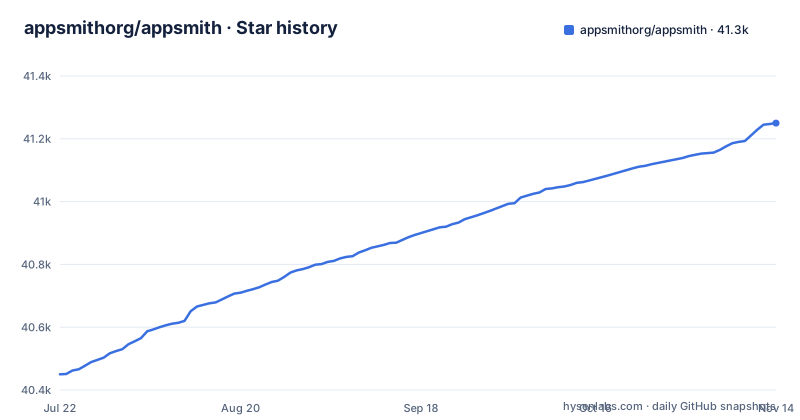
Star history
- appsmithorg/appsmith41,247 ★ · +797
| Repository | 2026-07-22 | 2026-11-13 |
|---|---|---|
| appsmithorg/appsmith | 40.5k | 41.2k |
797 Stars in the last 114 days, measured from the daily GitHub snapshot. Compare with other projects
Editorial analysis
What Appsmith Solves and Who It Is For
Appsmith targets a recurring problem: organizations that need custom applications like dashboards, admin panels, customer 360 views, IT automation, and service management tools. Building these from scratch consumes engineering time on repetitive CRUD interfaces, authentication, and data wiring. Appsmith offers a low-code platform to assemble such tools by connecting to existing data sources and dragging widgets onto a canvas. The intended audience is teams that have internal operational needs and want to ship tools quickly, often without a dedicated frontend team. The README emphasizes that organizations build these apps to help teams work more efficiently, which frames Appsmith as a productivity layer over existing systems rather than a general-purpose application framework.
How Appsmith Works: Data Connections and Widgets
Appsmith operates as a self-hosted or cloud-hosted platform where you define data sources, write queries or API calls, and bind results to UI widgets. The platform integrates with 25+ databases and any REST API, which is the core mechanism: you create a datasource, write a query, and then map the response to tables, forms, charts, and other components. The architecture appears to be a server-side service that proxies connections to databases and APIs, plus a client-side editor for building the interface. The Dockerfile in the repository builds a single image that bundles the client UI, an RTS service and an MCP service. Recent releases are v2.5.0 on 2026-10-09, v2.5.1 on 2026-10-21 and v2.6.0 on 2026-10-28.
Getting Appsmith Running: Deployment Paths
The README lists three primary installation methods: Docker (marked as recommended), Kubernetes, and AWS AMI. For a quick start, Docker is the obvious choice, and the documentation link points to a dedicated guide. For production, Kubernetes offers scaling and orchestration, while AWS AMI suits teams already on AWS. The README also mentions Appsmith Cloud, a hosted option where you sign up without managing infrastructure. For local development, the contribution guidelines include a setup guide, but the README does not provide the exact commands. The absence of a one-liner install command in the README is a minor friction point; you must consult external docs.
The Agentic AI Addition: Appsmith Agents
A notable section in the README introduces Appsmith Agents, described as an agentic AI platform that integrates AI models with private and proprietary data at scale. The pitch is that teams can ask questions and configure automations without model fine-tuning or complex RAG implementations. This is a significant expansion beyond the core low-code tooling. However, the README provides no technical details about how Agents work, what models are supported, or how data privacy is handled. The claim about giving continuous context to AI models suggests a context-management layer, but the implementation is opaque. For engineering teams, this feature raises questions about data governance: if you connect internal databases, does the AI model access raw data? The README points to appsmith.com/ai for more. Treat Agents as a marketing-led feature until documentation clarifies its architecture.
Limitations and Failure Modes
Appsmith is not a fit for every scenario. The platform is designed for internal tools, not consumer-facing applications with complex interactions or high concurrency. Low-code platforms often struggle with fine-grained UI customization, and Appsmith is no exception: you are constrained to the widget set and the query model. If your tool requires unusual visualizations or complex state management, you may hit a wall. Another failure mode is data connectivity: while 25+ integrations sound broad, the README does not list them. If your database is not among the supported ones, you must rely on a generic API wrapper, which adds overhead. Self-hosting also introduces operational burden: you must maintain the Docker or Kubernetes deployment, handle upgrades, and secure the platform. The README does not mention scaling limits, but any self-hosted service requires monitoring. Finally, the agentic AI feature may be a distraction if you only need simple CRUD tools; it adds complexity without clear benefits for basic use cases.
Comparing Appsmith to Code-First Alternatives
The main alternative to Appsmith is building internal tools with a conventional web framework like React or Vue, paired with a backend like Node.js or Django. That approach gives full control over the UI and data flow, but requires significantly more development time. Another alternative is a competing low-code platform such as Retool or Budibase, but the README does not mention them. The key difference with code-first is the trade-off: Appsmith abstracts away the frontend and backend wiring, letting you focus on data and layout. If your team has strong frontend skills and needs custom interactions, code-first is more flexible. If you need speed and have non-engineers building tools, Appsmith is better. The choice hinges on whether the platform's abstractions match your requirements. The README does not provide performance benchmarks, so you must evaluate based on your own workloads.
Maintenance and License Considerations
Appsmith is licensed under Apache-2.0, a permissive open-source license that allows modification, distribution, and commercial use, provided you include the original copyright notice. This is favorable for enterprises that want to self-host and potentially customize the code. The repository is actively maintained, with recent releases v2.5.0 on 2026-10-09, v2.5.1 on 2026-10-21 and v2.6.0 on 2026-10-28. The default branch is release, and the project is not archived. However, maintenance cost is not trivial: self-hosted deployments require you to track updates, apply patches, and manage the underlying infrastructure. The README does not document upgrade procedures, so you must rely on the docs. The presence of a large contributor list suggests a community, but contributor count is not a quality metric. For a production deployment, you should plan for regular upgrades and test them in a staging environment.
Editorial conclusion
Adopt Appsmith if your team needs to rapidly assemble internal tools over existing databases and APIs without writing a full frontend, and if you can commit to running a self-hosted service (Docker or Kubernetes) or accept cloud hosting. Do not choose it for highly custom, performance-critical consumer-facing apps or if your team prefers code-first development with fine-grained control. Before adopting, verify the specific database connectors you need are supported, review the Appsmith Agents feature for any data-privacy implications, and check the Apache-2.0 license fits your distribution model. The platform is actively maintained with regular releases, but its value depends on how well its widget and query model matches your use cases.
Frequently asked questions
what is appsmith
It is an open-source low-code platform for building custom applications such as dashboards, admin panels, customer 360 views, IT automation and service management tools. It streamlines custom application development, deployment and maintenance, and the project describes it as integrating with more than 25 databases and any API.
how to install appsmith
The file gives two routes: sign up on Appsmith Cloud, or install on your own machine. For self-hosting it names three guides, Docker marked as recommended, Kubernetes, and AWS AMI, plus a link to the full installation guides. The file contains no command of any kind, so the guides are where the commands live.
Is Appsmith free to use?
The repository is Apache-2.0 licensed and the file calls Appsmith an open-source low-code platform, and it also points to a separate Appsmith Cloud you can sign up for. The file states no price for the cloud and no difference in features between the cloud and the self-hosted image.
is appsmith self hosted free
The self-hosted route is the three installation guides, Docker, Kubernetes and AWS AMI, and the repository license is Apache-2.0. The file does not describe any feature difference, usage limit or cost for self-hosting compared with the cloud signup, and it does not state what the telemetry setting covers beyond noting it only takes effect in self-hosted scenarios.
is appsmith open source
Yes by the project's own description. The file calls it an open-source low-code platform, the repository carries an Apache-2.0 license and a LICENSE file, and the source is on GitHub with a contribution guide, a code of conduct, a good first issues query and a security file at the top level.
Official sources
Where this project is recommended
Add this badge to your README
If you maintain this project, the badge below links readers to this analysis and shows its maintenance status from the daily GitHub snapshot. Paste the markdown into your README; add ?metric=license or ?metric=stars to the image URL for a different field.

[](https://hysenlabs.com/projects/appsmithorg-appsmith)Star history chart for your README
[](https://hysenlabs.com/projects/appsmithorg-appsmith)Was this useful?