Agent0 puts a curriculum agent against an executor agent
[ICML'26 & COLM'26] Agent0 Series: Self-Evolving Agents from Zero Data
At a glance
- What is it?
- The Agent0 series is two studies of agents that improve without human-curated data, one agent proposes harder tasks, the other solves them with tools, and the loop generates its own training signal. The numbers are reported against Qwen3-8B-Base on standard reasoning benchmarks, with the caveats that come with self-reported comparisons.
- Who is it for?
- Adopt Agent0 if you are studying self-improvement loops for language agents and want a readable reference implementation with its benchmark tables alongside. Do not adopt it as a production agent framework expecting documented APIs, since the repository is two research code drops with their own READMEs and no releases.
- Can I use it commercially?
- Yes. Apache-2.0 is a permissive licence: you can use, modify and sell software built on it, as long as you keep its copyright and licence notices.
- Is it still maintained?
- Yes. The repository last received commits 121 days ago.
- What is it written in?
- Mainly Python, according to GitHub's language statistics.
Answers come from the project's GitHub data, last synced on November 7, 2026, and from our analysis. They are not legal advice.
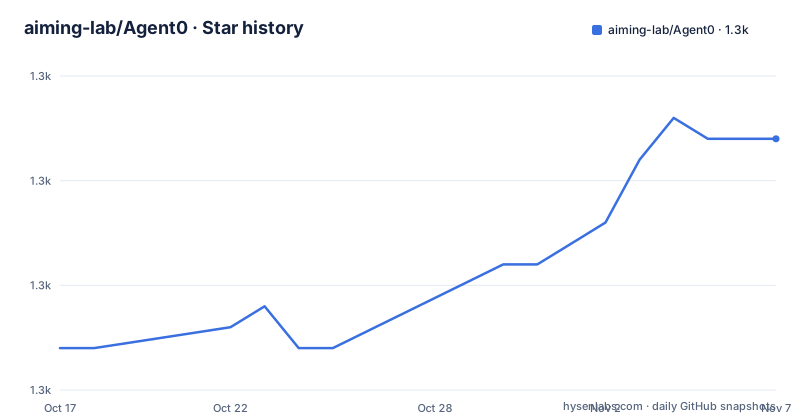
Star history
- aiming-lab/Agent01,287 ★ · +10
| Repository | 2026-10-17 | 2026-11-07 |
|---|---|---|
| aiming-lab/Agent0 | 1.3k | 1.3k |
10 Stars in the last 21 days, measured from the daily GitHub snapshot. Compare with other projects
Editorial analysis
The competition between two agents
The Agent0 study is titled Unleashing Self-Evolving Agents from Zero Data via Tool-Integrated Reasoning, and its mechanism is a competition rather than a single agent improving on its own output.
A Curriculum Agent proposes increasingly challenging frontier tasks. An Executor Agent learns to solve them using external tools. Neither has a fixed dataset to train on: the curriculum is generated, the solutions are generated, and the training signal comes out of that exchange. The README calls it a symbiotic competition, and multi-turn interaction is supported so the executor can iterate on a task rather than answer once.
The comparison in the README is against other self-evolving methods rather than against ordinary supervised fine-tuning, which is the right comparison for the claim but also narrows who should care. The baselines named are Absolute Zero, R-Zero and Socratic-Zero.
The second study, Agent0-VL, extends the same idea to vision-language reasoning and adds a dual-role architecture. A Solver performs multi-turn tool-integrated reasoning, and a Verifier generates structured feedback and fine-grained self-rewards. The verifier is what closes the loop for multimodal tasks, where checking an answer is harder than scoring a maths result.
Both are released on arXiv, 2511.16043 for Agent0 and 2511.19900 for Agent0-VL, and the project page describes the series as ICML'26 and COLM'26 work from UNC Chapel Hill, Salesforce Research and Stanford.
Reading the language reasoning table
The maths table is worth reading closely rather than skimming, because the row that matters is not the one in bold.
All rows use Qwen3-8B-Base. The base model averages 49.2 across AMC, Minerva, MATH, GSM8K, Olympiad, AIME25 and AIME24. Adding a tool takes it to 53.2, so tool access alone is worth roughly four points. Absolute Zero reaches 52.6, R-Zero 54.7, Socratic-Zero 56.1 and Agent0 58.2.
The important caveat is that Agent0 is not the best on every column. Socratic-Zero beats it on AMC at 63.7 versus 62.4, on Olympiad at 55.1 versus 54.0, and on AIME24 at 28.4 versus 28.0. Agent0 leads on Minerva, MATH, GSM8K and AIME25, and on the average.
So the claim is a win on aggregate across seven benchmarks, not a sweep. On the harder competition-style sets the two methods are close enough that the ordering is likely inside noise, and the README does not report confidence intervals or run counts.
The improvement summary states +18.3% over the base model and +3.7% over Socratic-Zero, which is consistent with the table.
Where the headline and the table disagree
The general reasoning table gives a different picture from the headline bullets, and that is worth flagging for anyone quoting this work.
The key results bullets at the top claim +18% on mathematical reasoning and +24% on general reasoning. The tables give the detail. For maths, the average moves from 49.2 to 58.2, which the summary line calls +18.3%.
For general reasoning, the numbers are 34.5 base, 36.7 with a tool, 39.9 for Absolute Zero, 38.7 for R-Zero, 39.2 for Socratic-Zero and 42.1 for Agent0. The improvement line under that table says +22.0% over the base model, not 24%.
That gap between the 24% in the summary and 22.0% in the table is small, and could be rounding against a different denominator, but it is the kind of inconsistency that matters when a number is going into a slide. Use the table.
There is also a detail in that table worth noting. On SuperGPQA, Absolute Zero scores 33.5 and Agent0 scores 33.0, so the method with the best average is not the best on the hardest general reasoning set there either.
Agent0-VL numbers and the comparison set
Agent0-VL reports +12.5% average improvement on visual reasoning benchmarks and +7.3% improvement in test-time scaling performance, with a claim of state-of-the-art among open-source vision-language models and zero external reward for self-evolution.
Its results table spans MathVerse, MathVision, MathVista, WeMath, HallBench, ChartQA and MMMU, and it is organised by model category beginning with closed-source models, starting with GPT-4o. The README section is truncated in what is published here, so the closed-source comparison cannot be read in full from this page.
That organisation is itself the point. The language study compared against peer methods doing the same thing; the vision-language study compares against a wider field including commercial models, and the state-of-the-art claim is scoped to open-source models. Scoped claims of that kind are usually true and frequently quoted without the scope.
The stated architectural contribution is that tool usage is not confined to reasoning but also feeds self-evaluation and self-repair, which is the Verifier role. That is the part that distinguishes Agent0-VL from simply applying Agent0 to images.
Repository layout and what to check first
The repository root is small: `Agent0/`, `Agent0-VL/`, `docs/`, `figs/`, `LICENSE` and `README.md`. Each study has its own directory and its own README, with the top-level page linking out to them for details.
That structure means the two studies are versioned together at the repository level but documented separately, and anyone reading has to decide which of the two to look at first. The top-level README is a summary of results, not a setup guide.
On maintenance, the last push was on 2026-07-10 and the repository is not archived. There are no GitHub releases, so there is no tag to pin and no published package version. The code was released on 11/29/2025 per the news list, with the papers on 11/20/2025 for Agent0 and 11/25/2025 for Agent0-VL.
The licence is Apache-2.0, with a LICENSE file at the root and an Apache 2.0 badge in the README.
The shared philosophy section states the three claims to check against the code rather than the abstract: no human annotations, tool-integrated reasoning, and autonomous evolution through self-generated training data. If you are going to spend an afternoon on this repository, verify the second one first, since it is the load-bearing assumption. An executor that solves tasks without tools and a curriculum that only proposes tasks the executor already solves will produce a loop that looks busy and learns nothing, and that failure mode is invisible in a benchmark average.
Editorial conclusion
Adopt Agent0 if you are studying self-improvement loops for language agents and want a readable reference implementation with its benchmark tables alongside. Do not adopt it as a production agent framework expecting documented APIs, since the repository is two research code drops with their own READMEs and no releases. Verify first the evaluation protocol behind the tables, because the headline figures and the table summaries do not match exactly, and confirm that the tool environment an executor relies on is available in your setup before comparing it to your own pipeline.
Frequently asked questions
What is the Agent0 series?
It is two studies of self-improving agents: Agent0 for language reasoning and Agent0-VL for vision-language reasoning, both released on arXiv as 2511.16043 and 2511.19900 by UNC Chapel Hill, Salesforce Research and Stanford.
How does Agent0 generate training data without human labels?
Through a symbiotic competition between a Curriculum Agent, which proposes increasingly challenging frontier tasks, and an Executor Agent, which learns to solve them using external tools. The tasks and their solutions are both generated inside the loop.
What benchmark results does Agent0 report?
On Qwen3-8B-Base across AMC, Minerva, MATH, GSM8K, Olympiad, AIME25 and AIME24, the average goes from 49.2 to 58.2, against 56.1 for Socratic-Zero and 54.7 for R-Zero. On general reasoning the overall average goes from 34.5 to 42.1.
What is different about Agent0-VL compared with Agent0?
Agent0-VL extends the paradigm to multimodal tasks and adds a Verifier role alongside the Solver, using tools in self-evaluation and self-repair to generate structured feedback and fine-grained self-rewards. It reports +12.5% average on visual reasoning benchmarks.
Official sources
Add this badge to your README
If you maintain this project, the badge below links readers to this analysis and shows its maintenance status from the daily GitHub snapshot. Paste the markdown into your README; add ?metric=license or ?metric=stars to the image URL for a different field.

[](https://hysenlabs.com/projects/aiming-lab-agent0)Star history chart for your README
[](https://hysenlabs.com/projects/aiming-lab-agent0)Was this useful?