Alpakka Kafka: Reactive Kafka Integration with Akka Streams
Alpakka Kafka connector - Alpakka is a Reactive Enterprise Integration library for Java and Scala, based on Reactive Streams and Akka.
At a glance
- What is it?
- Alpakka Kafka connects Apache Kafka to Akka Streams for Java and Scala applications that model event processing as reactive pipelines. It offers backpressure-oriented APIs, but release compatibility and the commercial build requirements require attention before adoption.
- Who is it for?
- Adopt Alpakka Kafka when the application already uses Akka Streams and Kafka integration should remain inside a Reactive Streams pipeline. Do not select it solely for Kafka access without accepting the Akka dependency and reviewing binary compatibility between releases.
- Can I use it commercially?
- Check first. The repository uses a licence we do not classify automatically, so read its LICENSE file before any commercial use.
- Is it still maintained?
- Yes. The repository last received commits 3 days ago.
- What is it written in?
- Mainly Scala, according to GitHub's language statistics.
Answers come from the project's GitHub data, last synced on November 7, 2026, and from our analysis. They are not legal advice.
Star history
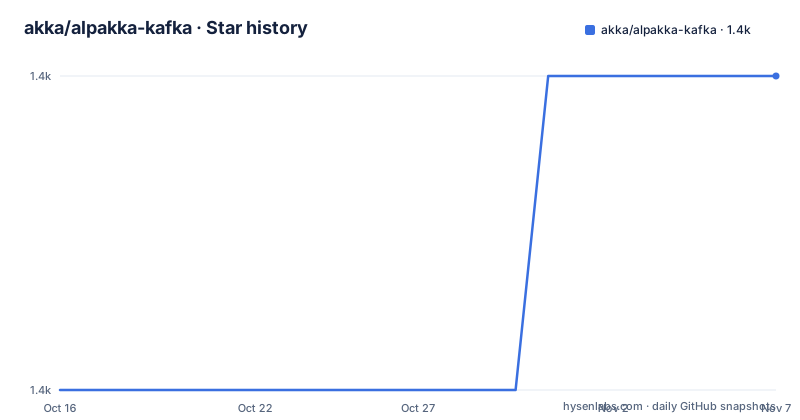
- akka/alpakka-kafka1,421 ★ · +1
| Repository | 2026-10-16 | 2026-11-07 |
|---|---|---|
| akka/alpakka-kafka | 1.4k | 1.4k |
1 Stars in the last 22 days, measured from the daily GitHub snapshot. Compare with other projects
Editorial analysis
Why Alpakka Kafka Exists in an Akka Streams Application
Alpakka Kafka solves the integration problem between Apache Kafka and applications built with Akka Streams. It is intended for Java and Scala developers working with streaming event flows rather than teams that only need a basic Kafka client. Kafka supplies records through topics, while Akka Streams exposes a stream-processing model based on Reactive Streams. The connector places those two concerns behind a stream-aware API instead of requiring the application to treat Kafka solely as a collection of producer and consumer calls.
The target use case is a service whose processing naturally consists of stages. A stage can consume, transform, route, publish, or otherwise handle a sequence of events without making downstream capacity an afterthought. The README explicitly describes backpressure as built-in support for this model. That matters when stages process events at different rates, because the stream model is intended to communicate demand rather than push unlimited work into every component.
This is a narrower choice than selecting a Kafka client. It suits an application already using Akka Streams, or one prepared to adopt that programming model for Kafka processing. It is less suitable when the surrounding application does not benefit from Akka Streams or when the team wants a dependency-neutral API across several reactive libraries. The connector's value comes from its fit with Akka Streams, not from claiming that every Kafka application needs this layer.
Reactive Streams as the Connector's Core Model
Alpakka Kafka is built on Akka Streams. The README states that Akka Streams is compliant with Reactive Streams and JDK 9+ `java.util.concurrent.Flow`, and that it can interoperate with other compliant implementations. This places the connector within a technology-neutral reactive abstraction while retaining a direct dependency on the Akka ecosystem.
The visible architecture has three layers. Apache Kafka is the external record system. Alpakka Kafka is the connector that maps Kafka activity into the connector API. Akka Streams supplies the stage and demand model, while Reactive Streams or `java.util.concurrent.Flow` defines the interface through which compliant stream implementations can interoperate.
This design favors composition. A Java or Scala service can express Kafka integration as part of a larger stream rather than as an isolated transport client. The repository description also identifies Alpakka as a Reactive Enterprise Integration library for Java and Scala. That context explains the connector's intended scope: integrating systems through stream-oriented pipelines, not reproducing every possible Kafka administration function.
The README does not document the concrete consumer, producer, commit, or deserialization APIs in its main text. It links to separate Scala and Java reference documentation for that information. Consequently, the architecture can be evaluated confidently, but exact control flow and configuration semantics should be verified in the version-specific reference before implementation.
Repository Modules for Connector Development
The repository layout shows that Alpakka Kafka is more than a small adapter module. Its top-level directories include `core/`, `artifact-bom/`, `testkit/`, `integrationtests/`, `cluster-sharding/`, `tests/`, `benchmarks/`, `docs/`, and build configuration under `project/` and `build.sbt`. This separation suggests that connector code, dependency alignment, documentation, test support, integration coverage, and examples or experiments have distinct homes.
The `artifact-bom/` entry is particularly relevant to adoption. In a library built on several aligned Akka components, dependency version management is a real integration concern. The README directs users to the Akka Dependencies page for current versions across Akka libraries, while GitHub releases list published Alpakka Kafka versions. Those two sources separate compatibility research from connector release discovery.
The presence of `integrationtests/` and `testkit/` also indicates more than unit-level source layout. However, the README does not enumerate test scenarios, supported Kafka versions, broker modes, or deployment environments. Based on repository layout alone, it would be wrong to claim coverage for a particular Kafka feature or failure condition.
For contributors, `CONTRIBUTING.md`, `.scalafmt.conf`, `.scala-steward.conf`, and `scripts/` provide visible entry points for contribution workflow, Scala formatting, dependency-update automation, and repository tasks. The README does not document their contents in detail, so their exact commands cannot be inferred from the top-level listing.
Local Build Access Requires an Akka Account Token
The README does not provide an end-user installation tutorial or a complete first-use program for adding Alpakka Kafka to an application. Instead, it links readers to the Scala and Java reference documentation and says that current Akka library versions are listed on the Akka Dependencies page. A first implementation should therefore begin by matching the connector release with the Akka dependency set selected for that application.
A local source build has an additional prerequisite. The README says a token must be fetched from `https://account.akka.io/token` and placed in `~/.sbt/1.0/akka-commercial.sbt`. Its documented resolver configuration is:
ThisBuild / resolvers += "lightbend-akka".at("your token resolver here")This configuration tells `sbt` where to resolve Akka artifacts, but the README does not define how the token is transformed into the placeholder resolver value. It also does not give a complete `sbt` command for compiling, testing, or publishing the connector. No such command or flag should be invented from the repository entry names.
The first real application use is likewise absent from the README. The linked language-specific reference is the authoritative place to locate the connector dependency and the relevant Kafka stage API. Before writing code, verify that its documented version matches `v8.1.0`, the latest listed release, and that the build can resolve the Akka artifacts required by that version.
Upgrade Boundaries in Alpakka Kafka v8
The repository warning about compatibility is the clearest adoption constraint in the README. It states that Alpakka components are not always binary compatible between releases. API changes that are not backward compatible may be introduced, and a module may be dropped in any release without prior deprecation.
That warning makes ordinary version upgrades a source-level review item rather than a mechanical dependency bump. An application may compile against an older connector API only to encounter changed signatures or removed modules after moving to a newer release. The warning does not say that every upgrade is breaking, but it explicitly refuses to guarantee binary compatibility between arbitrary releases.
The release history shows `v8.0.1` dated 2026-03-06, `v8.0.2` dated 2026-07-06, and `v8.1.0` dated 2026-10-01. The repository's last push was on 2026-10-01. It is not archived. These facts support treating the repository as recently changed, but they do not by themselves establish API stability for any individual module.
The `artifact-bom/` directory and linked Akka Dependencies page provide concrete places to begin checking alignment. They should be consulted together with the selected connector release. The README does not include a compatibility matrix, migration guide, or supported Kafka version list, so those checks cannot be replaced with an assumption that all artifacts in the v8 line are interchangeable.
Business Source License and Operational Fit
Akka is licensed under the Business Source License 1.1, according to the README. Tests and documentation use separate license terms, with details located in the `LICENSE` file in each documentation and test root directory. This is not a standard permissive software license, so source availability should not be treated as equivalent to unrestricted use, modification, or redistribution.
The README points to the Akka License FAQ for the full terms. It does not summarize use cases, conversion timing, redistribution conditions, or permitted production scenarios. Those points require direct review of the license text and are outside what can be established from the repository summary.
The build-token requirement adds a separate adoption consideration. The README explicitly requires an Akka account token for a local source build. It does not say that consuming a published artifact works the same way, nor does it describe entitlement behavior for hosted documentation or commercial services. The distinction matters during setup because obtaining the token and configuring artifact resolution are separate from adding a connector to application source.
Operationally, the connector is most coherent inside an Akka-based service. Teams evaluating a standalone Java program or a non-Akka Scala service should first account for the Akka Streams dependency and its compatibility requirements. Teams already operating Akka may find that architecture familiar, but the README does not describe deployment topology, observability configuration, or cluster behavior in enough detail to claim a specific operational advantage.
Choosing Between Alpakka Kafka and Direct Kafka APIs
A real alternative is to use Apache Kafka client interfaces directly in a Java or Scala application. The difference is where stream semantics live. Direct client code makes the application responsible for organizing record consumption, production, callbacks or completion handling, and any coordination between Kafka operations and application processing. Alpakka Kafka instead connects Kafka to Akka Streams, where processing is expressed as a stream and built-in backpressure is part of the stated design.
Choose the direct route when Kafka is an isolated integration and the service does not otherwise use Akka Streams. It avoids introducing a connector layer whose value depends on the Akka Streams programming model. Choose Alpakka Kafka when Kafka is one stage in a reactive pipeline and the application values composition within Akka Streams.
There is a trade-off beyond dependencies. Direct client access makes the underlying Kafka interaction explicit in application code, while Alpakka Kafka introduces an abstraction between Kafka and stream stages. The README does not show which operations are exposed, how records map to stages, or how commit and failure settings behave. Those details are decisive for low-latency, exactly-once, or failure-sensitive processing, but they cannot be inferred from the repository description alone.
Editorial conclusion
Adopt Alpakka Kafka when the application already uses Akka Streams and Kafka integration should remain inside a Reactive Streams pipeline. Do not select it solely for Kafka access without accepting the Akka dependency and reviewing binary compatibility between releases. Before upgrading, check the selected v8 release against the application's Akka dependencies and confirm the requirements for a local build under the Business Source License 1.1.
Frequently asked questions
What is Alpakka Kafka used for?
Alpakka Kafka connects Apache Kafka to Akka Streams so Java and Scala applications can incorporate Kafka into reactive, stream-oriented processing pipelines with backpressure support.
Are Alpakka Kafka releases binary compatible?
Not always. The README warns that API changes may not be backward compatible and that a module may be removed without prior deprecation, so applications should review each upgrade.
What is required to build Alpakka Kafka locally?
The README requires an Akka account token placed in `~/.sbt/1.0/akka-commercial.sbt`, together with a configured lightbend-akka resolver.
Official sources
Add this badge to your README
If you maintain this project, the badge below links readers to this analysis and shows its maintenance status from the daily GitHub snapshot. Paste the markdown into your README; add ?metric=license or ?metric=stars to the image URL for a different field.

[](https://hysenlabs.com/projects/akka-alpakka-kafka)Star history chart for your README
[](https://hysenlabs.com/projects/akka-alpakka-kafka)Was this useful?