anbeime/skill Is a Scraper, a Local Skill Dump and a Static Index in One Repository
The most comprehensive and frequently updated AI Agent skill library, featuring curated skill packs across document processing, content creation, programming, machine learning, automated workflows and more, all packaged ready to install. It also auto-scrapes tens of thousands of skill projects on GitHub, organized by category, update time and star count.
At a glance
- What is it?
- The repository bundles a daily crawler of six upstream skill repositories, 69 curated Chinese skill packs and a JSON/CSV export layer, but it ships no licence file and its backup paths point at a Windows D: drive. Here is what the documentation actually commits to, and where it stops.
- Who is it for?
- Adopt anbeime/skill if you want a single local index of agent skills that refreshes on a timer and can be exported to CSV for your own tooling. Do not adopt it if you need a per-skill licence you can audit before shipping, since the repository carries no LICENSE file and only a CC-BY-4.0 badge in the README.
- Can I use it commercially?
- Check first. The repository uses a licence we do not classify automatically, so read its LICENSE file before any commercial use.
- Is it still maintained?
- Yes. The repository last received commits 1 day ago.
- What is it written in?
- Mainly Python, according to GitHub's language statistics.
Answers come from the project's GitHub data, last synced on November 15, 2026, and from our analysis. They are not legal advice.
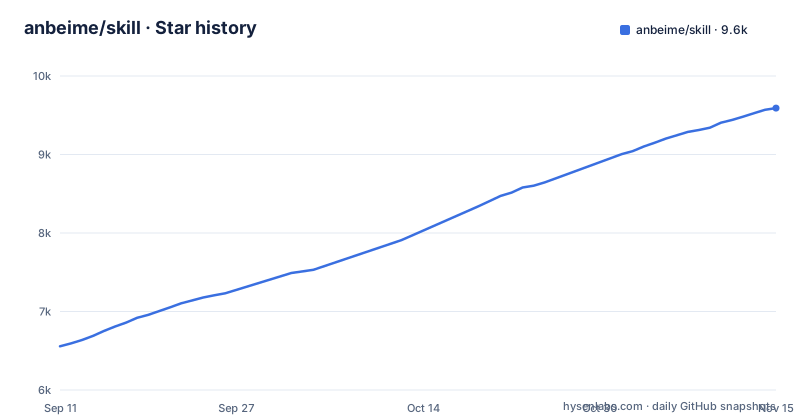
Star history
- anbeime/skill9,591 ★ · +3,034
| Repository | 2026-09-11 | 2026-11-15 |
|---|---|---|
| anbeime/skill | 6.6k | 9.6k |
3,034 Stars in the last 65 days, measured from the daily GitHub snapshot. Compare with other projects
Editorial analysis
The problem it solves: skill discovery across dozens of upstream teams
Agent skills are scattered. Anthropic publishes docx, pptx, xlsx, pdf and mcp-builder skills. Vercel publishes react-best-practices and composition-patterns. Cloudflare publishes agents-sdk and durable-objects. Trail of Bits publishes building-secure-contracts and static-analysis. The README lists 182 official skills pulled from six upstream repositories, plus 69 local skills, for a stated total of 251. The value here is not that the repository wrote those skills. It did not. The value is that one Python program walks the upstream list on a schedule and writes the result into data/skills.json, so you can grep one file instead of opening a dozen vendor repositories. The intended audience is a developer who already runs a skill-aware agent and wants a local catalogue with categories, source attribution and an update timestamp.
What the crawler actually does, and what it does not do
The mechanism described in the README is narrow: every day the project fetches six upstream repositories (OpenAI Skills, VoltAgent Awesome Agent Skills, Awesome DSH Plugin, Matt Pocock Skills, VoltAgent Awesome DESIGN.md and Narcooo/inkos) plus a trending-skills list and records what it finds. The command surface is main.py with a single flag per mode. The README claims a 100% backup coverage figure backed by 75 archives, but those archives live at D:\tool\skills\skill压缩文件\, a Windows path that will not exist on a Linux CI runner or a macOS laptop. That is the first real constraint: the backup story is a personal filesystem convention, not a portable feature. The second is that the local skill count is 69 across 16 categories, including 6 system built-ins, with 4 further open-source skills listed separately. That breakdown tells you the local library is a curated personal collection rather than a community-contributed one.
Getting it running: clone, install, run once or as a daemon
The README gives a four-step quick start. Clone with git clone https://github.com/anbeime/skill.git, then cd skill. Install with pip install -r requirements.txt. Then run one of five modes: python main.py --once performs a single update; python main.py --daemon starts the scheduled update process; python main.py --stats prints data statistics; python main.py --export skills.csv writes a CSV; python main.py --once -v turns on verbose logging. Browsing is file-based: cat data/skills.json for the crawled set, cat data/local_skills.json for the curated set, and ls docs/ for the documentation directory. Note the mismatch between the quick start and the repository metadata: the quick start links an online store at skill.vercel.app while the repository homepage field points at skill.miyucaicai.cn. Both are mentioned, neither is described further.
The licences of the 245 skills are the weakest part of the pitch
The repository itself shows a CC-BY-4.0 badge in the README, but the licence field for the repository is unknown. That matters more here than in a normal project, because this repository redistributes other people's skills. Anthropic, Vercel, Cloudflare, Stripe, Supabase, Expo, Sentry, Hugging Face and Trail of Bits each publish under their own terms, and a CC-BY-4.0 badge on the aggregator does not relicense the aggregated content. The README also carries a free-trial sign-up for a 知易多模型知识管家 product with a Feishu link, which suggests the repository doubles as a funnel for a commercial service. That is not disqualifying, but it means the repository is not a neutral index. If you plan to ship any of the local skills inside a product, note that the README marks a licence only on a few entries, such as the Apache-2.0 antinet skills. Treat the aggregated set as a discovery index you read, not a bundle you redistribute, until a LICENSE file and per-skill attribution appear.
Where the local skill packs sit, and why the star ratings are not evidence
The 69 local skills are grouped into 16 categories. Content creation has ten entries including content-creation-publisher and baoyu-post-to-wechat. Video creation has nine, including video-creation-suite and three-body-video-creator. E-commerce has seven, headlined by ecommerce-full-pipeline, which the README describes as covering 1688 collection, cleaning, listing, promotion, video, dropshipping and Xianyu product picking. Document and analysis has four, including paper-analysis-assistant for arXiv papers and contract-review. Among the four extra open-source skills listed separately is archify, which converts a codebase or system description into interactive architecture, workflow, sequence, data-flow and lifecycle diagrams exported as single-file HTML plus PNG, SVG and WebM. Every entry carries a star rating from two to five. Those ratings are the README author's own labels, not a measurement. Read them as a hint about which packs the maintainer uses most, nothing more.
The alternative is the upstream list, and the difference is aggregation versus curation
The obvious alternative is awesome-agent-skills itself, one of the six upstream repositories this project crawls daily. The difference in approach is straightforward. Upstream is a human-maintained list of links, and it is one of the six sources for the 182 official skills. anbeime/skill adds three things on top: a machine-readable export in JSON and CSV, a classification layer by function, source and star count, and a local set of 69 Chinese-language skill packs that upstream does not carry at all. If you only need the official Anthropic and Vercel skills, going upstream gets you there with fewer moving parts and no Python dependency. If you need the Chinese content, video and e-commerce packs, or you want to feed a CSV of skills into your own tooling, upstream will not help you. The trade is that you inherit this project's daily update lag and its parsing assumptions about upstream formats.
Maintenance cost is low, but the update path is a single maintainer's filesystem
Running this is cheap. One Python process, one scheduled flag, one JSON output. The costs that matter are elsewhere. First, the crawler depends on upstream formats, so it can break when an upstream repository restructures. Second, the backup feature assumes D:\tool\skills\ exists, so on any non-Windows host the 100% coverage claim is inapplicable. Third, the documentation set is written in Chinese (for example 技能管理数据库.md, 技能清理与迁移指南.md and 技能数量差异分析报告.md), which is fine for the target audience and a barrier for anyone else. Fourth, the repository has no published GitHub releases, so upgrades mean pulling main. There is no changelog in the repository. If you build on that file, snapshot it yourself.
Editorial conclusion
Adopt anbeime/skill if you want a single local index of agent skills that refreshes on a timer and can be exported to CSV for your own tooling. Do not adopt it if you need a per-skill licence you can audit before shipping, since the repository carries no LICENSE file and only a CC-BY-4.0 badge in the README. Before cloning, verify two things: whether a LICENSE file now exists at the repository root, and whether requirements.txt and main.py both exist on main.
Frequently asked questions
how to install skill from github to claude
Skill Store collects those skills for you. It crawls six upstream repositories, including VoltAgent's awesome-agent-skills, daily and lists the official skills in data/skills.json, and you install the crawler itself with `pip install -r requirements.txt` after cloning the repository.
what is skill.md
SKILL.md is the skill file format for agent skills; this repository has one at its root. The README points to docs/specification.md, its Agent Skills specification, for the file format.
Does Skill Store tag releases I can pin?
No. The repository has no GitHub releases, so there is no version to install or pin. The last push was on 2026-11-02, and any clone gives you the current tree.
Can I export the Skill Store catalog to analyze it?
Yes. `python main.py --export skills.csv` writes the inventory to a CSV file, and the README says JSON export is also supported, with the official skill list kept in data/skills.json.
Official sources
Add this badge to your README
If you maintain this project, the badge below links readers to this analysis and shows its maintenance status from the daily GitHub snapshot. Paste the markdown into your README; add ?metric=license or ?metric=stars to the image URL for a different field.

[](https://hysenlabs.com/projects/anbeime-skill)Star history chart for your README
[](https://hysenlabs.com/projects/anbeime-skill)Was this useful?