Apache Spark: The Unified Engine That Made Big Data Batch and Streaming Share One API
Apache Spark - A unified analytics engine for large-scale data processing.
At a glance
- What is it?
- Apache Spark is a Scala-based analytics engine that unifies batch, SQL, streaming, and machine learning under one execution model. This review looks at what the README actually promises, how the engine is structured, and where its complexity becomes a real cost.
- Who is it for?
- Adopt Apache Spark if your workloads span batch processing, SQL, streaming, and machine learning and you want one engine with a consistent API. Skip it if your data fits in memory on a single node or if you need sub-second latency on a simple pipeline, because the cluster setup and tuning overhead will outweigh the benefits.
- Can I use it commercially?
- Yes. Apache-2.0 is a permissive licence: you can use, modify and sell software built on it, as long as you keep its copyright and licence notices.
- Is it still maintained?
- Yes. The repository received new commits within the last day.
- What is it written in?
- Mainly Scala, according to GitHub's language statistics.
Answers come from the project's GitHub data, last synced on November 13, 2026, and from our analysis. They are not legal advice.
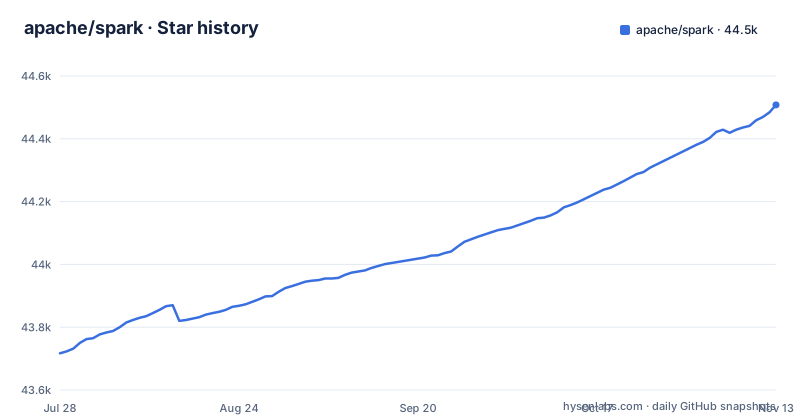
Star history
- apache/spark44,508 ★ · +791
| Repository | 2026-07-28 | 2026-11-13 |
|---|---|---|
| apache/spark | 43.7k | 44.5k |
791 Stars in the last 108 days, measured from the daily GitHub snapshot. Compare with other projects
Editorial analysis
What Spark Actually Solves
Apache Spark solves a coordination problem. Before it, teams often used one system for batch jobs, another for SQL queries, and a third for stream processing. Each system had its own API, its own cluster manager, and its own failure model. Spark's pitch is that a single engine can handle all of these with high-level APIs in Scala, Java, Python, and R. The README lists the higher-level tools explicitly: Spark SQL for SQL and DataFrames, pandas API on Spark for pandas workloads, MLlib for machine learning, GraphX for graph processing, and Structured Streaming for stream processing. That is a wide net. The target user is an engineering team that has a data pipeline touching multiple of these areas and wants to avoid maintaining separate clusters. If you only need one of those features, Spark may be overkill, but if you need two or three, the unification argument becomes real.
The Execution Model: Computation Graphs, Not Just MapReduce
The README says Spark provides an optimized engine that supports general computation graphs for data analysis. That phrase distinguishes Spark from the older MapReduce model, where each job is a rigid two-stage pipeline. A computation graph means the engine can represent dependencies between operations, reorder them, and fuse stages. In practice, this allows Spark to handle iterative algorithms, which are common in machine learning, without writing data to disk between every step. The graph is built lazily: you define transformations on DataFrames or RDDs, and the engine compiles them into a physical plan when an action triggers execution. This is a different approach from a tool like Flink, which processes events continuously and treats streaming as the primary case. Spark treats batch as the default and streaming as a special case of the same graph model.
Getting It Running: Build Requirements and Version Branches
The README says it contains only basic setup instructions, and the build pipeline table shows practical requirements. The CI matrix runs on Java 17, 21, and 25, and it tests Python versions from 3.11 to 3.15, including a no-GIL 3.14 variant. There are separate workflows for ARM builds and for macOS 26, which suggests the project expects cross-platform use. To build from source, you would clone the repository and use Maven, since the CI includes build_maven.yml workflows. The default branch is master, but the table tracks branch-4.x and branch-4.3 alongside master. If you are not a contributor, you probably want to download a pre-built release from the official website rather than building master, because master is the development version. The README points to the official version at spark.apache.org and the development version at apache.github.io/spark, so the distinction is explicit. The README includes a badge linking to Temurin 17.
The Streaming Story: Structured Streaming and Its Limits
Structured Streaming is one of Spark's most distinctive components. It treats streaming data as an unbounded table, which means you can run the same SQL or DataFrame operations on a stream that you run on a static batch. It is built on micro-batches: the engine collects events for a short interval and processes them as a batch. That gives you exactly-once semantics with the same fault tolerance as batch jobs, but it adds latency. If you need event-at-a-time processing with millisecond latency, Spark is the wrong tool. Flink, by contrast, processes each event as it arrives and offers lower latency. For streaming use cases where a few seconds of latency is acceptable, Spark's unified API is a strong reason to choose it.
A Real Alternative: Flink and the Streaming-First Approach
The most direct alternative to Spark is Apache Flink. Flink takes a streaming-first approach: every job is a continuous stream, and batch is a special case of streaming. That is the opposite of Spark's batch-first model. Flink offers true event-at-a-time processing and lower latency, but its API for batch analytics is less mature than Spark SQL. Flink also has a different programming model: you use DataStream API and Table API, not DataFrames. If your primary workload is streaming and you occasionally run batch jobs, Flink is likely a better fit. If your primary workload is batch and you occasionally need streaming, Spark is more natural. A third alternative is a single-node tool like DuckDB or Polars, but those do not scale out to a cluster, so they solve a different problem.
The Cost of Unification: Memory, Tuning, and Operational Complexity
Spark's power comes with a heavy operational footprint. The README shows a build pipeline with over 30 workflows. The engine is designed for cluster deployment, so you need a cluster manager, either standalone, YARN, or Kubernetes. Memory tuning is a constant concern: each executor has a fixed memory limit, and out-of-memory errors are common when the computation graph exceeds it. For a small team, this complexity can be a burden. You need to understand Spark's memory model, shuffle behavior, and partition sizing to get good performance. The documentation on the web page is extensive, but the learning curve is steep. If you cannot afford that investment, a simpler tool may serve you better.
Maintenance and License Implications
Spark is Apache-2.0 licensed, which is permissive. You can use it in commercial products, modify it, and redistribute it, as long as you preserve the license notice. The README includes a badge linking to the Apache-2.0 license. Maintenance is a different matter. The repository has multiple active branches, and the CI matrix includes Java 25, which is a recent LTS release. That suggests the project keeps up with new JDK versions, but it also means you need to track those updates. The build pipeline table tracks master, branch-4.x and branch-4.3. If you adopt Spark, you should plan to upgrade periodically to get security fixes and performance improvements. The pandas API on Spark is a notable feature: it lets you run pandas code on a cluster, but it is not a drop-in replacement for all pandas operations, so you need to test your code against it.
Editorial conclusion
Adopt Apache Spark if your workloads span batch processing, SQL, streaming, and machine learning and you want one engine with a consistent API. Skip it if your data fits in memory on a single node or if you need sub-second latency on a simple pipeline, because the cluster setup and tuning overhead will outweigh the benefits. Before committing, verify which branch you need: master targets the next release, while branch-4.x and branch-4.3 are the other branches in the build table. Check that your Java version (17, 21, or 25) matches the build matrix, and confirm your Python version is supported, since the CI matrix shows 3.11 through 3.15. Spark is Apache-2.0 licensed, so you can embed it in commercial products without paying a fee, but you must keep the license notice. The real decision point is whether you need Spark's unique combination of Structured Streaming and Spark SQL, or whether a simpler tool like Flink or a single-node dataframe library would serve you better.
Frequently asked questions
What exactly does Apache Spark do?
It is described as a unified analytics engine for large-scale data processing, providing high-level APIs in Scala, Java, Python, and R with R marked deprecated, along with an optimized engine supporting general computation graphs. Higher-level tools named are Spark SQL for SQL and DataFrames, pandas API on Spark, MLlib for machine learning, GraphX for graph processing, and Structured Streaming.
How do I install Apache Spark?
The README carries only basic setup instructions and sends you to the project web page for documentation. The artifacts are published outside the repository, through the Maven group org.apache.spark and the pyspark package on PyPI, and the file separates the official version at spark.apache.org from the development version at apache.github.io/spark.
How do I use Apache Spark?
The README says the latest documentation, including a programming guide, is on the project web page and that it contains only basic setup instructions. What it does record is what gets built: master alongside branch-4.x and branch-4.3, with Java 21 and Java 25 jobs on master and Python jobs for 3.11 through 3.15, plus separate Spark Connect, free-threaded, and pandas 3 jobs.
Why is the Spark app shutting down?
The repository is the Apache Spark data processing engine and does not discuss any application. The maintenance branches it builds are master, branch-4.x, and branch-4.3, and the repository itself publishes no GitHub releases, so a build's version is resolved from the project website, from Maven under org.apache.spark, or from PyPI as pyspark.
Can you make $1000 a week with Apache Spark?
The repository is unrelated to that question. It is Apache Spark, an Apache-2.0 licensed unified analytics engine for large-scale data processing written in Scala, with the default branch master last pushed on 2026-11-02 and no GitHub releases in the repository.
Official sources
Add this badge to your README
If you maintain this project, the badge below links readers to this analysis and shows its maintenance status from the daily GitHub snapshot. Paste the markdown into your README; add ?metric=license or ?metric=stars to the image URL for a different field.

[](https://hysenlabs.com/projects/apache-spark)Star history chart for your README
[](https://hysenlabs.com/projects/apache-spark)Was this useful?