Dexed: a DX7-modelled FM synth that installs as a VST3, AU, CLAP or standalone build
DX7 FM multi plaform/multi format plugin
At a glance
- What is it?
- Dexed wraps the msfa FM engine in JUCE and aims at DX7 patch compatibility rather than a modern synth feature set. Here is how it installs, what the engine actually does, and where it stops.
- Who is it for?
- Adopt Dexed if you already work with DX7 .syx cartridges or want a free FM voice in a DAW that loads VST3, AU or CLAP. Skip it if you need 4-operator Yamaha formats (the README lists DX21/DX27/DX100 sysex import as open TODO) or parameter resolution beyond the original machine.
- Can I use it commercially?
- Yes, with conditions. GPL-3.0 is a copyleft licence: if you distribute software that includes it, you must release that software's source code under the same licence. Running it internally without distributing it does not trigger that obligation.
- Is it still maintained?
- Yes. The repository last received commits 1 day ago.
- What is it written in?
- Mainly C++, according to GitHub's language statistics.
Answers come from the project's GitHub data, last synced on November 15, 2026, and from our analysis. They are not legal advice.
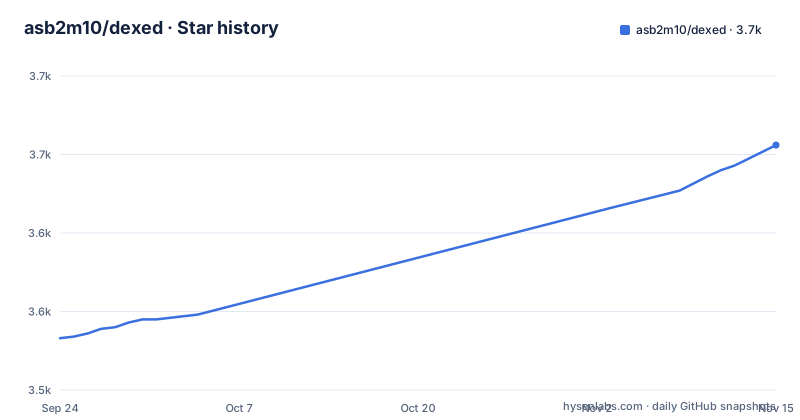
Star history
- asb2m10/dexed3,656 ★ · +123
| Repository | 2026-09-24 | 2026-11-15 |
|---|---|---|
| asb2m10/dexed | 3.5k | 3.7k |
123 Stars in the last 52 days, measured from the daily GitHub snapshot. Compare with other projects
Editorial analysis
What Dexed is for, and the compatibility line it refuses to cross
Dexed is a plugin synth modelled on the Yamaha DX7. The README describes it as "a tool/companion for the original DX7", and that framing decides most of its design choices. If you own a DX7 and want to move patches between hardware and a DAW, or you have a folder of .syx cartridges and no working FM synth, Dexed is aimed at you. It is not aimed at someone shopping for a modern FM instrument with wavetables, a modulation matrix or a built-in effects chain.
The maintainer makes the boundary explicit: float-valued parameters and TX81z-style waveforms would be welcome, but "anything that goes beyond the DX7 should and will be a fork of this project". That is a deliberate refusal to drift. A synth that keeps chasing new features stops being a faithful reproduction of a 1983 machine, and the project treats fidelity as the product. The practical consequence is that the parameter set you get is the DX7 parameter set, including its quirks and its resolution limits.
Inside the engine: msfa, JUCE, and two selectable FM implementations
The synth engine is not written by this project. Dexed uses music-synthesizer-for-android, referred to in the source tree as msfa, with JUCE acting as the application and plugin wrapper. That split matters for anyone reading the code: the DSP lives under libs/ and the msfa folder, while the plugin plumbing, UI and host integration live under Source/.
The changelog shows the engine itself has been the subject of sustained work. Version 0.9.2 made the Mark I engine the default. Version 0.9.1 notes that Mark I moved to 10-bit sine and exponential tables, described in the release notes as still a work in progress. Later entries mention corrected feedback for algorithms 4 and 6, and feedback calibrated for the Mark I engine. So there are at least two engine variants exposed to the user, and which one is active changes the sound of feedback and operator behaviour. The README does not document a comparison table between them, which is a real gap if you are trying to match hardware.
Licensing inside the engine is also split. Dexed as a whole is GPL v3, but the README states the msfa component stays under Apache 2.0 to allow collaboration between projects.
Installing Dexed and loading a cartridge for the first time
The README does not carry install instructions. It points readers to the Dexed User Website at asb2m10.github.io/dexed for "user and download information", and separately notes that pre-release builds are available on the Nightly release tag. For a stable build, the releases list includes v1.0.1. There is no package manager command documented in the README, so do not expect one.
If you build from source, the README begins with a clone and states that the project depends on several submodules. The build system is CMake; the changelog for 0.9.7 records that "cmake is now the built system" and that JUCE is acquired locally. The repository root contains CMakeLists.txt and a Dexed.jucer file, so both a CMake path and a JUCE project file exist in the tree.
git clone https://github.com/asb2m10/dexed.gitAfter cloning, the README says submodules are required. The .gitmodules file at the repository root lists them, so treat the submodule step as mandatory rather than optional.
Once the plugin is installed and scanned by your host, the workflow the changelog describes is cartridge-based. Version 0.9.1 added dropping .syx files into the cartridge manager, and support for sysex streams, meaning a single .syx file containing multiple sysex messages. Version 0.9.3 loosened cartridge validation to a size check of 4104 or 4096 bytes. If a cartridge is rejected, that size check is the first thing to inspect. The README does not document rollback or how to remove a cartridge once loaded.
Plugin formats, UI scaling and the CLAP caveat
Dexed ships in more formats than most free synths. The changelog records VST3 support in 0.9.5, CLAP support in 0.9.7, Apple AU support in 0.9.0, and a standalone application in 0.9.4. Apple Silicon M1 builds arrived in 0.9.6, and 0.9.7 notes that macOS releases are notarized.
Format support is not uniform in practice. The 0.9.7 entry says CLAP support landed but "sadly scaling is not available for now", and 1.0.1 lists a fix for a scaling issue with the CLAP format. The 1.0.1 notes also describe a change in how the UI is scaled: the DAW scales the interface first and the user can zoom further. If you run a high-DPI display, that is the version where the scaling behaviour settles.
1.0.1 also moved plugin parameter dialogs into the main plugin window, removing separate windows. That is a small change with a large effect on how the synth feels inside a host, because separate parameter windows are a common source of focus bugs in DAWs.
Where Dexed stops: formats it will not import and accuracy it does not claim
The TODO list is short and honest. Under "TODO - Dexed" the README lists code cleanup and "Yamaha 4 operators (DX21/DX27/DX100) sysex import". That means the four-operator Yamaha family is not supported for import. If your patch library is DX21, DX27 or DX100 material, Dexed is the wrong tool today, and the README says so rather than leaving you to discover it.
Under "TODO - msfa" the list includes better amplitude modulation and accurate live operator level envelope updates. Version 0.9.3 added what it calls "preliminary live operator level update". Preliminary is the operative word: if your patch programming depends on sweeping operator levels in real time and hearing exactly what hardware does, that behaviour is still on the open list.
There is also the compatibility ceiling itself. Because the project refuses to go beyond the DX7, you will not find modern conveniences in the parameter set. Microtuning is the exception rather than the rule: MTS-ESP support arrived in 0.9.7 and SCL/KBM support in 0.9.5, both credited to the Surge Synth Team. MPE support is described in 0.9.5 as "initial".
Alternatives and forks: when to leave the main repository
The README lists two forks, and both are genuine alternatives with different approaches rather than cosmetic copies. MiniDexed runs a DX7 on bare metal from a Raspberry Pi. That is a hardware approach: no DAW, no plugin host, a dedicated box. If your goal is a live rig or an embedded FM voice, MiniDexed is the branch to look at, and it is the reason the phrase "Dexed hardware" appears in search traffic.
The second fork is a SIMD-optimized version using Google's highway library, hosted under risicle/dexed on a branch named ris-highway. That is a CPU optimization of the same engine. If you are running many Dexed instances and the CPU cost is the constraint, that fork addresses the constraint directly, while the main repository keeps its portable implementation.
Neither fork is maintained by the same process as the main repository, and the README does not describe their release cadence. Treat them as separate projects that happen to share an engine lineage.
Maintenance, licence and what upgrading costs you
The last push to the default branch was on 2026-09-21, and the repository is not archived. The maintainer describes it in the README as "this 10-year-old project" and asks for donations, noting that Apple notarization costs are part of the reason. Nightly builds are published on a separate release tag, with a Nightly release dated 2026-07-21, and the last stable tag is v1.0.1 from 2025-11-29.
The upgrade path is not frictionless in one specific way: if you track Nightly, you are running builds the README labels pre-release, and the changelog shows engine-level changes landing between versions (table widths, feedback calibration, envelope accuracy). Those change how patches sound. Presets that depend on feedback or envelope timing may need re-checking after an engine change, and the README does not document a preset migration path.
On licensing: Dexed is GPL v3, and the README states the msfa component remains Apache 2.0. If you plan to redistribute Dexed inside another product, the GPL v3 terms govern the combined work, and the Apache 2.0 carve-out applies only to the msfa portion. That is a question for your own legal review, not something this article can settle.
Editorial conclusion
Adopt Dexed if you already work with DX7 .syx cartridges or want a free FM voice in a DAW that loads VST3, AU or CLAP. Skip it if you need 4-operator Yamaha formats (the README lists DX21/DX27/DX100 sysex import as open TODO) or parameter resolution beyond the original machine. Before relying on it, verify which engine is selected, since the changelog makes Mark I the default from 0.9.2, and confirm that your host scans the plugin format you actually installed.
Frequently asked questions
Is Dexed free?
Yes. Dexed is licensed under GPL v3, and the README points to the Dexed User Website for download information. Pre-release builds are published on the Nightly release tag.
How do I install Dexed?
The README does not give install steps; it directs readers to the Dexed User Website for user and download information, and notes that pre-release builds live on the Nightly release tag. Building from source starts with a git clone and requires the submodules listed in .gitmodules, with CMake as the build system.
What does Dexed mean?
The README does not define the name. It describes the project as a multi-platform, multi-format plugin synth closely modelled on the Yamaha DX7, built on the msfa engine with JUCE as the wrapper.
Is Dexed a good synth?
That depends on what you need. Dexed targets DX7 compatibility rather than modern features, and the README states that anything going beyond the DX7 should be a fork. The open TODO list still includes better amplitude modulation and accurate live operator level envelope updates in the msfa engine.
Is Dexed safe?
The README gives no security guidance. It points to the Dexed User Website for downloads and notes that macOS releases are notarized, which is the only distribution detail the changelog records.
How do I use Dexed in a DAW such as Ableton, FL Studio, Logic or Reaper?
The README does not document per-DAW setup. What it does describe is the cartridge workflow: drop .syx files into the cartridge manager, select a program with a single click, and use "Send current program to DX7" to push a patch to hardware.
Official sources
Where developers are discussing it
Posts on Hacker News, dev.to and Lobsters that link to this repository, found by our scan of those communities. 1 in the last 30 days; newest first.
- Dexed: DX7 FM multi plaform/multi format pluginHacker News · Oct 26, 2026 · 2 points · 0 comments
Add this badge to your README
If you maintain this project, the badge below links readers to this analysis and shows its maintenance status from the daily GitHub snapshot. Paste the markdown into your README; add ?metric=license or ?metric=stars to the image URL for a different field.

[](https://hysenlabs.com/projects/asb2m10-dexed)Star history chart for your README
[](https://hysenlabs.com/projects/asb2m10-dexed)Was this useful?