AVsitter: A Pose System for Second Life and OpenSim That Puts Furniture Scripts in Your Hands
AVsitter pose system for Second Life and OpenSim
At a glance
- What is it?
- AVsitter is an LSL-based furniture pose system for Second Life and OpenSim, distributed under MPL-2.0. This review covers its import process, licensing, and the trade-offs of using the open-source repository versus the paid Marketplace package.
- Who is it for?
- Adopt AVsitter if you build furniture for Second Life or OpenSim and need a flexible, open-source pose system that you can modify under MPL-2.0. Avoid it if you cannot comply with the license's source-sharing requirement for changes, or if you need a fully supported commercial product.
- Can I use it commercially?
- Yes, with conditions. MPL-2.0 is a weak copyleft licence: you can use it inside commercial and closed-source software, but if you distribute changes to its own files, you must publish those changes under the same licence.
- Is it still maintained?
- Yes. The repository last received commits 36 days ago.
- What is it written in?
- Mainly LSL, according to GitHub's language statistics.
Answers come from the project's GitHub data, last synced on October 22, 2026, and from our analysis. They are not legal advice.
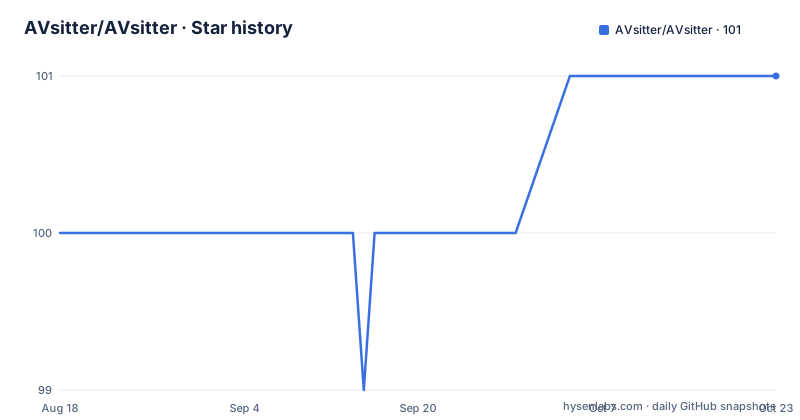
Star history
- AVsitter/AVsitter101 ★ · +1
| Repository | 2026-08-18 | 2026-10-22 |
|---|---|---|
| AVsitter/AVsitter | 100 | 101 |
1 Stars in the last 65 days, measured from the daily GitHub snapshot. Compare with other projects
Editorial analysis
What AVsitter Solves and Who It Is For
AVsitter addresses a specific pain point for content creators in virtual worlds: making furniture that avatars can sit on, pose in, and interact with. In Second Life and OpenSim, this normally requires writing LSL scripts from scratch, handling animation playback, menu systems, and avatar attachment. AVsitter packages these functions into a reusable system. It is for furniture builders, sim owners, and hobbyist scripters who want to add pose functionality without reinventing the wheel. The repository targets two platforms: Second Life and OpenSim, both of which use LSL but have subtle differences. The README explicitly mentions that one release, 2.2-02.02, is an 'OpenSim-only release', indicating that the maintainers track platform-specific quirks. This is not a general-purpose scripting library; it is a domain-specific tool for a niche but active community.
How the System Works: Scripts, Menus, and Animation Control
The repository layout shows a directory called AVsitter2, which contains the core scripts. The README refers to an 'AVsitter2 Import Guide' and a 'Release Building Guide', suggesting that the system is composed of multiple LSL scripts that work together. Typically, such a system uses one script for the furniture object and another for the avatar, communicating via link messages. The documentation likely covers how to configure pose positions and animation names, but the README itself does not detail the internal data flow. What is clear is that the system relies on LSL's standard mechanisms: state events, link messages, and menu dialogs. The user instructions are hosted on the official website, not in the README, which means the repository is primarily for developers, not end users. This separation is a practical choice: end users get a polished guide, while developers get the raw source. The mechanism is not documented in the supplied material beyond that, so I cannot confirm specific functions or event handling.
Getting It Running: Import Guide and Marketplace Options
The README gives two ways to get AVsitter into Second Life or OpenSim. The first is manual: follow the AVsitter2 Import Guide, which is a file in the repository. This likely involves creating an object, dropping in the scripts, and configuring them. The second is buying a pre-packaged version from the SL Marketplace. The Marketplace version has extra memory, according to the README: it says 'in order to benefit from the extra memory that the SL Marketplace version provides, you're advised to optimize the scripts following the same method used for packaging the releases.' This implies that the raw repository scripts are not memory-optimized, and you may need to run them through LSL-PyOptimizer, an online tool, to reduce their memory footprint. The README specifically links to LSL-PyOptimizer and notes that if you use it, you must keep the license notification in the script header. So the setup process is not trivial: you either use the paid package or spend time optimizing the scripts yourself. This is a real barrier for non-technical users.
The License: MPL-2.0 and What It Means for Your Work
AVsitter is licensed under the Mozilla Public License Version 2.0. The README summarizes it: you must make your changes to the AVsitter scripts available under MPL, but you can combine the MPL code with proprietary code as long as you keep the MPL code in separate files. This is a file-level copyleft, which is less restrictive than GPL. For a furniture builder, this means you can use AVsitter in a commercial product, but if you modify the scripts, you have to share those modifications. The README also mentions trademark guidelines: you cannot use the AVsitter brand without permission. This is a common dual-license approach, but it adds a compliance burden. You need to track which files are MPL and ensure your changes are shared. The license section is the most detailed part of the README, which suggests that the maintainers care about legal clarity. It is not legal advice, but the implications are clear: if you plan to keep your script changes private, this is the wrong tool.
A Real Limitation: Memory Optimization and Platform Divergence
The most obvious limitation is script memory. LSL scripts have a 64KB memory limit per script, and complex systems can hit that ceiling. The README implies that the repository scripts are not fully optimized, because it advises using LSL-PyOptimizer to gain 'extra memory' that the Marketplace version already has. This means that if you grab the free source, you may face performance issues or even compilation failures due to memory limits, especially in Second Life where the limit is strict. OpenSim may have different limits, but the README does not specify. Another limitation is platform divergence: the release notes mention a 'Minor OpenSim-only release', which suggests that some fixes or features are specific to OpenSim and may not apply to Second Life. This can cause confusion if you are building for both. The README does not provide a compatibility matrix, so you have to test each version on your target platform. This is a case where the free option is not necessarily the easiest option.
Alternative Approach: Writing Your Own LSL Scripts or Using Other Pose Systems
The obvious alternative is to write your own LSL scripts for furniture poses. That gives you full control over memory and features, but it requires deep LSL knowledge and time. The README does not mention any competing pose systems, so I cannot name a specific one from the material. However, the general difference in approach is that AVsitter is a pre-built framework, while custom scripts are a from-scratch effort. Another alternative is to use the SL Marketplace version of AVsitter, which is not a different product but a packaged version with memory optimizations and in-world updates. The README says that Marketplace sales support development and that buyers receive 'packaged in-world updates'. This is a practical alternative for users who want the same system without the manual optimization. The trade-off is cost versus convenience. If you are a developer, the repository gives you source access; if you are a builder, the Marketplace version saves time. The choice depends on your budget and technical comfort.
Maintenance and Upgrade Cost: What to Expect
The repository's last push was in 2018, and the latest release is 2.2-03.01 from March 2018. That is several years old at the time of writing. The README does not mention a maintenance schedule or a roadmap. The project is not archived, but the lack of recent activity suggests that development is slow or dormant. This matters for adopters: if you rely on AVsitter, you may not get fixes for new platform changes. Second Life and OpenSim evolve, and LSL features can change. The README does mention in-world updates for the Marketplace version, but that is a distribution mechanism, not a guarantee of new features. The upgrade cost is low in terms of effort: you can pull the latest release from the repository, but you need to re-apply any local modifications. The license requires you to share those modifications if you distribute them, but not if you keep them internal. For a long-term project, the lack of recent commits is a risk. You should check the repository's issue tracker or the official website for any known issues before adopting.
Editorial conclusion
Adopt AVsitter if you build furniture for Second Life or OpenSim and need a flexible, open-source pose system that you can modify under MPL-2.0. Avoid it if you cannot comply with the license's source-sharing requirement for changes, or if you need a fully supported commercial product. Before adopting, verify the exact script memory limits in your target environment, since the repository version may not have the same memory optimizations as the Marketplace package. Also check the import guide for your platform to ensure you can handle the manual setup.
Frequently asked questions
How do I get AVsitter into Second Life or OpenSim?
Two ways. You can manually import the AVsitter2 scripts following the AVsitter2 Import Guide in the repository, or you can visit the SL Marketplace for a pre-packaged version of the latest release, which also delivers packaged in-world updates of future releases.
What licence is AVsitter under, and can I combine it with proprietary code?
The scripts are under the Mozilla Public License Version 2.0. The README states you must make the source code for any of your changes available under MPL, but you can combine the MPL code with proprietary code as long as you keep the MPL code in separate files.
Why should I optimize AVsitter scripts before distributing them?
Because the SL Marketplace version provides extra script memory, and the README advises optimizing the scripts using the same method used for packaging the releases. The method is described in the Release Building Guide in the AVsitter2 directory, and scripts can be run through LSL-PyOptimizer online.
May I use the AVsitter brand in a derivative?
Only as permitted. The permitted use of the brand is set out in TRADEMARK.mediawiki at the repository root. The README also notes that Second Life is a trademark of Linden Research, Inc., and that AVsitter is not affiliated with or sponsored by Linden Research.
Official sources
Add this badge to your README
If you maintain this project, the badge below links readers to this analysis and shows its maintenance status from the daily GitHub snapshot. Paste the markdown into your README; add ?metric=license or ?metric=stars to the image URL for a different field.

[](https://hysenlabs.com/projects/avsitter-avsitter)Star history chart for your README
[](https://hysenlabs.com/projects/avsitter-avsitter)