GoldenMatch: Entity Resolution That Keeps a Stable Identity and an Audit Trail
Zero-config entity resolution feeding a durable identity layer: messy records from any source become stable golden entities, a Customer 360 with provenance, merge/split and audit. Fellegi-Sunter beats hand-tuned Splink. Arrow-native/Rust, 250M rows in 11.2 min. Python + edge TypeScript (WASM), SQL-native in Postgres & DuckDB, 97 MCP tools + REST.
At a glance
- What is it?
- GoldenMatch is a Rust-based, Arrow-native entity resolution library that turns messy records into stable golden entities with provenance and merge/split, and claims to beat hand-tuned Splink. This review covers its mechanism, setup, limitations, and alternatives.
- Who is it for?
- Adopt GoldenMatch if you need stable entity IDs that survive re-runs, per-field provenance, and a tamper-evident audit log, and if your data fits its Arrow-native, Rust-based engine. Do not adopt it if you require a mature ecosystem with extensive community support, or if your matching logic depends on custom rules that Fellegi-Sunter cannot express.
- Can I use it commercially?
- Yes. MIT is a permissive licence: you can use, modify and sell software built on it, as long as you keep its copyright and licence notices.
- Is it still maintained?
- Yes. The repository last received commits 1 day ago.
- What is it written in?
- Mainly Python, according to GitHub's language statistics.
Answers come from the project's GitHub data, last synced on October 21, 2026, and from our analysis. They are not legal advice.
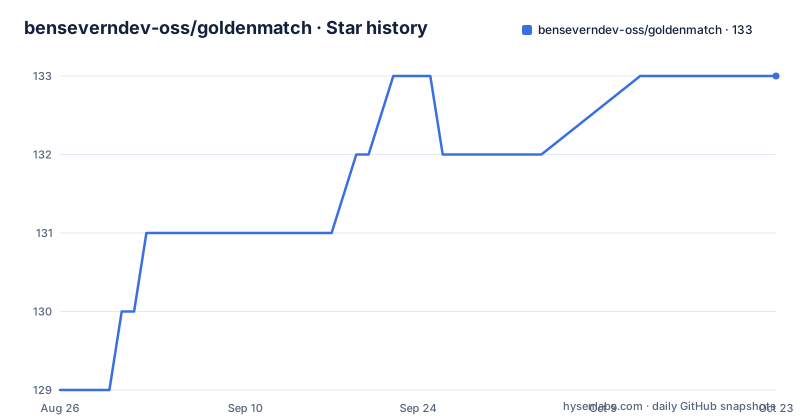
Star history
- benseverndev-oss/goldenmatch133 ★ · +4
| Repository | 2026-08-26 | 2026-10-21 |
|---|---|---|
| benseverndev-oss/goldenmatch | 129 | 133 |
4 Stars in the last 56 days, measured from the daily GitHub snapshot. Compare with other projects
Editorial analysis
The Problem: Messy Records and Unstable Cluster IDs
Entity resolution tools typically output cluster numbers that change on every run. That makes downstream systems unreliable: a customer ID from last week no longer matches today's cluster. GoldenMatch addresses this by producing a durable `entity_id` (UUIDv7) that persists across runs. The README states that "run-local cluster numbers reshuffle on every run; these don't." This is the core value proposition: a stable identity for each real-world customer, even as new records arrive and entities merge or split. The target user is a data engineer or platform team that needs a Customer 360 view across CRM, billing, and spreadsheets, and wants to answer "how many customers do we actually have" with confidence. The tool is not just a matcher; it is an identity layer with provenance and audit.
How the Matching Engine Works: Fellegi-Sunter, Not Black-Box ML
GoldenMatch uses the Fellegi-Sunter model, a classic statistical approach to record linkage. The README claims it "beats expert-tuned Splink head-to-head on messy customer records." The mechanism is visible in the v3.13.0 changelog: training runs distributed on Spark, where the E-step reads only the comparison vector. Identical vectors collapse to one counted row, making the training cost track distinct patterns, not pairs. The README gives an example: 1M to 5M rows grew candidate pairs 5.00x, but distinct patterns grew only 3.0% (from 433 to 446), and driver-side EM stayed at 0.01s. This is a concrete design choice: the heavy lifting is a Spark `GROUP BY` over agreement patterns, not a pair-wise loop. The engine is Rust-authoritative and Arrow-native, meaning it uses Apache Arrow for memory layout and Rust for computation. This is a real technical foundation, not a wrapper. The README also mentions owning its primitives: byte-identical, faster-than-`rapidfuzz` / `jellyfish` / FAISS kernels. That is a claim you should verify, but the architecture is clear.
The Durable Identity Layer: Provenance, Merge/Split, and Audit
Beyond matching, GoldenMatch provides a "transaction-native control plane" that manages entities. Each entity has a stable `entity_id`, and every field in the golden record has provenance: which source record won, when it was last seen, and which survivorship strategy picked it. The README shows a `customer_360(entity_id)` call that returns the golden record, per-field provenance, linked source records, event timeline, and relationship neighborhood. Conflicting values are resolved by an explicit policy: most-complete, source-priority, most-recent, or majority-vote. The identity changes are recorded in an append-only event timeline, and the log is sealed with a hash-chained, tamper-evident audit. This is a significant feature: you can see why a value was chosen and who the source was. For compliance or data governance, this is a differentiator. The README states that the audit log can be independently verified by a reviewer or another language port, which suggests cross-language consistency.
Getting Started: Installation and Basic Usage
The README provides a direct install command: `pip install goldenmatch[web]` for the web UI, then `goldenmatch serve-ui <project>`. For the core library, you would install `goldenmatch` from PyPI, and there is an npm package with the same name for TypeScript. The README mentions Python, TypeScript, and SQL, with "4-decimal parity" across them. Native integrations exist for Postgres and DuckDB, and there is edge WASM support for TypeScript. The repository layout includes packages for Python, Rust (crates), and a Spark integration via `goldenmatch-spark`. The README also lists MCP tools (70+ or 97 in the description, the README says 70+). To run a basic dedupe, you would likely use a CLI or Python API, but the README does not show a minimal code example beyond the `customer_360` call. The web UI command is the most concrete starting point. You should check the docs at docs.bensevern.dev for the full API.
Limitations and Failure Modes: When It Is the Wrong Tool
The README is heavy on claims and light on caveats. One limitation is the reliance on the Fellegi-Sunter model. If your matching logic requires complex business rules, such as "only merge if the domain is the same and the phone number matches exactly," Fellegi-Sunter may not capture that without significant feature engineering. The README mentions reference-data name scorers, but the model is still statistical. Another limitation is the Spark training path: it requires a Spark cluster for large-scale training, which adds operational overhead. The README notes that training cost tracks distinct comparison vectors, bounded by `prod(levels + 1)`, so if your data has many distinct patterns, training could blow up. Also, the README claims 250M rows in 11.2 minutes, but that is a benchmark, not a guarantee. The project is young (last push 2026-08-23, recent releases), so the ecosystem is thin. The 70+ MCP tools might be overkill or underdocumented; the README does not list them. If you need a simple one-off dedupe, GoldenMatch is overkill; a tool like `dedupe` or even `pandas` with fuzzy matching might suffice.
The Alternative: Splink and the Difference in Approach
The README explicitly positions GoldenMatch against Splink, a popular open-source entity resolution library. Splink also uses Fellegi-Sunter, but it requires manual tuning of match weights, thresholds, and sometimes blocking rules. GoldenMatch claims to be "zero-config," meaning it auto-trains the model. The difference is in the training and the output. Splink outputs cluster IDs that are run-local, while GoldenMatch provides stable `entity_id`s and a full identity layer. Splink is Python-only and uses a Pandas or Spark backend, while GoldenMatch is Arrow-native and Rust, with SQL and WASM support. If you already have a Splink pipeline and are happy with it, switching to GoldenMatch would require migrating your matching logic. The README claims GoldenMatch beats "expert-tuned Splink head-to-head," but that is a benchmark claim you should test. The real difference is the durable identity and provenance, which Splink does not offer out of the box. If you only need clusters, Splink is a mature, well-documented choice. If you need a Customer 360 with audit, GoldenMatch is a different proposition.
Maintenance, Licensing, and Upgrade Cost
GoldenMatch is licensed under MIT, which is permissive and allows commercial use without copyleft obligations. The project is under active development: the last push was August 2026, and there are frequent releases (v3.16.0, v3.15.0, and golden-suite v0.5.2 within a few days). The README has a CHANGELOG that is auto-synced into the README, so you can track changes. The v3.13.0 change introduced distributed training on Spark, which is a significant feature. The upgrade cost is not documented, but given the rapid release cadence, you should pin versions and review the CHANGELOG before upgrading. The project has multiple packages (goldenmatch, golden-suite, goldenmatch-duckdb, etc.), which can be confusing. The maintenance burden is on the user to keep track of these packages. The web UI is an extra install, and the MCP tools are another surface. There is no mention of a migration guide or deprecation policy, so you should test upgrades on a staging environment. The audit log is hash-chained, but if you need to change the survivorship policy, you would need to re-run the resolution, which could change entity IDs.
Editorial conclusion
Adopt GoldenMatch if you need stable entity IDs that survive re-runs, per-field provenance, and a tamper-evident audit log, and if your data fits its Arrow-native, Rust-based engine. Do not adopt it if you require a mature ecosystem with extensive community support, or if your matching logic depends on custom rules that Fellegi-Sunter cannot express. Before adopting, verify the benchmark claims on your own data, check the Spark integration for distributed training limits, and confirm the 70+ MCP tools are actually useful for your workflow. The project is under active development, so review the CHANGELOG for breaking changes.
Frequently asked questions
What does goldenmatch do?
It is zero-config entity resolution for Python. You point it at a CSV or a table and it chooses which columns to match exactly, which fuzzily and which to block on, reports that decision as a config object, and merges each group of duplicates into one golden record.
How do I control which columns goldenmatch matches on?
Three ways. Reuse the config it chose by passing it to the next run, pass your own exact and fuzzy column lists directly, or supply a YAML config. The chosen config is available as result.config after a run.
Did goldenmatch change the values in its output?
Yes, in the v3.22.0 release. The unique, duplicate and deduplicated tables now carry your original values rather than standardized ones. Setting keep_original_values to false, or passing the command line flag for standardized values, restores the previous output.
Does goldenmatch call a paid LLM API by default?
Not since the v3.21.0 release. Auto-config used to enable the paid LLM scorer whenever an OpenAI or Anthropic key happened to be set in the environment. It now requires passing the explicit auto flag, or setting the scorer in your config.
What languages and databases does goldenmatch support?
The engine is described as Arrow-native and Rust-based, with Python as the primary package, an edge TypeScript build through WebAssembly, and SQL-native operation in Postgres and DuckDB. The claim is parity between those surfaces to four decimal places.
How do I see what goldenmatch decided?
The chosen matching config is returned on the result object, and the output includes the deduplicated rows, the merged golden records, the records that had no duplicate, and the cluster membership showing which input rows were grouped together.
Official sources
Add this badge to your README
If you maintain this project, the badge below links readers to this analysis and shows its maintenance status from the daily GitHub snapshot. Paste the markdown into your README; add ?metric=license or ?metric=stars to the image URL for a different field.

[](https://hysenlabs.com/projects/benseverndev-oss-goldenmatch)Star history chart for your README
[](https://hysenlabs.com/projects/benseverndev-oss-goldenmatch)