engineering-management: the reading list a new manager actually opens
A collection of inspiring resources related to engineering management and tech leadership
At a glance
- What is it?
- A curated, opinionated index of articles, books, talks and podcasts on running engineering teams, organised by the sixty situations a manager actually hits rather than by management theory.
- Who is it for?
- The strongest thing in this repository is the table of contents. Sixty-odd headings, from one-on-ones to on-call to second-level management, is the actual job description of an engineering manager written out as a table of contents, and it is a far better way to find what you need this afternoon than any management taxonomy.
- Can I use it commercially?
- Yes. MIT is a permissive licence: you can use, modify and sell software built on it, as long as you keep its copyright and licence notices.
- Is it still maintained?
- Yes. The repository last received commits 96 days ago.
- What is it written in?
- Mainly Shell, according to GitHub's language statistics.
Answers come from the project's GitHub data, last synced on October 23, 2026, and from our analysis. They are not legal advice.
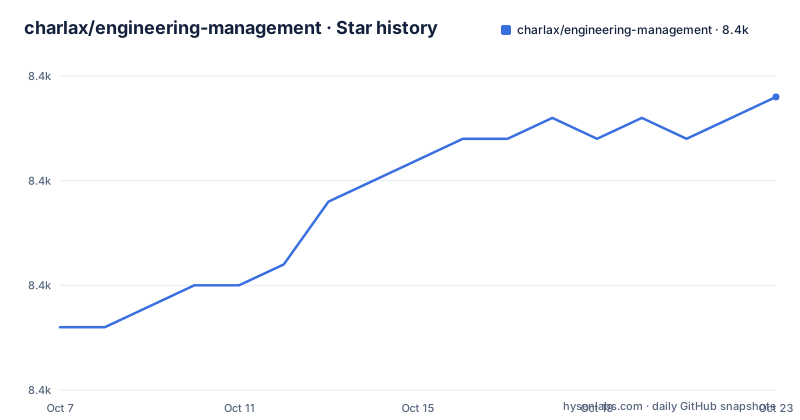
Star history
- charlax/engineering-management8,389 ★ · +11
| Repository | 2026-10-07 | 2026-10-23 |
|---|---|---|
| charlax/engineering-management | 8.4k | 8.4k |
11 Stars in the last 16 days, measured from the daily GitHub snapshot. Compare with other projects
Editorial analysis
The table of contents is the argument
Most curated lists fail at the same point: they mix a person's taste with a person's taxonomy, and you end up scrolling. This one front-loads its organisation, with a generated table of contents that runs for eighty lines before the content starts, and that table is more useful than most management books.
The headings are arranged as situations rather than disciplines. There is 1-1, antipatterns, biases, brainstorming, career growth and job ladder, change management, code reviews, communication, conflict resolution, delegation, delivery, escalation, execs, FinOps, feedback, hiring, mentoring, motivation, meetings, onboarding, prioritisation, quality, release management, remote teams, RFCs, retros, second level manager, trust, work ethics and work-life balance, and writing.
A few are more specific than that and carry subheadings. Hiring breaks into general, interviews, interview questions, job postings, process, résumé review, sourcing, take home exercises, and quotes, which is eight separate searches instead of one. Planning splits into goals and OKRs. Incident prevention and response carries the on-call and outages phrasing in the same heading.
That structure has a practical consequence. When someone asks you for a reading recommendation on code review or on a difficult one-on-one, you can answer in about five seconds. The cost is that it does not offer a theory of management to believe in, and for some readers that is a feature rather than a bug.
The topics attached to the repository back the same reading: article, bias, culture, decisions, employee-handbook, engineering-management, leader and management.
An opinionated list, and the author says so first
The section called About this list is short and worth reading, because it explains the two things that make a list either useful or noise: what the author endorses, and what the annotation markers mean. Resources, books, video or movie extracts, slides or presentations, podcasts, and a separate marker for must-read material.
Then the first substantive section opens with a piece of editorial honesty that sets the tone for everything after it: management is full of fluffy books that could be summarized in one hundred-word article. The author says there are a number of excellent ones anyway, and puts them on the list.
That framing matters because it sets the bar the rest of the list is measured against. The first entry is Turn the Ship Around! by L. David Marquet, described as hands down the preferred management book, with the reason given rather than the praise: it is what made the author understand what empowering local decision means. The specific argument quoted is that the usual chain of command requires information to travel up the chain and decisions to travel down it, which the author calls insanely inefficient. The concept it contributes to the practice of delegation is deliberate action, and the annotation notes that the explanations are short and to the point, with the narration holding up too.
There is a linked slideshare deck on the same concepts and a video summary, which tells you how seriously the entry is meant.
The one line quoted from the book, Control without competence is chaos, is the kind of sentence that makes it into a slide deck within a year of publication. Whether it survives contact with a specific organisation is a different question, and one this list is implicitly inviting you to argue about.
Where the generalist books stop and the situational links begin
After the featured book there is a section called Other generalist books, and the way the annotations are written is what separates this from a bare bibliography. Each book gets a few sentences pulling out a specific idea rather than summarising the plot.
The entry for The Advantage by Patrick Lencioni is a good example. It is credited with the argument that the only way for people to embrace a message is to hear it repeatedly, in a variety of situations, and preferably from different people, which is why the annotation says great leaders see themselves as Chief Reminding Officers as much as anything else. It then takes the cascading communication point further: the best kind is face-to-face and live, because seeing a leader and hearing their tone is critical, and so is being able to ask a question. Then it turns and notes that most organisations are unhealthy precisely because they are not doing the basic things.
That last move is characteristic of the list. An annotation will make a claim, then immediately undercut it with the harder observation, which stops the entry from being usable as management-speak you can repeat in a standup.
This section also contains book reading lists, which is the repository handing you onward rather than pretending to be complete. Given the size of the topics list that follows, that is the honest move: no single person has read everything on delegating to second-level managers, and a list of lists is how a curator admits it.
What is engineering management, and where the answers point
A short section asks the definitional question and answers it by pointing rather than by asserting. It has three subsections: general management resources, articles, and tools. Articles and tools are the two that most lists conflate. An article is something to read once. A tool is something you adopt, and adopting it changes how your week works, so it deserves a different place on the page.
The topics list then does the real work, and it is worth noting what is not in it. There is no section on interviewing tricks, no section on stack-specific technology, and no section on how to get promoted. What is there is a heavy concentration on the parts of the job that are difficult and unglamorous: conflict resolution, escalations, employee retention, performance management, delegation, mentoring, feedback, and work-life balance.
Those are the headings that get read by people who already have the job and are finding it difficult. That is a different audience from someone deciding whether to study engineering management, and it is the audience this list is built for.
A couple of the phrasings reveal a point of view worth noticing before you read anything. First-time manager has its own section, separate from general management, which suggests the author treats the transition as its own problem rather than a variation on managing. Hands-on has its own section too, which is the question every engineer asks when they become a manager and which most resources dodge. And under Hiring there is a résumé review heading with the accent preserved in the anchor, which tells you the author cared enough about getting that link right to keep the diacritic.
Other sources: lists, films and television
The Other sources section has three subsections, and each one is a deliberate widening of scope. Other lists points at collections by other people. Movies points at film extracts. TV Shows points at series.
Including film and television in an engineering management reading list is a choice, and an interesting one. Management books tend to describe the abstract shape of a hard conversation. Drama shows dramatise one, usually badly, usually with better stakes than you have. A list that includes both is making the argument that what you need to recognise on Monday is not a framework but a scene, and that some of those scenes are in other media.
It also tells you what kind of resource list this is. A repository of one-line links to PDF documents would not have a film section. This one has a video and movie extract marker in its legend, which means the author has been collecting audiovisual material for years and has the annotation habit to go with it.
The cost of the choice is uneven quality, which is unavoidable in a list of that size and is exactly why the must-read marker exists. A list this long cannot tell you what to read first, so the marker is the only curation signal that survives the volume, and you should treat anything unmarked as a maybe.
The repository also holds a glossary, which is a small sign of care. Maintaining vocabulary as well as links means the author is thinking about what people search for, not only what they should read.
Keeping a link list alive is the actual maintenance work
This repository has no releases. There is nothing to install, no package to depend on, and nothing to upgrade. The language GitHub reports is Shell, which comes from the tooling rather than the content: the tree contains `.git_hooks/` and `.pre-commit-config.yaml`.
That combination is the entire maintenance story of the project. A curated list of external links rots in two ways. Links die, which is mechanical. And the list drifts out of date without dying, keeping working URLs to advice that no longer reflects current practice. Pre-commit hooks are how you catch the first problem, and running them on every commit is a reasonable place to notice the second.
The rest of the tree is small: LICENSE, README.md, an `articles/` directory, `glossary.md` and `pictures/`. So the content lives partly in the README and partly in a directory of files, which is what lets the topics list stay a single readable page while the articles themselves sit elsewhere.
The numbers say this is a curated project rather than a neglected one. 8,365 stars and 684 forks, with two open issues, MIT licensed, no archive flag, and a last push on 2026-07-19. Two open issues on a repository of that size is unusual and worth interpreting correctly: it is what a project looks like when the maintainer closes things quickly, not when nobody cares. A high fork count relative to issues also suggests people are taking their own copies and adapting them, which is the highest compliment a list of this kind can receive.
Editorial conclusion
The strongest thing in this repository is the table of contents. Sixty-odd headings, from one-on-ones to on-call to second-level management, is the actual job description of an engineering manager written out as a table of contents, and it is a far better way to find what you need this afternoon than any management taxonomy. Two honest limits. There are no releases and the repository is a README with an articles directory, so the value is entirely in the curation and not in anything you can install or depend on. And the linked articles will rot, which is why the pre-commit configuration and git hooks are in the tree: keeping a link list alive is real work. The last push was 2026-07-19, the repository is MIT licensed with 8,365 stars and 684 forks, and two open issues is a sign of curation rather than neglect.
Frequently asked questions
What is the engineering-management repository for?
It is a collection of inspiring resources on engineering management and tech leadership. The README organises roughly sixty topics, from one-on-ones and code reviews to on-call, hiring sub-sections, second-level management and work-life balance, with each item annotated rather than merely listed.
What kind of books does this list recommend?
Mostly management books, and the author is opinionated about which. The README opens by noting that management is full of fluffy books that could be summarized in one hundred-word articles, then places Turn the Ship Around! first as hands down the preferred one, because it explains what empowering local decision means. There is also a section of other generalist books and a set of book reading lists.
Does the list include anything other than written articles?
Yes. The legend at the top marks resources, books, video or movie extracts, slides or presentations, and podcasts, plus a must-read marker. There is an Other sources section with subsections for other lists, movies and TV shows, and a final section collecting blogs, newsletters and podcasts.
How is the list maintained and is it still active?
There are no releases and nothing to install; the value is the curation. The repository tree contains `.git_hooks/` and `.pre-commit-config.yaml`, so link checking runs as part of the workflow. The last push was 2026-07-19, the repository is MIT licensed, and it has two open issues against 8,365 stars.
Official sources
Add this badge to your README
If you maintain this project, the badge below links readers to this analysis and shows its maintenance status from the daily GitHub snapshot. Paste the markdown into your README; add ?metric=license or ?metric=stars to the image URL for a different field.

[](https://hysenlabs.com/projects/charlax-engineering-management)Star history chart for your README
[](https://hysenlabs.com/projects/charlax-engineering-management)Was this useful?